McArdle Franco Earns Chambers USA 2025 Ranking in Miami Business Litigation
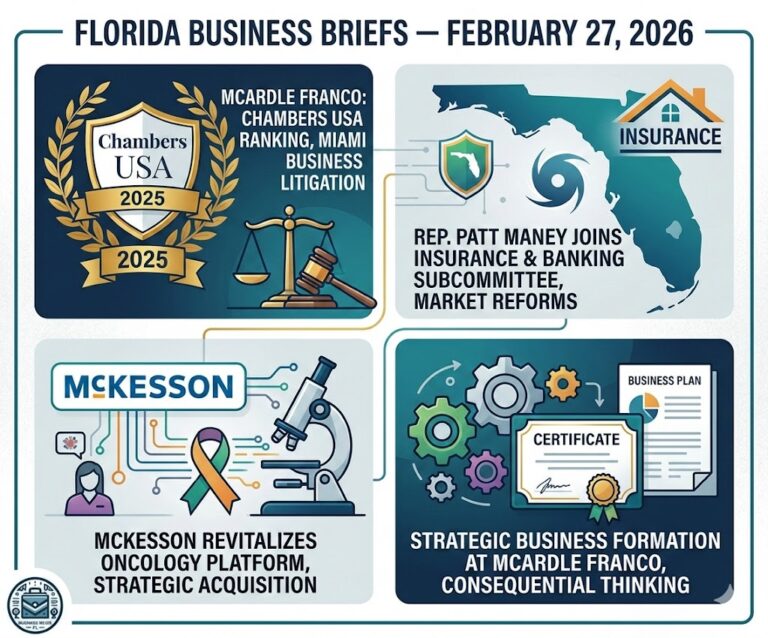
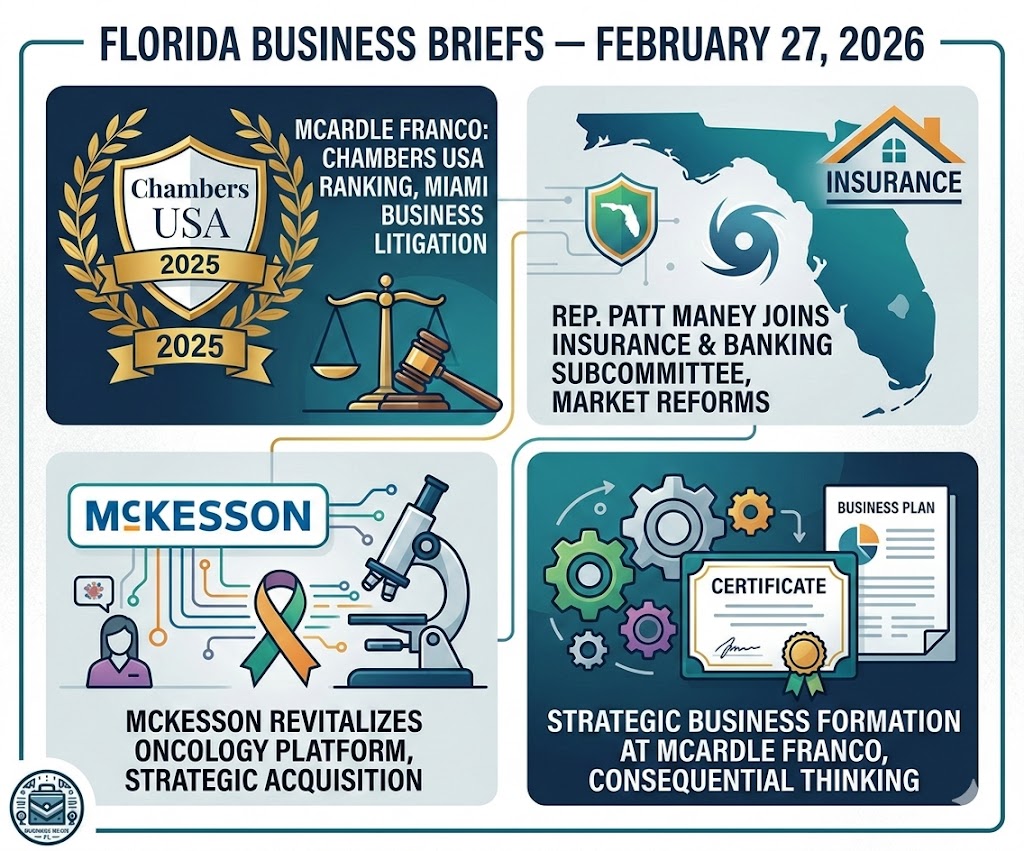
A Chambers USA ranking is not something a law firm can buy or campaign for. It is earned through years of consistent performance, client outcomes that speak for themselves, and peer recognition from attorneys who compete against the firm — making it one of the most credible benchmarks in the legal industry. The announcement that McArdle Franco PLLC has been ranked in the Chambers USA 2025 guide for Litigation: General Commercial — Highly Regarded in Florida is recognition built on exactly that foundation. The firm, headquartered at 255 Alhambra Circle in Coral Gables, has represented business clients in complex transactions, litigation, and workouts since 2002, with founding partners who bring decades of combined experience alongside genuine business backgrounds in real estate development, private equity, and construction.
Chambers praised the firm’s team as “knowledgeable, professional, and personable,” with a creative and efficient approach to complex commercial matters. For a firm of McArdle Franco’s size operating in the highly competitive South Florida legal market, the ranking places it in distinguished company. The firm handles an unusually wide range of work: business structuring and formation, mergers and acquisitions, real estate development, commercial lending, joint ventures, government procurement, construction contracting, and commercial litigation from pre-dispute through trial and appeal. As a Miami business litigation law firm with over six decades of combined partner experience, McArdle Franco represents domestic and foreign companies in matters across Florida, the United States, and internationally.
What sets the firm apart from larger competitors is its collaborative operating model. Rather than siloing partners by practice area, McArdle Franco’s attorneys meet regularly to discuss client matters collectively, bringing cross-disciplinary perspectives to every engagement. That approach is particularly valuable in construction and real estate disputes, where litigation risk, business strategy, and contractual structuring are inseparable. The firm’s senior partners, having built real businesses themselves, understand that legal outcomes must serve long-term business objectives — not just win in court. That philosophy is evident in the firm’s track record of high-value settlements and favorable rulings that preserve client relationships and avoid unnecessary disruption.
For Florida businesses and developers facing complex commercial or construction disputes, the Chambers ranking provides meaningful independent validation of the firm’s capabilities. McArdle Franco PLLC is located at 255 Alhambra Circle, Suite 925, Coral Gables, FL 33134 and can be reached at (305) 442-2214 or through mcardlefranco.com.
Coral Gables Business Formation Law Firm McArdle Franco
Starting a business in Florida requires more than filing paperwork with the state. The entity structure chosen at formation — whether LLC, corporation, partnership, or a multi-tiered combination — will shape the company’s tax exposure, liability protection, financing options, governance flexibility, and ultimate exit value for years to come. For entrepreneurs, investors, and established companies expanding into new ventures in South Florida, McArdle Franco PLLC has positioned itself as a trusted counselor at precisely this foundational moment. The Coral Gables firm’s business formation and structuring practice draws on the same business-owner experience that makes its litigation work distinctive — the firm’s senior partners have built and operated their own enterprises, so they understand what is actually at stake when structuring decisions are made.
Business formation at McArdle Franco is not a transactional exercise. The firm’s attorneys bring what they describe as consequential thinking to every engagement — working through the downstream implications of entity choices before committing a client to a structure. That includes analyzing litigation risk exposure, asset segregation strategies, tax implications of single versus multi-entity arrangements, governance documentation, and long-term financing and exit planning. For clients with multiple business lines or real estate holdings, the firm designs multi-level structures that isolate profit centers and quarantine liabilities — protecting successful operations from risks taken elsewhere in the enterprise.
The firm’s transactional team extends these capabilities into ongoing corporate life: handling mergers and acquisitions, joint ventures, commercial contracts, cross-border business transactions, government procurement agreements, private placement memorandums, and commercial leases. Senior Partner George E. McArdle’s background as a former banker who specialized in real estate workouts and later built residential and commercial real estate developments from the ground up gives the firm a perspective on business structuring that is genuinely rare in legal practice. That background means clients receive advice informed by how business decisions actually play out over time — not just whether documents are technically correct at signing.
For entrepreneurs launching new ventures, established businesses restructuring for growth, or foreign companies establishing a Florida presence, McArdle Franco offers the kind of strategic business counsel that extends well beyond the formation documents. The firm is located at 255 Alhambra Circle, Suite 925, Coral Gables, FL 33134 and reachable at (305) 442-2214. More information about the firm’s business structuring and transactional services is available at mcardlefranco.com.
Patt Maney Appointed to Florida House Insurance and Banking Subcommittee
In the architecture of Florida’s legislative process, committee assignments determine whose voice shapes policy. The appointment of Representative Patt Maney to the Florida House Insurance and Banking Subcommittee placed him at the center of one of the most consequential policy debates in the state: how to restructure Florida’s deeply troubled property insurance market. Florida had spent years as a cautionary tale in insurance circles — a state where a runaway litigation environment and reinsurance costs driven by hurricane exposure had pushed multiple carriers into insolvency and forced others to exit entirely, leaving hundreds of thousands of homeowners dependent on Citizens Property Insurance, the state’s insurer of last resort.
Maney brought to the subcommittee a practical perspective grounded in a career that combined legal training with military service. His background gave him credibility in discussions about regulatory reform that blended technical insurance policy with on-the-ground understanding of how Florida families and businesses actually experience coverage gaps and claim disputes. The subcommittee’s work during this period was directly tied to the legislative reforms that Florida has since credited with beginning to stabilize the property insurance market — including measures that curtailed one-way attorney fees, tightened assignment of benefits rules, and restructured the conditions under which insurers could be sued for bad faith.
The significance of those reforms has become increasingly clear in retrospect. Since their passage, more than 17 new property insurers have entered the Florida market. Citizens’ policy count, which peaked near 1.4 million, has dropped toward 550,000. Florida recorded the lowest average homeowner premium increase in the nation in 2024 at just 1%, while other states saw double-digit increases. Personal insurance litigation dropped nearly 25% in the first half of 2025. For the lawmakers who worked on insurance and banking policy during the period when these reforms were enacted, the data now shows the long-term impact of that work.
The appointment was consistent with the Florida Business News focus on tracking business-relevant legislative developments across the state. For Florida homeowners, small businesses, and property investors, the composition of insurance oversight committees has direct consequences for market conditions, rate levels, and the availability of coverage — making these appointments more than procedural formalities. They are decisions that affect Florida’s economic competitiveness and the financial security of millions of families who depend on functioning private insurance markets.
McKesson Revitalizes Oncology Business Through Strategic Acquisition
When one of the largest healthcare companies in North America makes a major strategic move in oncology, the effects ripple across providers, patients, and payers for years. McKesson Corporation’s revitalization of its oncology platform through strategic acquisition reflects a broader reconfiguration of how cancer care is structured, financed, and delivered in the United States — with implications that extend directly to Florida’s large and growing oncology market, which spans major academic medical centers, community oncology practices, and the state’s significant population of cancer patients.
McKesson, headquartered in Texas with extensive operations and customer relationships across Florida, has built its oncology business around its relationship with The US Oncology Network, one of the largest networks of community-based oncology physicians in the country. The company’s strategic acquisitions have been designed to deepen that network’s capabilities, expand its geographic footprint, and integrate the pharmaceutical supply chain and specialty pharmacy functions that allow oncology practices to operate more efficiently. For cancer patients in Florida and nationally, the practical effect of a well-resourced and operationally integrated oncology network is faster access to innovative therapies, better coordination between specialists, and more consistent protocol adherence across sites of care.
The healthcare innovation dimension of McKesson’s oncology strategy is increasingly tied to data. Community oncology practices generate enormous volumes of real-world clinical data that, when properly aggregated and analyzed, can accelerate the identification of treatment patterns, resistance mechanisms, and patient subgroups that respond best to specific therapies. McKesson’s scale — it serves thousands of oncology providers and manages the distribution of a substantial portion of the specialty pharmaceuticals used in cancer treatment — positions it to contribute to and benefit from those data assets in ways that smaller competitors cannot match.
For Florida’s healthcare landscape, which encompasses world-class cancer centers at institutions like Moffitt Cancer Center in Tampa and major hospital systems in Miami, Orlando, and Jacksonville, the strength of the community oncology infrastructure that McKesson supports is a critical complement to academic medicine. The vast majority of cancer patients in Florida receive their care not at academic centers but at community practices — and the investment McKesson has made in elevating that infrastructure’s quality, capacity, and access to innovative therapies has tangible consequences for outcomes across the state’s diverse patient population.
About the Author