How negativity bias is quietly killing your best ideas — and what Florida business owners should do about it
Picture this: You have a business idea. It’s genuinely good. You can feel it. But before you’ve even drafted a plan, a familiar voice in your head starts cataloguing everything that could go wrong. The market might not want it. What if you waste your weekends? What if people think it’s stupid? What if it fails? So you shelve it, just like the last one.
Here’s the thing — that voice isn’t wisdom. It’s evolution. And for Florida’s business owners operating in one of the most dynamic, idea-driven economies in the country, that ancient wiring is costing you far more than you realize.
Wired for Danger: Where Negativity Bias Comes From
Negativity bias is one of the most well-documented phenomena in human psychology. Simply put, our brains assign significantly more weight to negative experiences, outcomes, and information than to equivalent positive ones. Research consistently shows that negative events are felt roughly twice as intensely as positive events of the same magnitude.
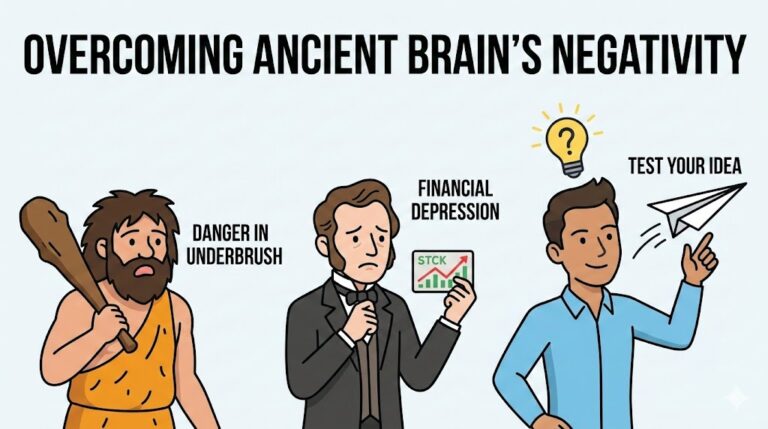
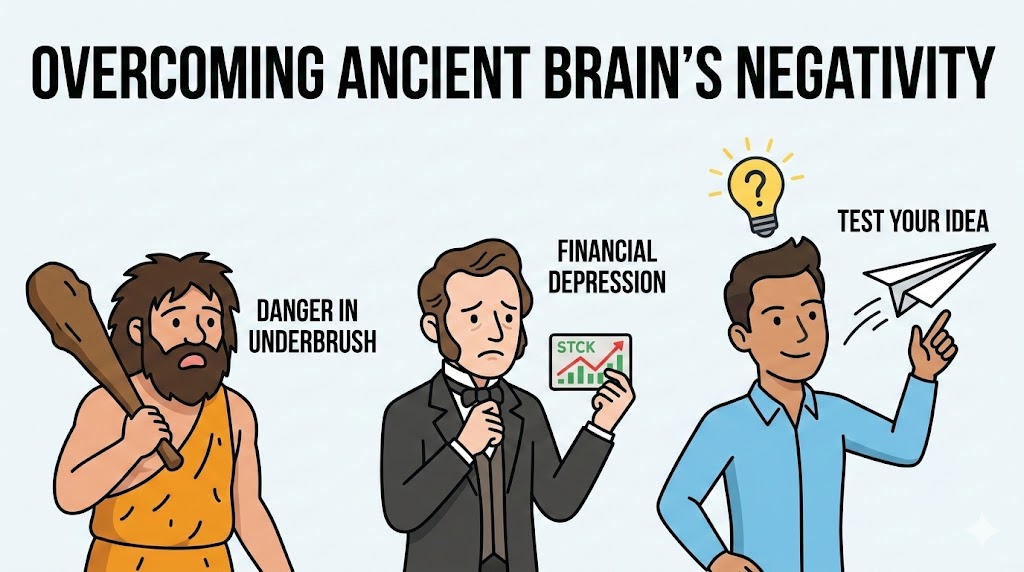
This isn’t a character flaw. It was a critical survival feature for our ancestors. In an environment where a rustling in the grass might be a predator, the cost of ignoring a threat was death. The cost of overreacting to a false alarm was just a brief sprint. Asymmetric consequences created asymmetric attention — and the humans who survived were the ones who treated every ambiguous signal as a genuine threat.
That wiring is still running in every brain today. It’s why bad news spreads faster than good news. It’s why one negative customer review can sting more than ten glowing ones. And it’s why, when you sit down to evaluate a new business idea, your mind instinctively floods the risk column long before the opportunity column gets a fair hearing.
The Problem: Ancient Threat Detection in a Modern Economy
Negativity bias served our ancestors because the threats they faced were real, immediate, and often fatal. A miscalculation about a predator’s intentions didn’t offer a second chance. The response — heightened vigilance, worst-case-scenario thinking, rapid threat escalation — was proportionate to the stakes.
But here is the critical mismatch: your brain applies that same threat-detection intensity to a business idea that it once reserved for encounters with apex predators. When you weigh the pros and cons of launching a new product line, your negativity bias doesn’t just flag legitimate risks — it amplifies low-probability events, makes them feel vivid and imminent, and crowds out rational assessment of what’s actually likely to happen.
A classic example: an entrepreneur considers launching a new service. The upside is real and measurable — new revenue, market expansion, a chance to learn what customers actually want. But the negativity bias fixates on the edge cases. What if one client complains loudly? What if it cannibalizes existing revenue? What if a competitor copies it? These concerns might represent a 5% probability of occurring, but they receive 80% of the mental real estate. The analysis feels balanced. It isn’t. The deck is stacked from the moment the brain enters evaluation mode.
Not All Downside Is Equal: The Immaterial Risk Problem
Here is where the logic of negativity bias breaks down most completely for idea-stage decisions: in a surprising number of cases, the actual downside of pursuing a new business idea is genuinely immaterial.
Consider what it truly costs to test a new service concept, reach out about a potential partnership, launch a simple landing page to gauge interest, or pitch an idea to a prospect. In most cases, the financial exposure is minimal to zero. You might invest a weekend, a few hundred dollars in small experiments, or some professional goodwill. If it doesn’t work, you learn something and move on. No bankruptcy. No permanent reputational damage. No material loss.
The risk, in these cases, is almost entirely emotional. The fear of looking foolish. The discomfort of uncertainty. The sting of a small failure. These are real feelings — the brain processes them with genuine intensity — but they are categorically different from the kind of existential risk that negativity bias evolved to protect against. Your brain, however, doesn’t make this distinction automatically. It treats the fear of embarrassment with nearly the same urgency as the fear of ruin.
This is one of the most important recalibrations a business owner can make: learning to consciously ask, “If this fails, is the outcome actually material?” When the honest answer is no — when the downside is an emotional bruise rather than a financial wound — the calculus changes entirely.
The Idea Economy: Asymmetric Upside Changes Everything
Florida’s economy is in a remarkable moment. The state has evolved well beyond tourism and real estate into a genuine hub for technology, finance, healthcare innovation, logistics, and creative industries. Tampa Bay has built a serious startup ecosystem. Miami has positioned itself as a credible competitor to Silicon Valley for tech talent and venture capital. The common thread through all of it is ideas.
In an idea-driven economy, the fundamental economics of risk-taking change. Physical and capital-intensive businesses have always carried real, symmetric downside — if a restaurant fails, you’ve lost the buildout. But in an idea economy, the most valuable assets are weightless. A software concept, a service model, a new market approach, a creative positioning strategy — these cost relatively little to test and nothing to abandon.
This creates a powerful asymmetry. The downside of pursuing an idea-based opportunity is capped and often immaterial. But the upside can be transformative — a new client vertical, a scalable product, a partnership that reshapes your business. In a world with asymmetric payoffs, the rational strategy is to pursue as many high-quality ideas as possible.
The math is straightforward, even if it runs against instinct. If you pursue ten idea-stage experiments and eight go nowhere, but one generates meaningful new revenue and one becomes a cornerstone of your business — you’ve won enormously. The cost of the eight quiet failures was minimal. The gain from the two successes was substantial. Negativity bias would have you protect against the eight failures at the cost of never finding the two wins.
A Framework for Taking More Idea Risk
Overcoming negativity bias doesn’t mean becoming reckless. It means developing a more accurate risk assessment process — one that separates genuine financial and operational risk from the emotional discomfort your brain has mislabeled as danger.
Separate material from immaterial risk. Before dismissing an idea, ask what the actual worst-case outcome looks like. Be specific. If the answer is “I’ll feel embarrassed” or “I’ll spend a weekend on something that doesn’t pan out,” that is not a material risk. That is an emotional one. Recognize it clearly for what it is.
Audit your probability estimates. When you imagine what could go wrong, ask how likely each outcome actually is. Negativity bias inflates the vividness of bad outcomes, which makes them feel more probable than they are. If you’re imagining a scenario with a realistic 5% chance of occurring, don’t give it 50% of your decision-making weight.
Build an idea pipeline and work it relentlessly. Don’t treat business ideas as rare, precious objects that must survive an exhaustive gauntlet before you attempt them. Treat them as abundant and cheap to test. Create a habit of small, fast experiments — a pilot offer, a single outreach conversation, a one-page concept shared with a trusted peer.
Reframe failure explicitly. In an idea economy, a failed experiment is not a loss — it is data. The business owners who compound their advantages fastest are not the ones who avoid failure; they are the ones who cycle through small failures quickly and update their thinking accordingly.
The Opportunity Cost No One Talks About
There is a cost to caution that never shows up on a balance sheet: the ideas you didn’t pursue, the markets you didn’t enter, the offers you never made. These invisible losses are the real price of an unchecked negativity bias. They compound quietly over years, while your business stays exactly the size and shape it was before.
Florida is attracting talent, capital, and attention at a pace it hasn’t seen in decades. The conditions for idea-driven growth are genuinely favorable. But opportunity doesn’t wait for the perfectly risk-free moment, because that moment never comes. Your brain, doing exactly what it evolved to do, will always find another reason to wait.
The business owners who thrive in this environment will be the ones who learned to work with their negativity bias rather than surrender to it — who developed the discipline to distinguish real risk from imagined catastrophe, and who built a habit of relentless, low-cost experimentation.
Most of the time, the idea sitting in your notebook costs almost nothing to test. The risk isn’t financial. It’s emotional. And that is a risk worth taking.
More Interesting Fl Business News:
• Florida Business Economy Tops $1 Trillion
• The Crushing Weight of the Crowd: Why American Teens Are Drowning in Social Stress
• Florida SEO Link Building with News Articles and Press Releases
About the Author