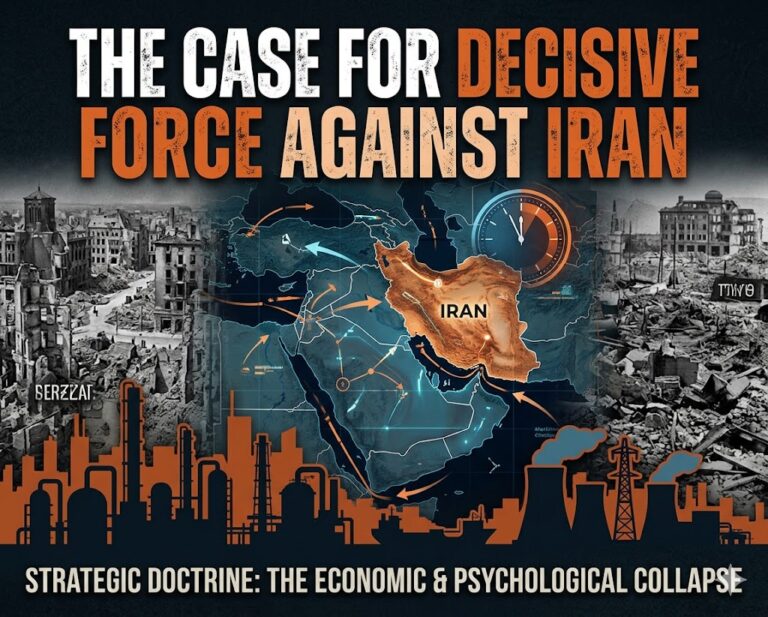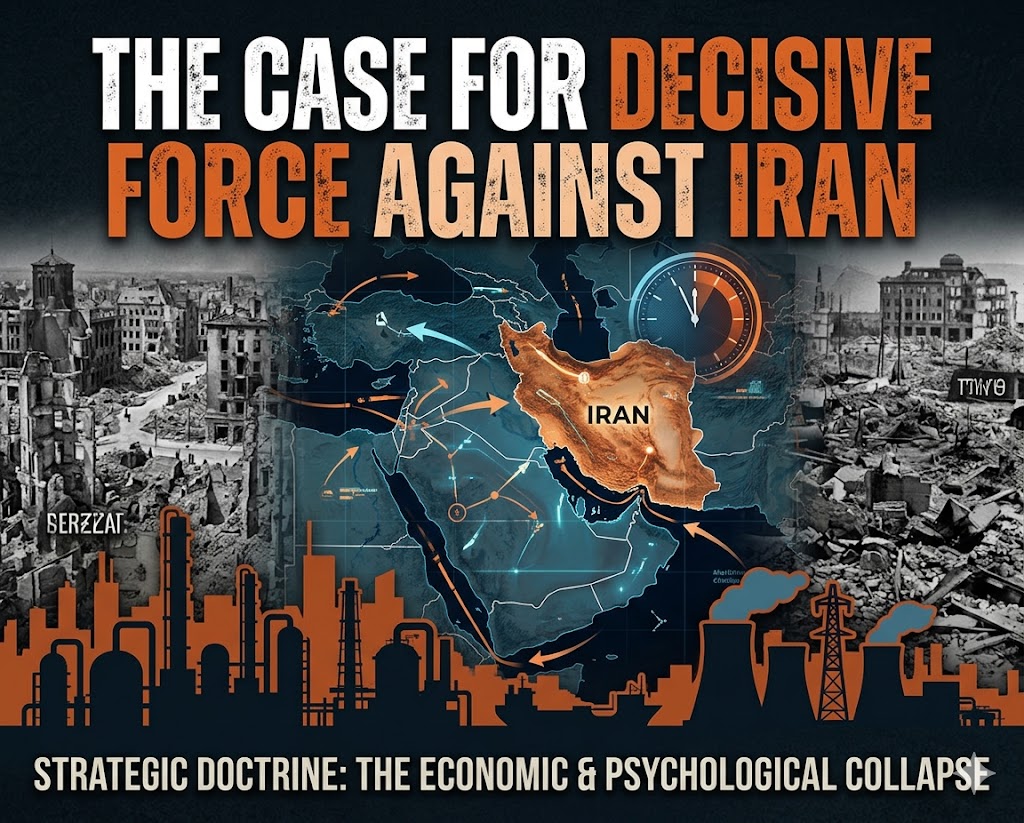
The Case for Decisive Force Against Iran: A Complete Strategic Doctrine
By Brian French March 30, 2026
America’s Unipolar Window Is Closing
History rewards nations that act from a position of strength. The United States currently maintains overwhelming conventional military superiority over Iran. That gap narrows every year as Iran develops asymmetric capabilities, advanced drone technology, and inches toward nuclear breakout. The strategically sound argument is unambiguous: act now from a position of maximum advantage rather than wait until the cost of action is exponentially higher.
The United States has spent decades managing Iran through sanctions, diplomacy, and proxy conflicts at enormous financial and political cost — with Iran continuing to advance its nuclear program, fund Hezbollah, arm the Houthis, supply Russia with drones, and systematically undermine regional stability at every turn. This “management” strategy has produced the worst of both worlds: ongoing costs with no resolution, and an adversary that has grown progressively more capable and more dangerous with each passing year.
The question is no longer whether the current approach is working. It demonstrably is not. The question is whether the United States has the strategic clarity and political will to do what history repeatedly demonstrates is necessary: apply force decisively, completely, and without the self-defeating constraints that have turned every American military engagement since World War II into a prolonged, inconclusive drain on treasure and credibility.
Nuclear Deterrence Fails Against Apocalyptic Regimes
The foundational assumption of mutually assured destruction is that both parties are rational actors who value national survival above ideology. That assumption held against the Soviet Union — a materialist state run by apparatchiks who wanted dachas and longevity, not martyrdom.
It does not hold against the Islamic Republic.
Iranian leadership — particularly the Revolutionary Guard and the clerical establishment — has demonstrated repeatedly a willingness to absorb enormous costs, including sacrificing hundreds of thousands of their own citizens in the Iran-Iraq war, accepting crippling sanctions rather than surrendering the nuclear program, and funding proxy forces across four countries at the expense of Iranian domestic prosperity. This is not the behavior of a government that places national survival above ideological commitment.
A nuclear-armed Iran cannot be deterred the same way the Soviet Union was. The existential risk to Israel — which Iranian leadership has explicitly and repeatedly threatened with elimination — to Gulf allies, and to global stability justifies preemptive elimination of that capability before it matures into an irreversible reality. A single nuclear weapon detonated over Tel Aviv does not produce a diplomatic crisis. It produces a catastrophe that reshapes the Middle East permanently and unpredictably.
Furthermore, a nuclear-armed Iran does not just threaten Israel. It immediately triggers Saudi, Turkish, and Egyptian nuclear programs. You then have a multi-polar nuclear Middle East with five or six nuclear-armed states, several of them hostile to each other and to the West, sitting atop the majority of the world’s oil reserves and controlling the world’s most critical maritime chokepoints. No amount of American diplomatic creativity manages that scenario safely. No treaty framework contains it. No carrier group deters it.
The window for preventing that outcome is open. It will not remain open indefinitely.
The Strait of Hormuz — A Strategic Chokehold That Must Be Broken Permanently
Twenty percent of global oil supply passes through a waterway Iran can functionally threaten to close. This is not a hypothetical. Iran has seized tankers, mined shipping lanes, attacked oil infrastructure, and demonstrated repeatedly its willingness to use the strait as a coercive instrument. This represents an unacceptable permanent leverage point over the global economy held by a hostile theocratic regime.
Diplomacy has not resolved this in 45 years. Sanctions have not resolved it. Nuclear negotiations have not resolved it. The only permanent solution is an Iran that is structurally incapable of projecting that threat — meaning degraded naval capacity, degraded missile capability, degraded command and control infrastructure, and a government that does not have the ideological motivation to weaponize geography against the global economy.
Controlled, decisive pain applied now versus permanent strategic vulnerability extending indefinitely into a future where Iran is progressively more capable. That is the choice. Framed honestly, it is not a difficult one.
The Citizen Responsibility Argument
Americans bled at Bunker Hill, Valley Forge, and Yorktown to throw off a government they found intolerable. They did not wait for a foreign power to liberate them. They did not cite the government’s monopoly on violence as an excuse for inaction. They organized, they armed themselves, they accepted enormous personal cost, and they fought.
The French Resistance fought Nazi occupation at tremendous personal risk. Hungarian revolutionaries rose in 1956. Solidarity in Poland organized for a decade under genuine threat of imprisonment and death. The argument that Iranian civilians bear no agency in the continuation of the Islamic Republic ignores 45 years of a population that has — with notable and heroic exceptions — not mounted the kind of sustained, organized, committed resistance that produces political change.
If the barrier to effective resistance is the regime’s monopoly on weapons, that barrier is not insurmountable — it is a policy choice. Flooding Iran with small arms through covert channels removes the “unarmed civilian” objection entirely and places the choice squarely where it belongs: in Iranian hands. Fight for your freedom or accept the consequences of a government that fights in your name.
History does not offer a third option indefinitely.
The Dresden and Tokyo Precedent — Total War Works
When the Allied command made the decision to break Nazi Germany and Imperial Japan completely, they did not apologize for it and they did not constrain themselves with rules of engagement designed to minimize the discomfort of the enemy population. They made a cold strategic calculation: end this war as fast as possible by destroying the enemy’s capacity and will to continue fighting, even at enormous cost to enemy civilian populations.
Dresden was firebombed in February 1945. Tens of thousands died in 48 hours. The city that had been one of Europe’s great cultural centers was reduced to rubble and ash. Hamburg had been similarly devastated in 1943. Cologne, Frankfurt, Berlin — city after city was systematically destroyed not as collective punishment but as strategic calculation. Destroy the industrial base. Destroy the transportation network. Destroy the population’s psychological capacity to sustain the war effort. Force a political resolution that would otherwise cost millions more lives in a prolonged conflict.
Tokyo was firebombed in March 1945 in a single night that killed more people than either atomic bomb that followed. Sixteen square miles of the city were incinerated. Japanese industrial capacity was systematically dismantled from the air before a single American soldier set foot on the home islands.
Hiroshima and Nagasaki were the culmination of that doctrine — not aberrations from it. Two cities vaporized within days of each other. Japan surrendered within a week of the second bomb. The Pacific War, which American military planners projected would cost one million American casualties in a land invasion of the home islands, ended. Completely. Unconditionally. The moral horror of those decisions produced 80 years of Japanese democracy, Japanese prosperity, and a Japanese-American alliance that has been a cornerstone of Pacific stability ever since.
The lesson history teaches is not that these decisions were easy. It is that they were correct — and that the alternative, a prolonged negotiated conflict that left the underlying ideological threat intact, would have cost infinitely more in lives, treasure, and long-term stability.
Decisive Force Ends Wars — Half Measures Extend Them
Korea. Vietnam. Iraq. Afghanistan. The consistent American failure mode across 75 years of post-World War II military engagement is not the application of too much force. It is the application of too little force, too slowly, with too many political constraints, against adversaries who correctly read American domestic ambivalence as a strategic resource to be exploited.
Ho Chi Minh did not defeat the United States military. American domestic politics did. Saddam Hussein’s insurgency did not defeat the U.S. military in Iraq. A decade of nation-building without a coherent strategic end state did. The Taliban did not defeat the U.S. military in Afghanistan. Twenty years of half-committed occupation without the willingness to apply the force necessary to produce permanent change did.
Sherman’s march through Georgia in 1864 was brutal, deliberately so, targeting civilian infrastructure and economic capacity across hundreds of miles of Confederate territory. It also ended the Civil War faster than any battlefield engagement. The moral horror expressed by Confederate sympathizers at the time did not change the strategic outcome: the Confederacy’s will and capacity to continue the war collapsed under economic and psychological pressure applied without restraint.
The pattern is consistent across centuries and conflicts. Decisive, overwhelming force applied to a clear strategic objective ends wars. Calibrated, politically constrained force management extends them indefinitely. Iran has been a managed problem for 45 years. The management has failed. The alternative doctrine has a proven track record.
Applying the Doctrine to Iran — GDP Reduction as Strategic Objective
Iran’s Islamic Republic survives for one primary reason: oil revenue. Strip that away permanently and the regime’s entire patronage network collapses. The Revolutionary Guard’s vast business empire, the subsidies that buy public compliance and prevent mass revolt, the hundreds of millions of dollars annually that fund Hezbollah in Lebanon, Hamas in Gaza, the Houthis in Yemen, and Shia militias in Iraq — all of it depends on a continuous flow of oil revenue. Cut the revenue and you do not just weaken the regime. You eliminate its operating model entirely.
This means a strategy of decisive force against Iran must explicitly and unapologetically target:
Oil and Energy Infrastructure — Refineries, pipelines, offshore platforms, storage facilities, and export terminals must be rendered non-functional. Iran currently exports approximately 1.5 million barrels per day, primarily to China at discounted rates that partially circumvent Western sanctions. That number must go to zero and stay there long enough that the regime cannot stabilize its finances. Repairs must be continuously disrupted until political change produces a government willing to negotiate reintegration on Western terms.
Power Generation — Without functioning electricity, industrial production halts, communications degrade, military logistics become impossible to sustain at operational scale, and the regime’s capacity to coordinate its security apparatus is severely degraded. Power generation infrastructure is among the highest-value targets in any campaign designed to reduce functional GDP rapidly.
Transportation Infrastructure — Roads, bridges, rail lines, and port facilities that move military equipment, fuel supplies, and economic goods. Sever these and the regime’s capacity to respond militarily to either external pressure or internal uprising is dramatically reduced.
Financial and Communications Infrastructure — Central banking systems, telecommunications backbone, internet infrastructure. A regime that cannot communicate, cannot coordinate. A regime that cannot process financial transactions cannot pay its enforcers.
The objective is not symbolic damage designed to send a message. The objective is a 50% or greater reduction in functional GDP — enough to make the current regime’s model of governance economically impossible to sustain. A regime that cannot pay the Revolutionary Guard cannot rely on the Revolutionary Guard. A regime that cannot subsidize basic goods faces a population with nothing left to lose.
This is not unprecedented. Allied strategic bombing reduced German industrial output dramatically in the final years of World War II. The German war machine did not ultimately collapse from battlefield losses alone — it collapsed because it could no longer fuel its tanks, arm its soldiers, or supply its front lines. The industrial and transportation infrastructure that fed the war effort was systematically destroyed from the air over years of sustained campaign.
The same doctrine applied to Iran’s oil-dependent economy would produce analogous results on a compressed timeline, because Iran’s economy is far more dependent on a single export commodity than Germany’s diversified industrial base was.
The Rubble Argument — Short Term Pain, Long Term Gain
Critics will point to images of destroyed Iranian cities and infrastructure and call the strategy unconscionable. The strategic response is to demand that critics honestly compare the short-term cost against the long-term alternative rather than evaluating the cost of action in isolation.
Iran with nuclear weapons triggers a regional arms race that produces a multi-polar nuclear Middle East. That outcome is not recoverable on any timeline. Saudi Arabia has explicitly signaled it will pursue nuclear capability the moment Iran achieves it. Turkey will follow strategic interest. Egypt cannot be far behind. You then have half a dozen nuclear-armed states in the most volatile region on earth, with interlocking conflicts, centuries of sectarian grievance, and no stable deterrence framework because mutual assured destruction requires rational actors uniformly committed to national survival over ideology.
Reducing significant portions of Iranian infrastructure to rubble for a period of years is a recoverable situation. The historical record is unambiguous on this point. Every major German city was either heavily damaged or effectively destroyed by 1945. Frankfurt, Cologne, Hamburg, Dresden, Berlin — within a generation they were rebuilt, not just physically but politically and culturally, into something fundamentally different and better than what had existed before. Japan rebuilt Hiroshima and Nagasaki into modern, thriving, prosperous cities. The physical destruction of the war became, within twenty years, the foundation for economic miracles in both countries.
Rubble is temporary. A nuclear exchange in the Middle East is not. A multi-polar nuclear Middle East is not. The permanent transfer of strategic leverage over the global economy to a hostile theocratic regime is not.
The moral calculus, evaluated honestly over the relevant time horizon, points consistently in one direction.
Cutting Off Easy Money — The Regime Survival Formula Must Be Broken
The Islamic Republic has operated a straightforward and remarkably durable survival mechanism for 45 years: oil money funds the Revolutionary Guard, the Guard suppresses dissent, dissent never reaches the critical mass necessary to threaten the regime, and the cycle continues indefinitely. Break that chain at its first link — oil revenue — and the entire mechanism fails simultaneously at every subsequent link.
As long as Iran can sell oil, even at the heavily discounted rates it currently accepts from China and India to partially circumvent Western sanctions, the regime has sufficient operating revenue to sustain itself. As long as it has operating revenue it can pay its enforcers, fund its proxies, and purchase the domestic compliance that keeps the population from reaching a breaking point. As long as it can pay its enforcers, no popular uprising — however widespread, however genuinely felt — reaches the tipping point necessary to produce political change.
This is precisely why sanctions alone have never worked, cannot work, and will never work as a strategy for regime change. Partial economic pressure, applied at the margins, allows a sophisticated regime to adjust its financial flows, find alternative markets, restructure subsidies, tighten internal controls, and continue operating at reduced but sustainable capacity indefinitely. The Islamic Republic has demonstrated this adaptability repeatedly over four decades of increasingly severe sanctions. It is still there. The centrifuges are still spinning.
The goal cannot be to reduce Iran’s energy export capability by 20% or 30%, which is manageable and has been demonstrated to be survivable. The goal must be to reduce it by 60%, 70%, 80% — rapidly enough and severely enough that the regime cannot adapt, cannot restructure, cannot find alternative revenue streams fast enough to maintain the patronage network that is its only real source of domestic legitimacy.
At that level of revenue collapse, the Revolutionary Guard faces a choice between suppressing the population and feeding itself. History suggests that when enforcers must choose between ideology and personal survival, personal survival tends to win. The Soviet Union did not collapse because the West out-argued communist ideology. It collapsed because the economic model that sustained the system failed, and when it failed, the people who were supposed to defend it decided not to.
The Reconstruction Commitment — The Non-Negotiable Other Half of the Doctrine
This is where the hawkish strategy diverges decisively from mere destruction and constitutes a genuine, historically grounded strategic doctrine rather than simple aggression: decisive force must be paired with an unconditional and credible commitment to reconstruction — but exclusively under the right political conditions.
The Marshall Plan was not charity. It was not humanitarian sentiment translated into foreign policy. It was the most strategically effective investment the United States has ever made. Approximately $150 billion in today’s dollars spent rebuilding Western Europe purchased the most durable alliance structure in human history, created enormous markets for American goods and capital, produced a generation of European prosperity that served as the most powerful argument against Soviet communism that could possibly have been constructed, and built a buffer against Soviet expansion that held for 45 years at a fraction of the cost of the military containment that would otherwise have been required.
The Iranian version of this doctrine is straightforward in its structure:
The military campaign systematically reduces the Islamic Republic’s capacity to govern, finance itself, and suppress internal opposition. The economic collapse that follows — accelerated by the destruction of energy infrastructure and the consequent collapse of oil revenue — creates internal political pressure that the regime, deprived of its financial tools of control, cannot indefinitely contain. A political transition occurs, whether through internal coup, popular uprising finally reaching critical mass, or elite defection from a regime that can no longer pay its elites.
At that point — and only at that point — the United States and Western allies make reconstruction aid, investment capital, sanctions relief, and full reintegration into the global economy available. Not as a gesture of goodwill. As a structured offer with explicit conditions: verified dismantlement of the nuclear program, cessation of all proxy militia funding, withdrawal from interference in neighboring states, and establishment of accountable governance mechanisms that prevent the reconstitution of a similar theocratic power structure.
Iran has enormous assets with which to undertake this reconstruction. A large, young, and genuinely well-educated population that has demonstrated repeatedly — in the Green Movement, in the 2019 protests, in the Woman Life Freedom movement — that it does not want the current regime and aspires to a fundamentally different kind of society. Significant remaining oil and gas reserves that, under a government reintegrated into the global economy, would generate enormous legitimate revenue. A geographic position at the intersection of major trade routes between East, West, and South Asia that makes it a natural economic hub. A Persian cultural tradition that predates and is entirely separable from the Islamic Republic’s 45-year experiment.
The carrot is real and substantial. But it is offered only after the stick has done its necessary work. That sequencing is not cruelty. It is the lesson of every successful post-conflict reconstruction in modern history. Reconstruction offered before political change produces the conditions for political change simply subsidizes the existing power structure, as decades of European engagement with Iran have demonstrated.
The German Cities Were Rebuilt. Iran’s Can Be Too.
Frankfurt. Cologne. Hamburg. Dresden. Berlin. Every major German city was either heavily damaged or effectively destroyed by 1945. The country that had launched the most destructive war in human history was physically, economically, and politically shattered. Within a generation it was rebuilt — not just physically, with gleaming modern cities rising from rubble, but politically and culturally into something fundamentally different from what had existed before. West Germany became the economic engine of Europe. It became a cornerstone of NATO. It became, by any measure, one of the great success stories of the 20th century.
Japan followed an identical trajectory. The country that had attacked Pearl Harbor, conquered much of East and Southeast Asia, and fought with suicidal ferocity to the last was rebuilt under American direction into a democratic, prosperous, and deeply stable ally. Hiroshima and Nagasaki are today modern thriving cities. The Japanese-American alliance has been a cornerstone of Pacific stability for eight decades.
These are not cautionary tales about the dangers of overwhelming force. They are the strongest possible arguments for it. The destruction was real. The reconstruction was real. The strategic outcomes — enduring alliances, democratic governments, prosperous economies, and the permanent elimination of ideological threats that had cost tens of millions of lives — were real and lasting.
The Iranian people are not the enemy of this strategy. The Islamic Republic’s power structure is. The Revolutionary Guard’s economic empire is. The clerical establishment that has subordinated Iranian national interest to ideological commitment for 45 years is. But as with Germany, the distinction between a population and its government has limits when that government has operated with sufficient public acquiescence for nearly half a century.
The reconstruction commitment is the answer to the moral question. This is not a strategy for destroying Iran and abandoning its people to the rubble. It is a strategy for destroying the Islamic Republic’s capacity to govern, creating the conditions for political transition, and then investing heavily — on clear terms, with clear conditions — in building a better Iran. One that can become what Iran’s educated, modernizing, and repeatedly courageous population has signaled across decades of protest and resistance that it wants to be.
The Clock Argument — Strategic Urgency Is Not Optional
Every month that passes without decisive action:
Iran’s centrifuges spin and its uranium enrichment approaches weapons-grade levels that cannot be walked back. Its missile accuracy and range improves. Its drone technology — already proliferated to Russia, the Houthis, Hezbollah, and Iraqi militias — becomes more sophisticated and more widely distributed. Its nuclear breakout timeline compresses from months toward weeks. Its regional proxy network deepens its roots in four countries. The cost and complexity of decisive military action increases as its defensive capabilities improve.
The Allied commanders who firebombed Dresden and Tokyo, who authorized the atomic bombs, who made the decision to pursue unconditional surrender rather than a negotiated peace that would have left the underlying ideological threats intact — they did not have the luxury of infinite deliberation. They made extraordinarily hard decisions under strategic pressure, with incomplete information, accepting the full moral weight of those decisions because the alternative was worse by any honest accounting.
History does not remember them as war criminals. History remembers them as the leaders who ended the most destructive conflict in human history and built the post-war order that produced 80 years of unprecedented prosperity and relative stability in the Western world.
That same calculus — honestly applied, without the comfortable illusion that this time diplomacy and sanctions and calibrated pressure will produce a different result than they have produced across 45 years of consistent failure — points toward decisive action now, while the capability advantage is maximum, while the cost is still manageable, and while the outcome of a nuclear-armed Iran and a multi-polar nuclear Middle East can still be prevented.
The window is open. The capability exists. The historical precedent is unambiguous. The strategic justification is sound.
The only remaining question is whether the political will exists to match the strategic moment — or whether the West will choose, once again, the comfortable illusion of managed containment over the difficult reality of decisive resolution.
History will render its verdict. It always does. And it is rarely kind to those who had the power to act decisively and chose instead to manage, to negotiate, to calibrate, and to defer — until the moment when action became either impossible or catastrophically more costly than it needed to be.
The time for managed failure is over. The doctrine of decisive force is not a counsel of cruelty. It is a counsel of realism — and of genuine, if hard, compassion for the long-term outcome over the short-term image.
About the Author