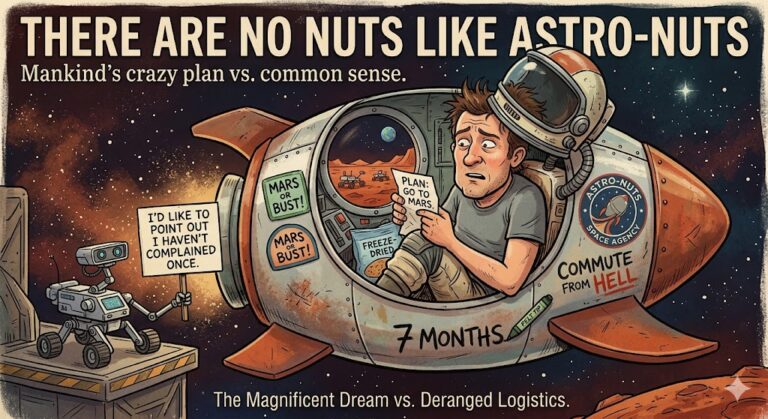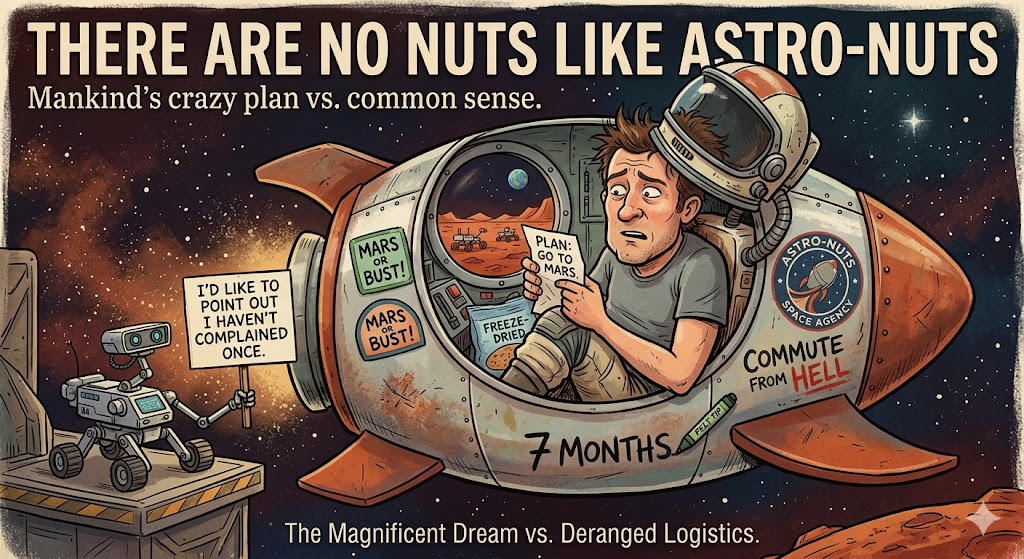
Mankind has spent sixty years dreaming of conquering the cosmos. A closer look at the actual plan suggests we’d be better off sending a very good drone.
Opinion • April 2026 • Brian French
Picture the scene. A child of about seven sits in front of a television, eyes wide with wonder, watching grainy footage of astronauts bouncing around on the Moon. “I want to do that,” the child says. Noble. Inspiring. Absolutely adorable.
Now picture that same child — now a 45-year-old tech billionaire with a private rocket company — saying the exact same thing with the exact same level of critical thought. Suddenly it’s a little less adorable. And a lot more expensive.
This, in essence, is the story of modern human space exploration: a multi-hundred-billion-dollar enterprise built almost entirely on the emotional foundation of a first-grader who watched Star Wars one too many times. The dream is magnificent. The actual logistics are, to use a technical term, completely and utterly deranged.
“The dream is magnificent. The actual logistics are completely and utterly deranged.”
The Commute From Hell
Let us begin with Mars, the current obsession of our more excitable species-members. People speak of going to Mars the way one might speak of a weekend city break. Pop over, plant a flag, perhaps open a small coffee shop, call it “civilisation.” What could go wrong?
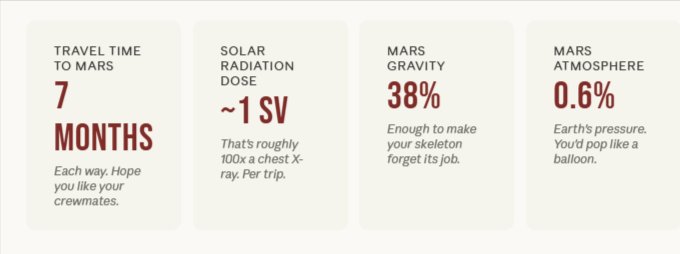
Quite a lot, as it turns out. Mars is, on average, 225 million kilometres away. The minimum travel time using current technology is approximately seven months. That is not seven months in a cruise ship. That is seven months in a tin can roughly the size of a Winnebago, hurtling through an environment that is actively trying to kill you in no fewer than six distinct and creative ways.
Radiation: The Universe’s Way of Saying “No”
Once you leave the warm, magnetic embrace of Earth, you enter a zone of solar radiation that treats the human body the way a microwave treats a wet sock. Galactic cosmic rays — the high-energy particles streaming in from exploded stars across the galaxy — pass through spacecraft walls as though they aren’t there, because to them, they aren’t.
A round trip to Mars would expose an astronaut to radiation doses well beyond what health agencies consider remotely acceptable. We’re talking significantly elevated cancer risk, potential damage to the central nervous system, and the distinct possibility that your bone marrow simply gives up and goes home. Your eyes, incidentally, may also experience flashes of light as particles streak directly through your optic nerve. Romantic, in a terrifying sort of way.
Also: The Kuiper Belt
Beyond Neptune lies the Kuiper Belt — a vast ring of icy debris, frozen rocks, and ancient planetary leftovers stretching for billions of kilometres. Any vessel attempting the outer solar system must navigate this cosmic junkyard. The good news: we have probes that have done it. The bad news: those probes didn’t contain anyone’s brain, spine, or irreplaceable collection of memories and experiences.
What Awaits You on Mars (Spoiler: Misery)
Suppose, against all odds and physics, you actually arrive. Welcome to Mars. Your new home is a freezing, airless desert where the average temperature is minus 60 degrees Celsius, the soil is laced with toxic perchlorates that would poison you if ingested, and there is no magnetosphere to protect you from the radiation you’ve been soaking in for the past seven months.
The soil, specifically, deserves a moment of appreciation for sheer inhospitability. Martian dirt is saturated with perchlorate salts — compounds that, on Earth, are used in rocket fuel and are classified as an environmental hazard. The idea of growing food in it requires a level of agricultural innovation that does not yet exist. You cannot drink the water (frozen and largely inaccessible). You cannot breathe the air (95% carbon dioxide). You cannot go outside without a spacesuit. You cannot, under any circumstances, relax.
And then there is the gravity. At 38% of Earth’s, Mars offers just enough gravitational pull to keep you on the ground but not nearly enough to keep your body functioning properly. Long-term low gravity causes bone density loss, muscle atrophy, fluid shifts toward the head, and cardiovascular deterioration. Astronauts returning from six months on the International Space Station require months of rehabilitation just to walk normally again. Mars colonists may never fully recover. They would effectively be a new, shorter, frailer sub-species, marooned on a toxic rock, wondering where it all went wrong.
“Martian colonists may effectively become a new, frailer sub-species — marooned on a toxic rock, wondering where it all went wrong.”
The Psychological Dimension (Or: Going Mad Very Slowly)
We haven’t even addressed the mental health dimension of spending fourteen to twenty-four months in a confined space with a small group of people, completely cut off from everyone you have ever loved, watching Earth shrink to a small blue dot in the window. Communications with home carry a time delay of up to 24 minutes each way. You cannot call your mother in an emergency. You cannot even get a timely response to an email. You are, for all practical purposes, more isolated than any human being in history.
Studies of analogue missions — where volunteers are locked in simulated Mars habitats for months on end — consistently find elevated rates of interpersonal conflict, depression, and what researchers diplomatically call “crew tension.” In plain English: people go absolutely spare. And those are people who can look out the window and see Earth.
The Crowning Absurdity: We’re Less Ready Than in 1969
Here is perhaps the most extraordinary fact of this entire cosmic saga: in certain critical respects, humanity is less prepared to send people to the Moon today than we were in 1969.
The Saturn V rocket that carried Apollo astronauts to the lunar surface was, by any measure, an extraordinary feat of engineering. Its blueprints were lost. The manufacturing techniques were discontinued. The engineers who built it are gone. When NASA set about designing a new heavy-lift rocket in the 21st century, they effectively had to start from scratch — producing a vehicle that costs more per launch, flies less frequently, and still hasn’t taken anyone beyond low Earth orbit as of this writing.
The Apollo programme employed 400,000 people, consumed roughly 4% of the federal budget at its peak, and was driven by the very specific geopolitical terror of the Soviet Union beating America to the Moon. That level of focused, lavishly funded, existentially motivated effort has not been repeated. What we have instead are billionaires with compelling PowerPoint presentations and a great deal of optimism about timelines that have historically slipped by a decade or more.
In Defence of Probes, Robots, and Common Sense
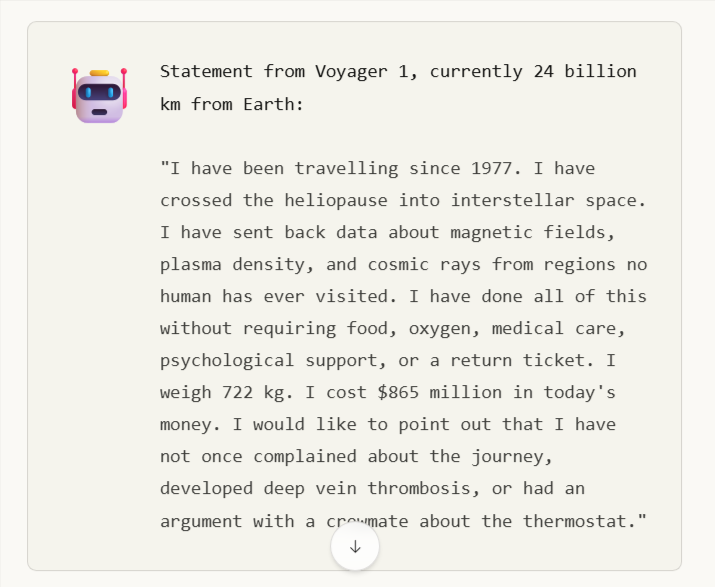
The great unspoken truth of space exploration is that robots are extraordinarily good at it. The Mars rovers have been trundling around the Martian surface for years, collecting data, analysing soil, and photographing rocks without once requiring a spacesuit, a calorie, or an encouraging word. The Voyager probes are in interstellar space. The James Webb Space Telescope is showing us the universe as it looked 13 billion years ago. None of these achievements required putting a fragile, squishy human being in harm’s way.
Robotic missions are cheaper by orders of magnitude. They can be sent on one-way journeys. They don’t get bored, lonely, or catastrophically ill from radiation. They don’t need to bring return fuel. A probe can be sent to Europa to look for life in its subsurface ocean without the added complexity of having to bring the probe back, let alone a crew.
The science argues, loudly and consistently, for robots first. The engineering argues for robots first. The economics argue, practically screaming, for robots first. And yet the dream of humans planting flags on distant worlds persists — because, at its heart, this was never really about the science, was it?
Conclusion: A Loving Diagnosis
There is something undeniably magnificent about the human impulse to explore. It is the same impulse that drove our ancestors across oceans in wooden boats, across deserts on foot, up mountains that offered only cold and danger and the occasional spectacular view. We are, as a species, fundamentally incapable of looking at a horizon without wanting to know what’s on the other side.
This is admirable. It is also, in the specific context of human interplanetary travel circa 2026, completely bonkers.
The correct course of action is to send our robots ahead — our probes, our rovers, our telescopes — to do the patient, unglamorous, heroic work of actually understanding the universe. And perhaps, in a few centuries when we have solved the radiation problem, the muscle atrophy problem, the psychological isolation problem, the toxic soil problem, the 400-million-kilometre commute problem, and the “where does the oxygen come from” problem, we can revisit the idea of sending people.
Until then, it would be very nice if the adults in the room could gently explain to the excitable seven-year-old currently running our space programmes that “wanting to go” is not, by itself, a sufficient engineering specification.
The cosmos is not going anywhere. It has been here for 13.8 billion years. It can wait while we do a bit more homework.
The author acknowledges that space exploration has produced GPS, memory foam, scratch-resistant lenses, and water filtration systems, all of which were achieved largely without anyone having to sit in a tin can for seven months next to a perchlorate-soaked desert. • No astronauts were harmed in the writing of this article. Several egos may have been.
About the Author