By Brian French
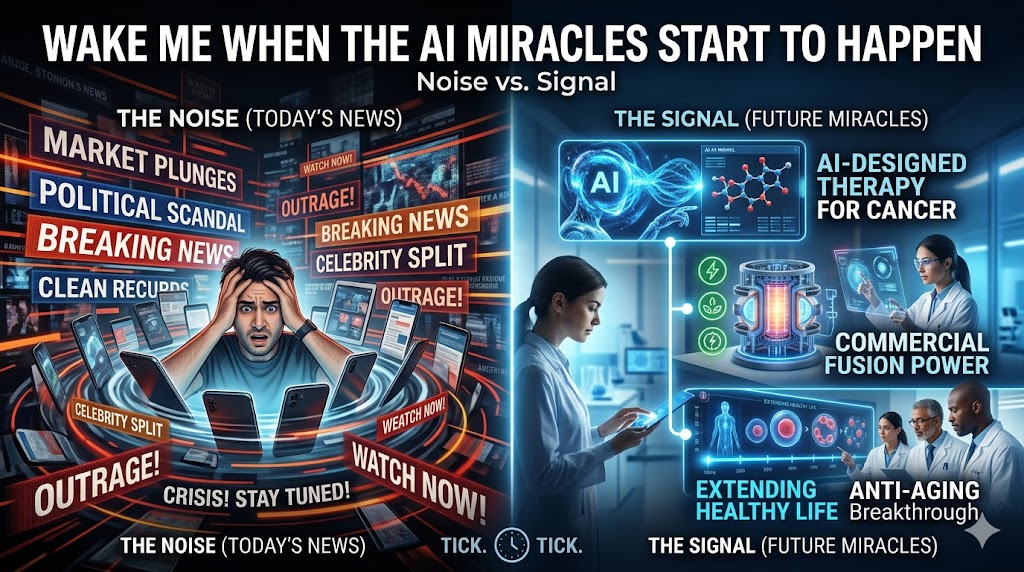
Most of what we call “news” is noise. The signal — the thing that will actually change your life — is being drowned out by it.
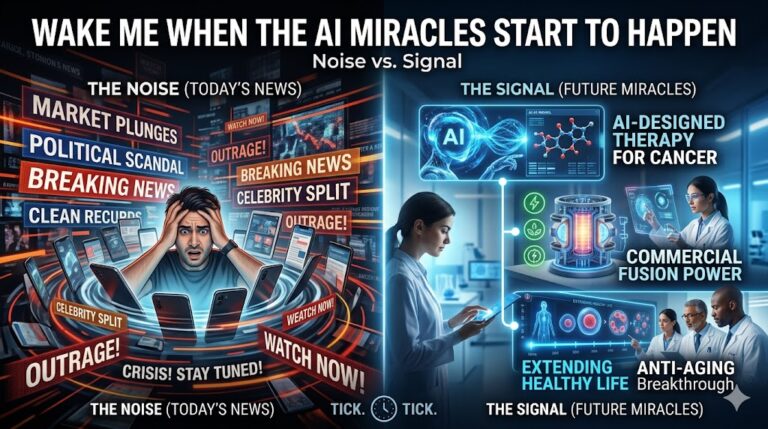
A politician said something provocative. A celebrity couple separated. A market moved two percent in a direction that will reverse by Thursday. A foreign leader made a threat they will not follow through on. A study found that something you eat either causes or prevents cancer, contradicting last month’s study. Breaking news. Stay with us. We’ll have more after the break.
Meanwhile, in a laboratory none of us have heard of, in a city none of us could find on a map, something is being discovered that will change everything. Nobody is covering it live.
The Attention Economy Has Stolen Your Perspective
Here is an experiment. Think about the ten biggest news stories from five years ago. The ones that consumed entire news cycles, dominated dinner table conversations, and felt — in the moment — like they mattered enormously. Write them down if you can remember them.
Now ask yourself: how many of them changed your life? Not in the abstract, geopolitical, “it contributed to a broader trend” sense. How many of them actually altered the arc of your daily existence, your health, your economic opportunity, your relationship to the future?
For most people, the answer is somewhere between zero and one. And that one was probably something local — a policy that affected your taxes, a decision that affected your job — not the story that was getting the most airtime.
The news, as an industry, has discovered something deeply uncomfortable about human psychology: we are far more reliably engaged by threats than by progress. A story about a disease outbreak that kills twelve people in a country most viewers cannot find on a map will generate more clicks, more watch time, and more advertising revenue than a story about a treatment that just saved twelve thousand lives. This is not a conspiracy. It is not even a choice, really. It is the straightforward result of optimizing content delivery for human attention, and human attention gravitates, relentlessly and helplessly, toward danger.
The news industry did not create this bias. It merely learned to exploit it with extraordinary efficiency.
“The news is not a picture of the world. It is a picture of the world’s most alarming recent events, curated by people whose business model depends on your alarm.”
The Negativity Bias: A Bug We Cannot Patch
Two hundred thousand years of evolution have left human beings with a cognitive architecture magnificently optimized for one thing: survival in an environment full of things trying to kill us. The rustle in the tall grass that might be a predator demanded immediate, consuming attention. The beautiful sunset did not. The berry that might be poisonous required more mental processing than the berry that was definitely safe. The stranger who might be hostile warranted more vigilance than the neighbor who had always been friendly.
This is negativity bias: the deeply wired tendency to weight negative information more heavily than positive information of equal or greater objective significance. And it was a magnificent adaptation for the Pleistocene savanna. It kept our ancestors alive long enough to become our ancestors.
It is a catastrophic adaptation for navigating the modern information environment.
Because in the modern information environment, the “rustle in the tall grass” is not a predator. It is a political scandal in a country on the other side of the world. It is a market correction that will reverse before you have time to act on it. It is a tweet from a person who craves attention and receives it in direct proportion to how alarming their content is. It is a conflict that is genuinely tragic for the people involved and genuinely irrelevant to the trajectory of your life or the future of civilization.
Your brain does not know the difference. Your amygdala cannot distinguish between a threat that requires your immediate physical response and a threat that is simply a story designed to activate the same neural circuitry. Both produce the same cortisol spike, the same narrowing of attention, the same cognitive hijacking that crowds out everything else.
And while your attention is hijacked — locked onto the latest crisis, the latest outrage, the latest thing to be afraid of — the actual future is being assembled quietly, in places the cameras are not pointed.
The Shelf Life of “Breaking News” Is Measured in Hours
There is a useful exercise practiced by some of the most effective thinkers and decision-makers in the world: before consuming any piece of news, ask yourself one question. Will this matter in ten years?
Not “is it interesting right now.” Not “does it feel urgent.” Not “will people be talking about it at work tomorrow.” Will it matter — to you, to your children, to the shape of the world — in ten years?
Applied honestly, this filter eliminates roughly 95% of what appears in any given day’s news coverage. The political scandal that consumes three weeks of cable news will be, in ten years, a footnote or a forgotten paragraph. The market move that sends financial pundits into paroxysms of analysis will have been reversed, revised, and replaced by a dozen subsequent moves. The celebrity controversy will be a trivia question. The viral outrage will be impossible to remember, indistinguishable from the dozen viral outrages that preceded and followed it.
The things that will matter in ten years are almost never breaking news. They move too slowly, too quietly, too technically for the news cycle’s metabolism. They don’t have spokespeople. They don’t have press conferences. They don’t have the dramatic narrative arc — villain, victim, conflict, resolution — that the human brain finds so satisfying and that the news industry has learned to manufacture so reliably.
They have researchers. They have data. They have long papers with technical titles published in journals that most people have never heard of. And they have, increasingly, AI systems running on hardware being assembled at a scale that dwarfs every previous technology buildout in history, working on them continuously, at a pace that human researchers could not sustain for a single afternoon.
“The things that will define the next thirty years are not on the front page. They are in the methodology sections of papers that have not been published yet.”
Noise vs. Signal: A Field Guide to What Actually Matters
The confusion is understandable. Not all news is noise. Some of it is signal — genuinely important, genuinely durable, genuinely connected to the long arc of human experience. The problem is that signal and noise look almost identical in the moment of consumption. Both feel urgent. Both demand attention. Both come through the same channels, in the same format, at the same volume.
The difference only becomes clear with time — and by then, you have spent hours, days, weeks, months of cognitive bandwidth on things that left no residue. Nothing learned. Nothing changed. Nothing enriched. Just the faint, familiar feeling of having been very busy thinking about things that did not matter.
Here is the rough taxonomy, though the categories bleed into each other and the exceptions are real:
Noise: Daily market movements. Political insults and counter-insults. Celebrity behavior. Crime stories that do not reflect statistical trends. Weather events in places you do not live. Polling numbers from elections more than six months away. Corporate earnings that beat or miss by marginal amounts. Diplomatic statements not backed by action. Social media controversies. “Studies suggest” stories based on single small trials. Rankings and lists designed to generate engagement. Anything described as “explosive” or “bombshell” that will not be mentioned again in a week.
Signal: Demographic shifts that take decades to unfold and reshape economies, politics, and culture. Technological developments that change what is possible in fundamental ways. Policy changes with long-term compounding effects on human health, education, and economic mobility. Scientific discoveries that alter the basic map of what we understand about the physical world, the body, or the mind. And — increasingly, urgently, inevitably — the progress of artificial intelligence from a promising technology into the most consequential development in the history of our species.
The first category fills the news. The second category barely appears in it.
What the News Gets Wrong About Time
The news cycle runs on a clock calibrated to human impatience: the next hour, the next day, the next week. It is, by structural necessity, a short-term instrument. A story that takes ten years to develop cannot compete for airtime with a story that developed this morning. A breakthrough that will take five years of clinical trials to confirm cannot compete with a press conference happening right now.
This creates a systematic distortion in our collective understanding of the world. We massively overweight recent, dramatic, fast-moving events and massively underweight slow-moving, structural, compounding ones. We think in news cycles when we should be thinking in decades. We optimize for not being caught off guard by today’s surprise when we should be orienting toward the changes already in motion that will be inescapable in ten years.
Steven Pinker has documented, painstakingly and controversially, that by almost every measurable metric of human wellbeing — child mortality, extreme poverty, violent crime, literacy, access to clean water, death from war — the world has been getting better for decades. Not in every place, not without setbacks, not without enormous remaining injustice. But better, on average, by almost every measure that matters to actual human lives.
You would not know this from watching the news. The news is not lying. It is simply selecting from the population of events in ways that are structurally biased toward the negative, the dramatic, and the recent. The slow, grinding, boring, invisible improvement in billions of lives does not produce footage. It does not have a date. It does not have a spokesperson. It cannot be covered live.
The result is a population that believes — in every survey, across every country, across decades of polling — that the world is getting worse, when the long-run data says it is getting better. And a population that is chronically, unnecessarily alarmed about threats that are receding, while being chronically, dangerously unaware of the opportunity that is advancing.
“We have been given a front-row seat to the most important transformation in human history. Most of us are watching a different show.”
The Distraction Economy’s Greatest Trick
There is a moment in any magic performance where the magician draws your attention dramatically to one hand — a flourish, a gesture, a raised voice — while the other hand does the actual work. The trick succeeds not because you are foolish. It succeeds because your attentional system is doing exactly what it was designed to do: tracking the most salient stimulus in the environment.
The news cycle is the magician’s flourish. And while your attention is fixed on it — on the scandal, the outrage, the crisis, the breaking development — the other hand is building the future.
In that other hand, right now: a research team at a university hospital is feeding ten years of patient genomic data into an AI system running on Blackwell-generation hardware, and the patterns emerging from that analysis are beginning to suggest that a specific type of leukemia has a molecular vulnerability that previous models were too limited to detect.
In that other hand: an energy laboratory is running AI-generated experiments on a new class of perovskite materials, and three of the last seven have shown photovoltaic efficiencies that exceed anything in the published literature.
In that other hand: a pharmaceutical company’s AI system has identified a peptide combination that, in early animal models, reverses the accumulation of senescent cells with an efficacy that the lead researcher, in a private email to a colleague, called “frankly implausible.”
None of this is breaking news. All of it is the future arriving, on schedule, ahead of the cameras.
The Signal We Should Actually Be Waiting For
There is a version of consuming information that is genuinely enriching — that leaves you more oriented, more capable, more prepared for the world that is actually coming, rather than more anxious about the world that is performing for cameras. It requires a different set of questions than the ones the news trains us to ask.
Not: What happened today that is alarming?
But: What changed this week that will still matter in ten years?
Not: Who said something provocative?
But: What did someone discover that nobody knew before?
Not: What is the current state of the conflict?
But: What structural forces are converging that will make the current conflict irrelevant within a decade?
Not: What is the market doing right now?
But: What technology is being deployed at scale that will change the economics of every market?
Applied honestly, this reorientation leads almost inevitably to the same place: to the laboratories and data centers where artificial intelligence is being trained on hardware that represents the largest coordinated technology investment in human history, working on problems that have defeated the accumulated intelligence of our species for generations.
That is the signal. Everything else is receiving interference.
Wake Me When It Starts
There is a particular kind of weariness that comes from years of news consumption — a fatigue that is not physical but epistemic. The sense of having processed enormous quantities of information while gaining very little understanding. Of having been very engaged while remaining essentially unprepared. Of having watched a great deal of television about the world while somehow knowing less about where it is actually going than you did before you started watching.
That weariness is rational. It is the correct response to a diet of noise dressed as signal, of urgency manufactured from triviality, of alarm harvested for advertising revenue. The fatigue is not a failure of attention. It is the appropriate reaction to a system designed to exhaust your attention rather than reward it.
So here is a different proposition. What if you stopped waiting to be alarmed and started waiting to be amazed?
Because something is coming. Not the next scandal, not the next market correction, not the next political drama that will feel seismic for three weeks and be forgotten in three months. Something that will not be forgotten. Something that will divide human history, clearly and permanently, into before and after — the way the printing press divided it, the way antibiotics divided it, the way the transistor divided it.
The first cancer that falls to an AI-designed therapy will not be a news cycle. It will be an era. The first fusion reactor that generates net-positive power at commercial scale will not be a headline. It will be a civilizational boundary. The first child born into a world where aging is not a fixed biological sentence will not read about it in a newsletter. She will simply live it, in the way that people who were born after antibiotics simply lived without dying of strep throat.
That is what is coming. That is what the hardware being assembled, the models being trained, and the intelligence being applied are pointing toward. Not in a distant, speculative, “someday maybe” sense. In a here, now, the-clock-is-already-running sense.
“Wake me when the AI miracles start to happen. That is the news worth waking up for.”
What Real News Would Look Like
Imagine, for a moment, a news broadcast designed not to maximize alarm but to maximize orientation. Not to keep you watching through manufactured tension, but to leave you genuinely more informed about where the world is going and why.
It would not lead with the politician’s latest statement. It would lead with the paper published this week in Nature Medicine that identified a new mechanism for senescent cell clearance that, if it replicates in human trials, will add healthy years to every life on Earth.
It would not spend twelve minutes on the latest diplomatic fracas. It would spend twelve minutes explaining why fusion ignition at the National Ignition Facility — which received roughly twelve seconds in most news coverage — was one of the most significant scientific events of the past decade.
It would not run a segment on the celebrity’s social media post. It would run a segment on the AI system that just solved a protein-folding problem that biochemists had been working on for forty years, and explain — clearly, accessibly, without condescension — what that means for the fifteen diseases that depend on understanding that protein.
It would not close with sports scores. It would close with a reminder that something, somewhere, is being discovered right now that none of us yet know about — and that the pace at which such discoveries are happening is not slowing. It is accelerating. And that the acceleration is not a story about technology. It is a story about us: about what becomes possible for human beings when the tools finally match the scale of the problems.
That broadcast does not exist yet, in the form most people consume news. But the information it would contain does exist — in journals, in preprint servers, in the patient-investor newsletters that track emerging science rather than emerging conflict, in the laboratories where the actual future is being assembled by people who are too busy making it to go on television and explain it.
The Permission Slip
This is not an argument for ignorance. There are things happening in the world that matter, that require attention, that have genuine stakes. Civic participation requires some baseline of current awareness. Democratic citizenship is not well-served by complete disconnection from events.
But there is a difference between informed and consumed. Between aware and addicted. Between knowing what is happening and spending four hours a day marinating in a curated feed of maximally alarming content that leaves you anxious, exhausted, and no better equipped to understand the future than you were before you started.
You have permission to be bored by the news cycle. You have permission to find it repetitive, because it is — the same dramas in rotating costumes, the same manufactured urgency, the same emotional manipulation dressed up as journalism. You have permission to decide that your attention is a finite resource and that you would like to point it at something that will still matter when your children are your age.
You have permission to wait for the real news.
And the real news — the genuine, consequential, civilizationally important news — is coming. An AI system trained on the complete global literature of oncology is, right now, generating hypotheses about cancer mechanisms that no human researcher has considered. A materials science AI is, right now, exploring a region of molecular space that no human chemist has visited. A genomics AI is, right now, identifying the molecular signature of biological aging in a dataset large enough to reveal patterns that smaller studies could never see.
None of this will interrupt the current programming. None of it will trend on social media this afternoon. None of it will generate the click-through rates that keep the lights on at news organizations built for a different kind of information diet.
But all of it is real. All of it is coming. And all of it will matter in ways that no current news story will.
Tick. Tick. Tick.
The clock is running. Not the news cycle’s clock, with its hourly resets and its manufactured urgency and its carousel of crises that feel enormous and vanish without a trace. A different clock. A slower one, but one that does not stop and does not reverse.
It is the clock of scientific progress, now running on hardware that makes every previous instrument of human intelligence look like a sundial. It is counting down to the first cancer that surrenders to an AI-designed therapy. To the first fusion reactor that makes the energy question a historical one. To the first anti-aging intervention that makes a child born today the potential beneficiary of decades of additional healthy life. To the first AI system that solves a problem so fundamental and so long-standing that the world requires a moment of collective silence before it can process what just happened.
That clock is the one worth watching.
So turn off the other one. Or at least turn it down. Spend less of the finite, irreplaceable hours of your one life marinating in alarm designed by algorithms and monetized by advertisers. Spend more of those hours oriented toward the actual future — the one that is being built, right now, in the places the cameras are not pointed.
And when the first miracle lands — when the headline arrives that is not noise, not manufactured urgency, not a story that will be forgotten by next week — you will know it. Because it will be the kind of news that does not require a countdown clock or a breaking news chyron or a panel of alarmed commentators to feel important.
It will simply feel like the future finally arriving. On time. Just ahead of schedule. More extraordinary than anyone thought to predict.
Wake me when the AI miracles start to happen.
Actually — keep me awake. I do not want to miss a single one.
Tick.
Tick.
Tick.
This article reflects the author’s perspective on media consumption, attention, and the potential trajectory of artificial intelligence. It is intended as a provocation toward more considered information habits, not a comprehensive critique of journalism, which at its best performs an essential democratic function. The AI breakthroughs referenced are speculative in their timing but grounded in current research trajectories.
About the Author