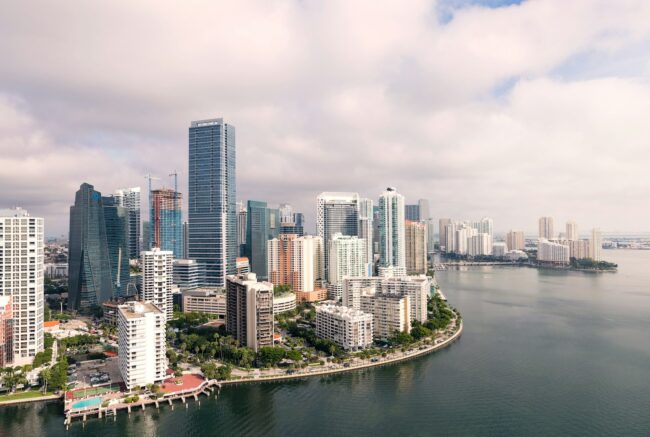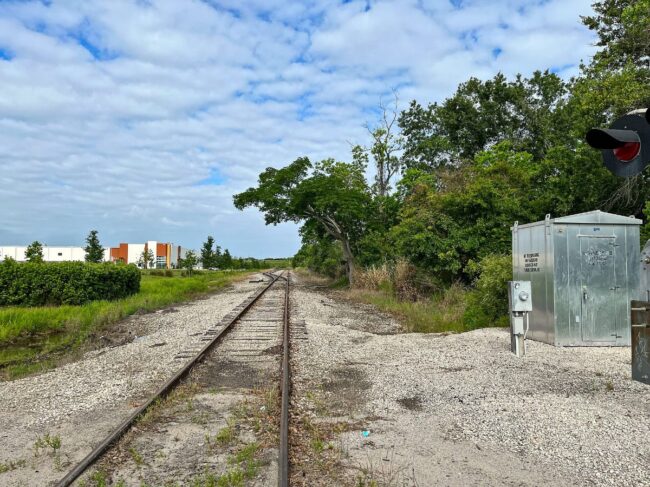
Railroad track in Florida. Photo via Wikimedia Commons. License: CC0.
Quick Answer: Seventeen parent companies of Brightline Florida filed a prearranged Chapter 11 case in the U.S. Bankruptcy Court for the District of New Jersey on September 24, 2026, backed by $490 million of new financing commitments. The operating railroad, Brightline Trains Florida LLC, did not file, and Miami-to-Orlando trains continue to run while ridership through August 2026 is up 14% from a year earlier.
Brightline, the privately financed intercity railroad that connects Miami and Orlando, has moved its long-running debt problem into bankruptcy court. The filing is not a shutdown. It is a holding-company restructuring designed to cut the debt burden that sits above a railroad whose ridership and revenue are still growing. For Florida businesses, commuters, local governments planning new stations, and the bond market, the case will shape what passenger rail in the state looks like for the next decade.
This report explains who filed, what the restructuring support agreement provides, how the debt got here, and what the latest operating figures show.
What did Brightline file and when?
According to Mass Transit, 17 parent companies of Brightline Florida filed for Chapter 11 protection on September 24, 2026, in the U.S. Bankruptcy Court for the District of New Jersey. Metro Magazine and Progressive Railroading described the case as prearranged, meaning key creditors signed on to a plan before the filing. A first-day hearing was set for September 29, 2026.
Several Brightline entities stayed outside the case. The operating company, Brightline Trains Florida LLC, did not file. Neither did Brightline Florida Holdings LLC, which holds commuter rail rights in Miami-Dade, Broward and Palm Beach counties, or AAF Operations Holdings LLC, which holds rights tied to a Tampa extension, according to Metro Magazine, Mass Transit and Progressive Railroading.
Are Brightline trains still running?
Yes. Multiple outlets reported that Miami-to-Orlando service continues under existing management. The Associated Press reported that the trains “will continue running.” Brightline’s system covers about 235 miles with six stations from Miami to Orlando International Airport, with approximately hourly service from early morning to late evening, according to the company’s June 2026 investor report.
Mass Transit reported that about 520 workers are employed by Brightline Management LLC, one of the debtors, and that the company asked the court for permission to keep paying wages and benefits, a standard first-day request.
What are the terms of Brightline’s restructuring deal?
The restructuring support agreement brings $490 million of new financing, made up of $140 million of additional senior debt and $350 million of new junior debt, according to Metro Magazine, WPTV, Progressive Railroading and the AP. The financing comes from existing stakeholders, including bond insurer Assured Guaranty Inc. and an ad hoc group of mutual fund bondholders. Mass Transit reported that the $490 million is to be funded when the companies emerge from bankruptcy.
| Restructuring element | Detail |
|---|---|
| Filing date | September 24, 2026 |
| Court | U.S. Bankruptcy Court, District of New Jersey |
| Debtors | 17 parent companies of Brightline Florida |
| Not in bankruptcy | Brightline Trains Florida LLC (operator); Brightline Florida Holdings LLC; AAF Operations Holdings LLC |
| New financing | $490 million ($140M senior, $350M junior) |
| Key backers | Assured Guaranty; ad hoc group of mutual fund bondholders |
| Holdco debt being restructured | About $2.5 billion |
| Bonds left in place | About $4.4 billion, no principal reduction |
| Offer to holdout corporate creditors | At least 4.75% equity stake plus governance rights and warrants |
Sources: Mass Transit, Metro Magazine, WPTV, Progressive Railroading, Associated Press via ABC News, Bloomberg Law; September 25-30, 2026.
How much debt is involved?
The answer depends on which entities are counted. Mass Transit reported that the 17 filing companies are seeking to restructure about $2.5 billion of holding-company debt. It also cited a sworn declaration by Patrick Goddard putting total funded debt across the parents, operating company and affiliates at about $7.1 billion. WLRN described Brightline as carrying about $5.5 billion in debt.
Metro Magazine and Mass Transit reported that about $4.4 billion of bonds stay in place with no principal reduction. Metro Magazine itemized those as $2.2 billion of Series 2024 tax-exempt bonds at Brightline Trains Florida LLC, $985 million of 2025B expansion bonds, and $925 million and $285.7 million of Series 2024 and 2024A bonds at AAF Operations Holdings.
Who is not part of the deal yet?
Mass Transit reported that holders of Brightline East’s $1.12 billion of 11% senior secured notes, represented by the law firm Davis Polk & Wardwell, are not part of the restructuring support agreement and that these notes are the largest single debt owed by the filers. Bloomberg Law reported on September 30 that Brightline offered creditors owning the corporate debt at least a 4.75% equity stake in the reorganized business, plus governance rights at a new holding company, a right of first offer on capital raised by future Brightline entities, and warrants to buy additional equity.
The filings reviewed by news outlets did not yet detail how each class of debt will be treated, according to Mass Transit, and no exit date had been reported.
How did Brightline’s debt problems build up?
Mass Transit laid out a timeline of missed payments that preceded the filing by more than a year.
| Date | Event |
|---|---|
| July 15, 2025 | $775 million parent-company loan misses an interest payment |
| Aug. 8, 2025 | Same loan misses a 10% principal payment |
| Aug. 13, 2025 | $985 million of bonds rolled into new 10% bonds |
| Nov. 8, 2025 | $775 million loan matures unpaid |
| Feb. 2026 | Commuter bond interest unpaid; grace periods repeatedly extended |
| May-June 2026 | Assured Guaranty provides short-term notes at 70 cents on the dollar |
| July 15, 2026 | Tampa-rights affiliate misses third straight interest payment on $1.2 billion of bonds |
| Sept. 24, 2026 | Restructuring support agreement signed; 17 parent companies file Chapter 11 |
Sources: Mass Transit (September 29, 2026); Brightline Florida June 2026 investor report.
Brightline’s own disclosures had flagged the risk. WUSF and WLRN reported on May 4, 2026, that the company’s 2025 financial statements said “substantial doubt remains as to the ability of the Company to continue as a going concern.” The same reporting said about $117 million of interest due in 2026 had been deferred. In its June 2026 investor report, Brightline said it “continues to need additional liquidity” and warned that it could be compelled to pursue restructuring, including “possible out of court restructurings or in-court relief.”
How is Brightline’s business actually performing?
The operating story is stronger than the balance sheet. WLRN reported that Brightline’s revenue grew from $87.6 million in 2023 to $187.9 million in 2024 and $214 million in 2025, and that the railroad carried 3 million passengers in 2025.
| Year | Revenue | Notes |
|---|---|---|
| 2023 | $87.6M | |
| 2024 | $187.9M | |
| 2025 | $214M | Up 14%; train operating loss $127M; net loss $233M |
| 2026 (Jan.-June) | $124.0M | Up 17% year over year |
Sources: WLRN (September 25, 2026); WUSF/WLRN (May 4, 2026); Brightline Florida June 2026 investor report.
Losses have narrowed but remain large. For 2025, WUSF reported a train-service operating loss of $127 million, down from $153 million in 2024, and a total net loss of $233 million. Year-end 2025 cash was $139 million, down 52%. WLRN reported that Brightline has recorded more than $2 billion in comprehensive losses since 2017 and paid $762 million in interest from 2017 through 2025.
What do the 2026 ridership numbers show?
Ridership has grown every reported month of 2026. Through June, Brightline carried 1,789,676 passengers, up 16% from 1,547,977 a year earlier, and generated $124.0 million of revenue, up 17%, according to its June 2026 investor report.
| Period | Ridership | Revenue | Change vs. 2025 |
|---|---|---|---|
| February 2026 | About 10,000 per day (record) | $18.3M | Revenue +8% |
| April 2026 | 292,626 | $22.3M | Ridership +20%, revenue +32% |
| June 2026 | 292,339 | $19.4M | Ridership +15%, revenue +15% |
| Jan.-June 2026 | 1,789,676 | $124.0M | Ridership +16%, revenue +17% |
| Jan.-Aug. 2026 | n/a | n/a | Ridership +14%; revenue +14% to +17% (sources differ) |
Sources: WLRN (March 31, 2026); Bloomberg Law (May 21, 2026); Brightline Florida June 2026 investor report; WPTV, Progressive Railroading, AP and Metro Magazine (September 2026).
June was helped by the FIFA World Cup. Brightline said four matches at Hard Rock Stadium, near its Aventura station, plus FanFest events drove a 31% jump in short-distance ridership to 117,835 and a 35% increase in short-distance revenue. Long-distance ridership rose 6% to 174,504, which the company called the third-highest in its history. Florida residents made up 88% of June riders.
Why doesn’t rising ridership solve the debt problem?
The fare mix is part of the answer. Year-to-date through June, Brightline’s average short-distance fare was $27.05, down 5%, while its average long-distance fare was $76.36, up 4%. South Florida commuter trips fill seats but generate far less revenue per rider than Miami-to-Orlando trips. WLRN reported that in May 2026, Brightline earned almost $28 per short-distance passenger and $73 per long-distance passenger.
Scale is the other issue. Debtwire analyst Tim Hynes, quoted by the AP, estimated current ridership at about 3.5 million people a year generating about $240 million of revenue. Against holding-company debt of $2.5 billion and total funded debt that Mass Transit cited at about $7.1 billion, that revenue base cannot support the interest the company took on to build the line.
What happens to Brightline’s expansion plans?
The entities holding Brightline’s expansion rights, including commuter rail rights in South Florida and rights associated with Tampa, are outside the bankruptcy, according to Metro Magazine, Mass Transit and Progressive Railroading. Brightline’s June 2026 investor report described several projects in development:
- Stuart station: Martin County approved up to $15 million in November 2024, and a federal grant application was submitted in February 2026. Construction is expected to be funded by sources other than Brightline.
- Cocoa station: A memorandum of understanding with the City of Cocoa was signed in July 2025, and a federal grant application was submitted in February 2026.
- Tampa extension: The state advanced a study of the Sunshine Corridor in 2025, with possible stations at the Orange County Convention Center and South International Drive.
Because station projects in Stuart and Cocoa depend on public and federal funding rather than Brightline’s own balance sheet, local officials will be watching whether the restructured company can commit to service at new stops.
What does the Brightline bankruptcy mean for Florida?
The filing carries practical implications for several groups.
Riders and employers: Service continues under existing management, according to the company’s announcements as reported by news outlets. Brightline reported 282 corporate travel agreements in place in June 2026, a sign of how many Florida employers already rely on the line.
Bond investors: Holders of the roughly $4.4 billion of operating-level bonds keep their principal, according to Metro Magazine and Mass Transit, while holding-company creditors face a restructuring that may convert part of their claims into equity. The 2025B commuter bonds, for example, were issued through the Florida Development Finance Corp., so the outcome will be closely watched in the tax-exempt bond market.
Local governments: Counties and cities planning stations will need clarity on the reorganized company’s capital plans before committing public funds.
The broader economy: Brightline has shown that Floridians will ride intercity trains in growing numbers. Whether a privately financed model can carry the debt load of building them is the question the bankruptcy court is now being asked to resolve.
Frequently Asked Questions
Did Brightline file for bankruptcy?
Seventeen parent companies of Brightline Florida filed a prearranged Chapter 11 case on September 24, 2026, in New Jersey. The operating company, Brightline Trains Florida LLC, did not file.
Is Brightline still running trains?
Yes. Miami-to-Orlando service continues under existing management, according to multiple news reports.
How much new money is Brightline getting?
The restructuring support agreement provides $490 million of new financing, $140 million senior and $350 million junior, from stakeholders including Assured Guaranty and mutual fund bondholders.
How much debt does Brightline have?
The filing companies are restructuring about $2.5 billion of holding-company debt. A sworn declaration cited by Mass Transit put total funded debt across all entities at about $7.1 billion.
Is Brightline ridership growing?
Yes. Ridership was up 16% and revenue up 17% through June 2026, and ridership was up 14% through August, according to company figures cited in news reports.
What happens to the Tampa extension and new stations?
The entities holding Tampa and South Florida commuter rights are outside the bankruptcy. Stuart and Cocoa stations depend largely on public and federal funding.
Sources and Further Reading
- Brightline Florida Parent Companies Seek to Restructure $2.5 Billion in Debt Through Chapter 11 Bankruptcy, Mass Transit
- Florida’s Brightline Announces Financial Restructuring, Metro Magazine
- Brightline Reworks Debt in Bankruptcy Court, High-Speed Trains to Keep Running, Associated Press
- Brightline Obtains $490 Million to Restructure Its Debt, WLRN
- Brightline Offers 4.75% Equity Stake to Lure Hedge Fund Holdouts, Bloomberg Law
- Brightline Florida Monthly Revenue and Ridership Report, June 2026, Brightline Florida
- Brightline Cuts Losses Yet Substantial Doubt Remains It Can Avoid Bankruptcy, WUSF and WLRN
- Brightline Florida Reaches Financial Restructuring Agreement, Progressive Railroading
About the Author

About Brian French
Led by a commitment to tech-intelligent curation, Brian French tracks and analyzes the Business News in Florida including corporate developments and breaking news defining Florida's economy. Brian brings an extensive financial background to his analysis, having graduated from the University of South Florida in Finance and serving as a Vice President and Portfolio Manager for Merrill Lynch Private Investors and the Trust Department in St. Petersburg, FL, as well as a Vice President and Trust Investment Officer for SunTrust Bank in Sarasota, FL. His writing blends macroeconomic trends, fiduciary capital markets, corporate strategy, and modern digital insights for a sophisticated look at Florida's business economy.