By Brian French | Florida Financial News | April 13, 2026
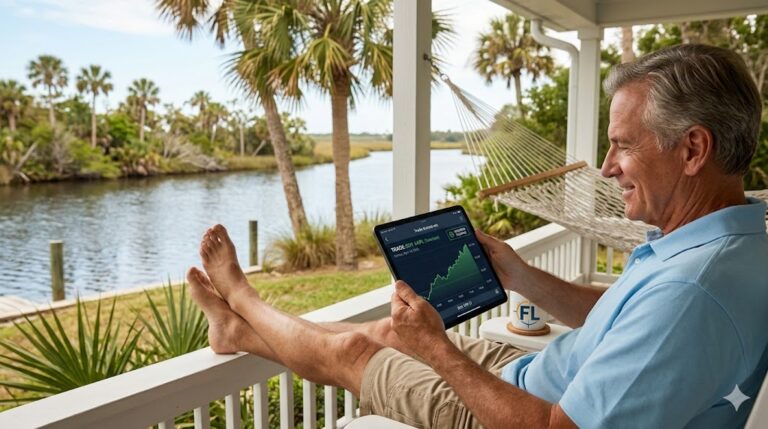
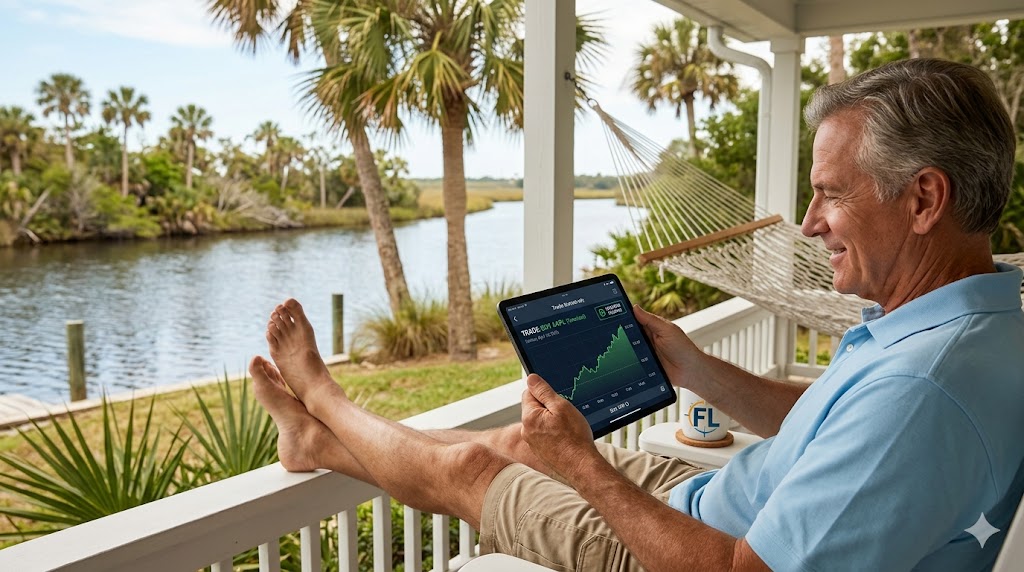
If you’ve ever wished you could buy or sell a stock on a lazy Sunday afternoon — while watching the Dolphins or sitting on your back porch in Citrus Springs — that future is arriving faster than most Floridians realize. Thanks to a technology called tokenization, a small but rapidly growing slice of the stock market now trades 24 hours a day, 7 days a week, and the biggest names on Wall Street are racing to make it the new normal.
What Is a Tokenized Stock?
A tokenized stock is a blockchain-based digital version of a real company’s shares. When you buy a tokenized share of Apple or Tesla, a custodian holds the underlying real stock on your behalf, and you receive a digital token that mirrors its price in real time. You still benefit from price movements — and on some platforms, even dividends — but the token trades on a blockchain rather than through a traditional brokerage.
Because blockchains never close, tokenized stocks can be bought and sold at any hour, including weekends and holidays, when traditional markets are dark. Think of it as your brokerage account without business hours.
The arrival of 24/7 tokenized trading is exactly the kind of slow-moving, structural shift that most financial media misses entirely — drowned out by the noise of daily market swings and political headlines. If you want to understand why the signals that actually reshape your financial future rarely make breaking news, our deep-dive into why transformative technology shifts get buried under noise — and how to spot the real ones is essential reading for any serious long-term investor.
Which Stocks Are Already Tokenized?
Several platforms are already offering tokenized trading of some of America’s most recognized companies. Crypto exchange Kraken now offers what it calls “xStocks” — tokenized versions of top U.S. equities and ETFs, including shares of the S&P 500, Amazon, and Tesla, tradeable 24 hours a day on weekdays, with weekend trading in development. When withdrawn to a personal crypto wallet, xStocks can already be traded on-chain around the clock.
Robinhood, meanwhile, has already rolled out 24/7 tokenized stock trading for customers in Europe, and its CEO has publicly framed the old five-day trading week as a temporary limitation that will soon seem as outdated as not being able to trade on your phone.
Even the biggest institutions are moving. The New York Stock Exchange — yes, the NYSE itself — announced in January 2026 that it is building a tokenized securities platform capable of 24/7 operations, instant settlement, and stablecoin-based funding. The platform, pending regulatory approval, is designed to allow tokenized shares that are fully fungible with traditionally issued securities. Nasdaq filed similar plans with the SEC to begin tokenized trading in 2026. The Depository Trust and Clearing Corporation (DTCC), which clears roughly $100 trillion in assets annually, has stated its long-term ambition is to tokenize its entire catalog.
For Florida retail investors, this is a meaningful development. Whether you’re working a night shift in Tampa, managing a vacation rental in Destin, or retired in The Villages, you’ll no longer need to be sitting at a computer at 9:30 a.m. Eastern to participate in the market.
The same technology-driven disruption reshaping how stocks are traded is simultaneously dismantling one of the most profitable advertising models in history — and Florida businesses are caught in the middle. Our analysis of how AI is eroding Google’s $237 billion search advertising empire reveals why every business owner and investor needs to understand the platform shift now underway across the entire digital economy.
A Word of Caution
Tokenized stocks are still an evolving space, and Florida investors should understand the differences from traditional brokerage accounts. Most tokenized stocks today are structured so that you hold price exposure — meaning you don’t have voting rights or the same legal protections as a direct shareholder. Platforms also carry their own risks, including custodian trust and platform security. Regulatory clarity is improving rapidly, with the GENIUS Act of 2025 establishing the first federal framework for stablecoins and further legislation advancing through Congress — but the rules are not yet complete.
As always, Floridians should do their research or consult a financial advisor before moving money onto any new platform.
Understanding which risks are real — and which are emotional noise — is a crucial skill for any investor considering emerging platforms like tokenized stocks. Florida investors who want to sharpen their risk-assessment instincts will find deep value in our deep-dive on how negativity bias quietly kills profitable opportunities for Florida investors — and how to recalibrate your thinking before it costs you.
The Bigger Picture: Tokenizing the Entire World
Tokenized stocks are just the tip of the iceberg. The same blockchain technology that lets you trade Apple shares on a Sunday morning is being applied to nearly every asset class imaginable — and one company is positioning itself at the center of it all.
Fine Art: Fractional ownership of blue-chip art — works by Picasso, Basquiat, or emerging artists — is now accessible through tokenization platforms. Instead of requiring millions of dollars to own a painting, you can purchase a fractional token representing a verified share of a physical artwork, stored in a certified vault, and potentially earn a return if it appreciates or is sold.
Luxury Real Estate: Platforms like RealT and others are tokenizing U.S. rental properties into fractional shares starting as low as $50, with investors receiving daily stablecoin dividends from rental income. Deloitte projects $1 trillion in tokenized private real estate funds by 2035. BCG estimates tokenized real estate could swell to $3.2 trillion by 2030. For everyday Floridians who can’t afford a $400,000 investment property, this opens the door.
Sports Wagering and Prediction Markets: Even the betting world is being tokenized. Prediction market platform Kalshi now allows bettors to buy and sell tokenized versions of their wagers on the Solana blockchain. That means a wager isn’t just a bet — it’s a tradeable asset you can sell before an event concludes if the odds move in your favor. Decentralized sportsbooks let you bet peer-to-peer with smart contracts settling payouts automatically, cutting out the middleman entirely.
Bonds and Treasuries: Tokenized U.S. Treasury funds are already live, with the market growing to nearly $8 billion in 2025 — more than tripling in a single year. These give investors on-chain access to yield-bearing government instruments with near-instant settlement.
The scale of these numbers becomes even more striking when you understand the economic gravity Florida already commands on the global stage — this is not a regional market watching global trends from a distance. Our data-driven breakdown of Florida’s $1.7 trillion economy and its position among the world’s top 15 national GDPs provides the full picture of why international investors, institutions, and fintech disruptors are all converging here.
The $75 Trillion Opportunity
The numbers being floated by analysts are staggering. Boston Consulting Group estimates tokenized assets could reach $16 trillion by 2030. Citi projects stablecoins alone could be worth $4 trillion by the end of the decade. BCG and Ripple together project tokenized assets could approach $19 trillion by 2033. Some broader estimates, incorporating everything from private credit to infrastructure to commodities, suggest $75 trillion or more in real-world assets could be tokenized over the next decade.
To put that in Florida terms: the entire GDP of the United States is roughly $30 trillion. What’s being described is a financial revolution that would move more value onto digital infrastructure than exists in the entire U.S. economy.
We are, almost certainly, in the first inning.
Tokenization is just one pillar of a much broader technology-driven wealth wave already reshaping who gets rich in the coming decade. Industry futurists Peter Diamandis, Salim Ismail, and Dave Blundin have argued that AI-driven wealth creation in Florida is outpacing any prior economic shift in history — and their insights reveal exactly where Sunshine State investors should be positioning themselves right now.
How to Own a Piece of It: The Case for Circle (CRCL)
For Floridians who want to invest in the tokenization wave itself — not just in individual tokenized assets — one publicly traded company stands out: Circle Internet Group (NYSE: CRCL).
Circle is best known as the issuer of USDC, the world’s largest regulated digital dollar stablecoin. Think of USDC as the oil that keeps the tokenization engine running. When someone buys a tokenized stock, a tokenized piece of real estate, or a tokenized Treasury fund, they almost always need a stable digital currency to settle the transaction. USDC is that currency — and as of late 2025, it has supported over $70 trillion in cumulative on-chain settlement, with nearly $12 trillion flowing through in just the final quarter of 2025 alone.
For investors new to platforms like tokenized stocks or USDC-settled instruments, the smartest posture isn’t to wait for perfect information — it’s to experiment small, learn fast, and build knowledge through direct experience. Our guide to using the fail-fast strategy to build investment confidence with minimal downside outlines exactly how smart Florida entrepreneurs approach unfamiliar platforms: with low-cost pilots, rapid iteration, and a clear-eyed view of what real failure actually costs.
Circle went public on the NYSE in June 2025, pricing its IPO at $31 a share. It opened at $69 — a 123% premium on day one — and at one point traded as high as $103. As of April 2026, CRCL trades around $88, with a market capitalization of roughly $21 billion.
But Circle is far more than a stablecoin company. It has built what it calls “Arc,” an enterprise-grade blockchain purpose-built for bringing real-world financial activity on-chain. The Arc testnet launched in October 2025 with over 100 major institutional partners already participating — including BlackRock, Visa, HSBC, Deutsche Bank, State Street, and Mastercard. These aren’t crypto startups experimenting at the margins. These are the foundational pillars of global finance, building on Circle’s infrastructure.
Circle also recently acquired Hashnote, the issuer of USYC — a tokenized U.S. Treasury money market fund now available on multiple blockchains including Solana, Ethereum, and Base. USDC is currently natively supported on 28 separate blockchain networks and counting.
The company earns revenue primarily from interest on the tens of billions of dollars held in its USDC reserves — invested in short-term U.S. Treasuries — plus growing fees from its Circle Payments Network, which allows financial institutions to settle directly with each other using stablecoins. As the tokenized economy grows, every dollar of new asset value that moves through blockchain infrastructure is a potential revenue opportunity for Circle.
Analysts at Baird have maintained an Outperform rating on CRCL with a price target of $138. Mizuho’s analyst has a Neutral stance with a target of $120. The stock has been volatile, as all fintech plays are, and investors should understand that Circle’s revenue is sensitive to Federal Reserve interest rates as well as the competitive stablecoin landscape.
But the strategic position is hard to ignore. Circle is not just riding the tokenization wave — it is building the pipes the wave flows through.
Circle’s infrastructure ambitions place it alongside some of the most consequential financial institutions ever built — and that scale matters more when you understand which Florida-headquartered companies already anchor the state’s investment landscape. Explore our breakdown of the largest publicly traded Florida companies by market capitalization to see how homegrown giants like NextEra Energy and Raymond James compare to the fintech disruptors entering their space.
The Bottom Line for Florida Investors
Tokenization is not a distant concept. It is happening right now, and it is accelerating. The NYSE and Nasdaq are both building 24/7 platforms. Stablecoins are receiving their first federal regulatory framework. Institutions from BlackRock to HSBC are testing on-chain infrastructure. Art, real estate, wagering, stocks, and bonds are all moving onto blockchains.
The International Monetary Fund published a note just last week calling tokenization not a marginal efficiency upgrade, but a “fundamental reconfiguration” of how the global financial system operates.
For Florida investors — whether you’re a retiree in Naples, a contractor in Gainesville, or a small business owner in Ocala — this shift offers something genuinely new: the ability to invest in more assets, at any hour, with lower fees and faster settlement than ever before.
The question isn’t whether tokenization will reshape finance. The question is whether you’ll be positioned for it when it does.
While tokenization opens exciting new asset classes, the quiet engine underneath long-term wealth building for most Floridians remains disciplined, systematic market participation. Our detailed analysis of how systematic investing fuels Florida wealth through recurring market contributions explains why structured dollar-cost averaging remains the most reliable foundation — and how newer tools like tokenized assets can complement, not replace, that bedrock strategy.
This article is for informational purposes only and does not constitute financial advice. All investments carry risk. Consult a licensed financial advisor before making investment decisions. Circle (CRCL) stock and tokenized assets are subject to market volatility and regulatory changes.
About the Author