By Brian French | April 15, 2026
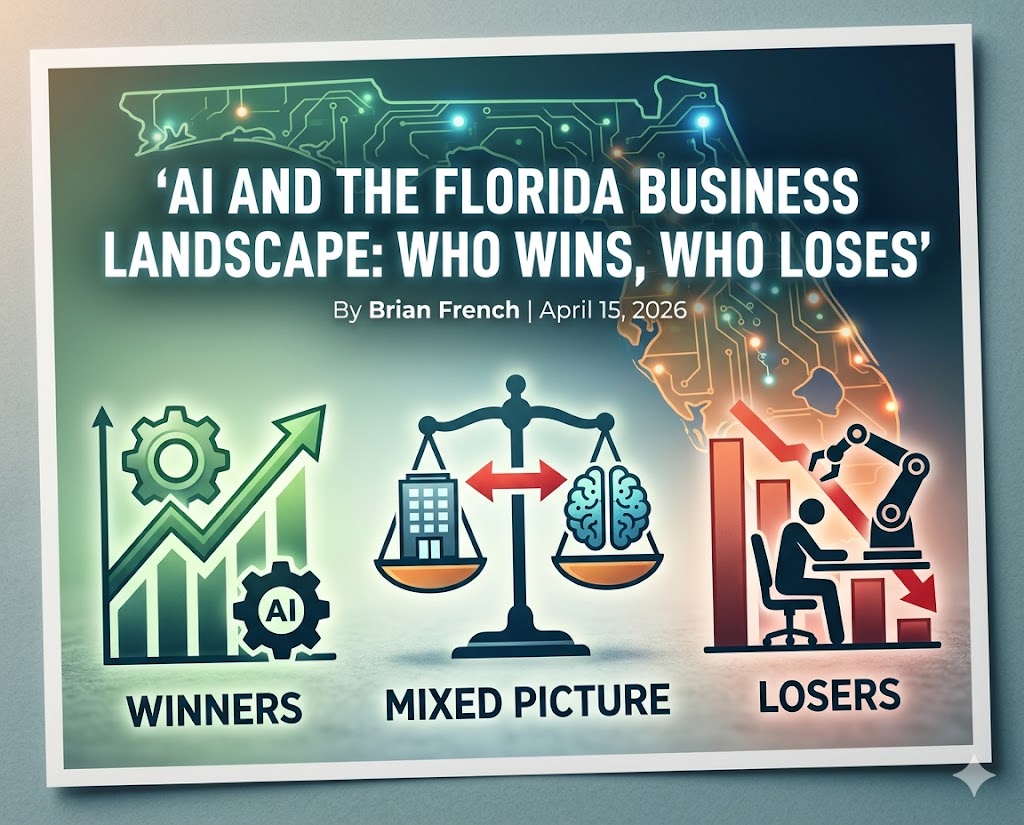
AI and the Florida Business Landscape: Who Wins, Who Loses, and What Every Owner Needs to Decide Right Now
The unfiltered guide to artificial intelligence for Florida business owners — the opportunities are real, the risks are real, and the time to act is shorter than most people think
Stop Waiting for Clarity That Is Never Coming
Here is the honest truth about AI and Florida business in 2026: no one can give you a perfectly clean picture of what the next decade looks like. The data is genuinely conflicting. The Federal Reserve Bank of Dallas says AI is unlikely to take significant numbers of jobs in the next ten years. The CEOs of the world’s largest companies say millions of jobs will be gone soon. Goldman Sachs reported that AI had zero measurable impact on U.S. GDP in 2025 despite $410 billion in investment. Meanwhile, Deloitte found that organizations deploying AI seriously are reporting returns three times higher than slow adopters.
Contradictions like these are not evidence that AI is overhyped. They are evidence that AI is a capability multiplier, not a guaranteed outcome — and that the difference between a company that wins from it and a company that gets hurt by it is almost entirely determined by the choices the owner makes.
For Florida business owners, the question is not “Will AI change my industry?” It will. The question is: “Which side of the line will my business be on when it does?”
This guide answers that question with specificity — identifying which Florida industries and business types are positioned to gain the most, which face the most serious structural threats, and what practical moves separate the winners from the losers in each case.
The Only Framework That Matters: Adaptation Speed Wins, Not Industry
Before getting into sector-by-sector analysis, one finding from the current research deserves to be stated plainly because it reframes the entire conversation.
The AI transition will not sort winners and losers by industry. It will sort them by adaptation speed within every industry.
This is the counterintuitive insight that both the doomsayers and the dismissers consistently miss. There will be winning law firms and losing law firms. Winning restaurants and losing restaurants. Winning real estate agencies and losing real estate agencies. The winners and losers will not be sorted by what sector they are in — they will be sorted by whether they moved with intelligence and speed or waited until competitive pressure made adaptation urgent and expensive.
Previous technology transitions gave workers and businesses decades to adapt. The internet disrupted publishing over fifteen years — enough time for editors to shift to digital platforms, for new content channels to develop, for markets to evolve. The AI transition is compressing that window from decades into years. ChatGPT launched in November 2022. By 2025, it was affecting hiring decisions across most knowledge-work sectors. That is a two-to-three-year transition window, not a twenty-year one.
For Florida business owners, that compression is the single most important strategic fact about the current moment. The window for early-mover advantage is not infinite. It is measured in years, not decades.
The Big Picture: What the Numbers Actually Say in 2026
Before the winners-and-losers breakdown, ground yourself in the current state of the market.
AI-related job postings are now 134 percent above 2020 levels. Forty percent of employers anticipate reducing workforce size where AI automates tasks in 2026. But AI is simultaneously projected to create 170 million new roles globally by 2030.
AI will augment 20 percent of all U.S. jobs by 2026, creating a net positive of 12 million new roles globally even as 10.4 million roles face displacement by 2030. Healthcare firms now view AI as a core operational requirement at a 94 percent rate. AI use in financial services more than doubled in a single year, jumping to 72 percent adoption as financial leaders prioritize AI-driven forecasting and risk management.
Morgan Stanley’s research economists examined five major innovation waves in U.S. history — from the Industrial Revolution to the internet — and found a consistent pattern: innovation waves are disruptive, capital-intensive, and often volatile. They displace workers and concentrate gains early. But over time, they raise productivity, restructure labor markets, expand output, and improve living standards broadly.
The historical record is reassuring about the long arc. It is sobering about the transition. Both things are true simultaneously, and Florida business owners need to plan for both.
The Clear Winners: Florida Industries and Business Types Positioned to Gain
Winner: Florida’s Healthcare System
Florida’s healthcare sector — anchored by the Miami Health District (the second-largest medical district in the United States), more than 2,900 life science companies, and a patient population that skews older and therefore more medically complex than most states — is positioned to extract more value from AI than almost any other industry in the state.
The math is simple. AI applications in healthcare can generate up to $150 billion in annual savings for the industry by 2026. AI-powered imaging solutions are expected to prevent up to 2.5 million diagnostic errors annually. In organizations that have deployed AI clinical assistants, providers have seen a 42 percent reduction in documentation time, saving approximately 66 minutes per provider per day.
Sixty-six minutes per provider per day. For a Florida medical practice with ten physicians, that is more than 600 hours of recovered clinical capacity per month — capacity that can be redirected to patients rather than paperwork.
The specific wins for Florida healthcare businesses include ambient documentation that transcribes and files patient encounters in real time, predictive triage models that identify deteriorating patients before they reach crisis, AI-assisted diagnostic imaging that flags anomalies for physician review, and automated prior authorization workflows that currently consume enormous administrative labor in Florida’s complex payer landscape.
What separates winning healthcare businesses from losing ones: The winners are deploying AI to eliminate administrative burden on clinical staff and redirect that capacity to patient care. The losers are either ignoring AI entirely or running disconnected pilot programs that never integrate into actual clinical workflows. The middle is disappearing fast — half-implemented AI projects are generating cost without benefit.
Winner: Florida Real Estate — Specifically Investors, Developers, and Tech-Forward Agents
Florida’s real estate market, which ranked second nationally for commercial investment attractiveness in 2025, is entering an era where AI competency becomes a direct competitive differentiator in deal-making speed, underwriting accuracy, and client acquisition efficiency.
For real estate investors and developers, AI-powered market analysis now processes permit activity, population migration data, zoning history, comparable transaction records, and demographic trend data across Florida’s fragmented regional markets simultaneously — producing site selection intelligence that previously required teams of analysts weeks to compile. A developer evaluating opportunities across Tampa Bay, the Space Coast, and Southwest Florida can run AI-assisted comparative underwriting across all three markets before a competitor finishes their first spreadsheet.
For agents and brokers, AI is not replacing expertise — it is amplifying it. Contract review AI flags non-standard terms and missing provisions in seconds. AI-powered CRM systems identify which leads are most likely to transact based on behavioral signals, allowing agents to focus human attention where it matters most. Virtual staging eliminates a meaningful per-listing cost while accelerating time-to-market on vacant properties.
What separates winning real estate businesses from losing ones: The winners are using AI to process more opportunities with less overhead, closing the productivity gap between boutique operators and institutional players. The losers are the agents and small firms treating AI as a threat to their expertise rather than a multiplier of it — and losing listing presentations to competitors who can demonstrate data-driven market analysis that feels superior even when the underlying human judgment is equivalent.
Winner: Florida-Based Technology and Cybersecurity Companies
Florida’s artificial intelligence sector continues its rapid expansion in 2026, fueled by Miami’s emergence as a tech hub, strong venture capital interest, and demand for custom AI solutions across industries including cybersecurity, healthcare, finance, and defense. Startups like Cast AI in cloud cost optimization, Togal.AI in construction estimation, and Worth AI in inclusive financial underwriting represent the innovative edge of Florida’s AI ecosystem.
Tampa specifically has emerged as a nationally recognized cybersecurity hub — a positioning that is becoming more economically valuable every year as AI makes cyberattacks faster, cheaper, and more sophisticated while simultaneously creating demand for AI-powered defenses. ReliaQuest, Simform in Orlando, and the constellation of firms forming around USF’s Bellini College of Artificial Intelligence, Cybersecurity and Computing are building businesses that did not exist five years ago and that will be worth substantially more five years from now.
Florida’s competitive advantage in this space — lower operating costs than Silicon Valley or Boston, no state income tax, strong international talent access through Miami’s multilingual workforce, and proximity to Latin American markets — makes it structurally attractive for AI-focused businesses to locate and scale here.
What separates winning tech businesses from losing ones: The winners are building IP and workflow expertise around specific, high-value AI applications rather than offering generic “AI services.” The losers are commoditizing themselves by competing on price for implementation work that will increasingly be performed by AI itself.
Winner: Construction Trade Businesses That Adopt AI Back-End Tools
Florida’s construction sector — serving one of the country’s most active building markets — faces something unusual in the AI transition: the physical work is nearly immune to automation while the business operations are highly automatable. That asymmetry creates a pure advantage for contractors willing to deploy AI in the right places.
Construction estimation firm Togal.AI, built in Florida, exemplifies what is happening: AI-powered takeoff and estimation tools are reducing bid preparation time by 80 percent or more on standard commercial and residential projects. AI-assisted permitting platforms are identifying regulatory requirements and potential objections before applications are filed, reducing costly delays. Project management platforms with predictive scheduling are flagging subcontractor conflicts and material delays before they hit the job site.
For Florida contractors, this is a pure productivity gain with no downside risk to their core skilled labor workforce. The humans who pour concrete, frame walls, and install mechanical systems are not going anywhere. The estimators who spend three days building a bid manually are facing a choice about whether to adapt.
What separates winning construction businesses from losing ones: The winners are using AI to bid faster and more accurately than competitors, protecting margins through better cost visibility, and freeing estimators for relationship development and value engineering rather than spreadsheet work. The losers are bidding the same way they did in 2020 against competitors who are bidding faster, cheaper, and more precisely.
Winner: Small and Mid-Sized Florida Businesses That Move First in Their Category
This may be the most underappreciated dimension of the AI opportunity in Florida. AI will augment 20 percent of all U.S. jobs by 2026, but the distribution of that augmentation is not uniform. The businesses capturing the most productivity from AI are not primarily large enterprises — they are the organizations that moved early and deliberately within their specific category.
A five-person accounting firm in Jacksonville that deploys AI bookkeeping, anomaly detection, and client communication tools this year will be able to serve 30 to 40 percent more clients by next year with the same headcount. Its competitor across town that waits another eighteen months will face a client acquisition environment where the early-mover has lower costs, faster delivery, and more capacity for complex advisory work — and that gap will be very difficult to close.
The same dynamic applies to marketing agencies, law firms, insurance agencies, financial advisors, staffing companies, and virtually every professional services category in Florida. First mover advantage within a local category compounds rapidly, and 2026 is the year when that compounding is starting to become visible in competitive outcomes.
The Clear Losers: Florida Industries and Business Types Facing Structural Threat
Loser: Independent Insurance Agents Focused on Commodity Lines
No segment of Florida’s business community faces a more precisely quantified, more immediately actionable threat from AI than the independent insurance agent selling standard personal and small commercial lines.
Bank of America analysis identified over $15 billion in commissions paid to independent agents by just six major carriers in 2025, concentrated in low-complexity risks like standard home and auto insurance. The BofA report stated that large language model digital agents can effectively do a non-immaterial portion of the work currently provided by 20,000 to 30,000 independent agents across the United States. Munich Re’s Next Insurance already offers an AI chatbot on its site where customers can purchase and bind commercial policies directly without a human agent involved.
BofA drew a sharp distinction from the slow-moving autonomous vehicle disruption: while transitioning to self-driving cars requires trillions in infrastructure and decades of timeline, deploying large language model chatbots is cheap, easy, and happening right now.
Florida is one of the highest-insurance-cost states in the country due to hurricane exposure and litigation environment — meaning it has an unusually large base of commodity insurance transactions, an unusually high volume of policy renewals and comparisons, and an unusually transactional relationship between many policyholders and their agents. All of those characteristics accelerate the threat.
What separates surviving insurance agencies from disappearing ones: The survivors are moving aggressively up the complexity ladder — toward commercial insurance, specialty lines, high-net-worth clients, and the advisory relationships where human judgment and trust justify premium pricing. The agencies that remain dependent on commoditized personal auto and homeowners transactions for their revenue base are running out of time to pivot.
Loser: Entry-Level Administrative and Clerical Roles Across All Industries
Administration faces the highest exposure of any job category, with 26 percent of roles at risk from AI automation. Customer service roles rank second, with 20 percent at risk as chatbots and AI assistants increasingly handle frontline interactions.
For Florida, this matters more than in most states because the service economy employs a disproportionately large share of the workforce in exactly these roles. The administrative coordinator, the data entry specialist, the customer service representative handling routine inquiries, the paralegal performing document review, the junior analyst producing standard reports — these are the roles disappearing fastest and being replaced slowest.
Many firms see fewer entry-level positions as AI tools handle basic tasks that newcomers used to do. Companies that previously hired junior employees to build their way up through basic task mastery are rethinking that entry path entirely.
The Florida businesses most exposed to this transition are those that have large administrative support functions — insurance back-offices, healthcare billing departments, legal support staff, real estate transaction coordinators, and corporate administrative teams across every industry.
What separates businesses managing this transition well from those managing it poorly: The winners are redeploying administrative capacity toward client-facing relationship work, quality oversight of AI outputs, and complex problem-solving that requires genuine judgment. The losers are either ignoring the transition until it creates sudden operational disruption or handling it so clumsily — mass layoffs without reskilling investment — that they damage employee morale across the entire organization.
Loser: Florida Businesses Investing in AI Without Measuring Outcomes
Companies are laying off workers because of AI’s potential — not its performance. The job losses and slowed hiring are real even though companies are still waiting for generative AI to deliver on its promises. This strategy of focusing on short-term gains based on long-term hopes has real costs.
Insurance companies and other businesses that have deployed AI are seeing 30 to 40 percent productivity gains in claims and underwriting operations — but the difference is not technological access. Every company can buy the same models and platforms. The difference is approach: workflow-first deployment with governance built in versus model-first pilots with integration as an afterthought.
A substantial percentage of Florida businesses spending money on AI right now fall into the second category. They have subscriptions to AI tools that are underused. They have conducted pilot programs that never moved to production. They have executives who cite AI adoption in communications while actual operations remain unchanged. This is not winning from AI. It is paying for the appearance of modernity while competitors who are doing AI with discipline and measurement pull ahead.
What separates productive AI investment from wasteful AI investment: The winners define specific outcome metrics before any AI implementation begins — time saved, error rate reduced, revenue generated, cost eliminated. They measure those metrics rigorously before and after deployment. The losers run AI initiatives with vague goals like “improve efficiency” and have no way to determine whether the investment paid off.
Loser: Florida Businesses That Ignore New AI-Related Insurance Liability
This is a risk that most Florida business owners have not yet encountered — and that is precisely why it belongs in a losers section.
The Insurance Services Office introduced new optional endorsements in 2026 — CG 40 47 and CG 40 48 — creating generative AI exclusions under commercial general liability policies. These exclusions allow insurers to deny coverage for claims tied to generative AI outputs, including defamatory content, intellectual property infringement from AI-generated material, and physical damages traceable to AI-driven errors. Small to mid-sized firms, often without specialized coverage, may be hit hardest.
Florida businesses that are using AI tools to generate marketing copy, draft contracts, produce customer-facing communications, or automate decisions that affect third parties are operating under commercial insurance policies that may now contain explicit exclusions for liability arising from those AI outputs. Most of those businesses do not know this.
What separates protected businesses from exposed ones: The winners have reviewed their commercial general liability policies with a broker who understands these new exclusions and have either secured affirmative AI coverage through tech errors and omissions policies or cyber liability products, or have implemented governance frameworks that reduce their exposure. The losers are one AI-generated defamation claim or copyright infringement lawsuit away from discovering their standard policy does not cover it.
The Mixed Picture: Industries Where It Genuinely Depends on What You Do
Hospitality and Tourism: Massive Opportunity, Real Displacement
Florida’s tourism economy — responsible for hundreds of billions in annual economic activity — sits in a genuinely complex position in the AI transition.
The opportunity is substantial. AI-powered revenue management, dynamic pricing, guest personalization, and marketing attribution are delivering measurable competitive advantages to hotels, resorts, and attractions that deploy them well. Visit Florida and the state’s destination marketing organizations are using AI to track how specific campaigns influence actual visitor behavior in ways that were previously impossible — making every marketing dollar more accountable.
The displacement is also real. Automated check-in kiosks, AI-powered phone systems handling reservations and guest inquiries, and intelligent scheduling tools are reducing the labor intensity of hotel operations at the entry level. In a state where hospitality jobs represent millions of positions, this is not a theoretical concern.
The distinguishing factor: Florida hospitality businesses that invest in training their existing workforce to operate alongside AI tools — rather than treating AI purely as headcount reduction — will maintain service quality advantages that tech-only competitors cannot replicate. The human warmth and contextual judgment of experienced hospitality staff remain genuinely valuable. The question is whether those staff members are empowered by AI or simply waiting to be replaced by it.
Legal Services: Profound Efficiency Gains, Uncertain Revenue Model
Global legal technology spending is projected to reach $50 billion by 2027, fueled by agentic AI, automation, analytics, and secure cloud services. AI adoption in the legal function has had a significant or transformative impact in 51 percent of firms surveyed by KPMG. AI-powered legal research tools have cut research-related hours by 60 percent in documented case studies, with attorneys gaining more time for client-facing strategic work.
For Florida’s large legal market — concentrated in Miami, Orlando, Tampa, and Jacksonville — this creates a paradox. Law firms that deploy AI well will serve more clients with the same attorneys. But the traditional billing model that charged by the hour for work AI can now do in seconds is under direct pressure. The firms that figure out how to reprice their value around judgment and strategy rather than time and volume will capture enormous market share. The firms that try to bill AI-assisted work at the same hourly rate as manual work will lose clients to competitors who pass the efficiency gains on.
The distinguishing factor: Law firms in Florida that shift their value proposition toward strategic counsel, relationship management, and complex judgment — and price accordingly — will emerge from the AI transition stronger. Firms that remain primarily transaction-volume businesses built on routine document work face genuine revenue compression as AI makes that work faster and cheaper across the entire market.
The Five Moves That Separate Florida Winners From Losers Right Now
Move 1: Audit your business for where AI reduces cost fastest. Document repetitive, rule-based tasks in your operation — every form that gets filled out the same way every time, every email that gets drafted with the same structure, every report that compiles the same data sources weekly. These are your fastest AI wins, and they fund the harder transformations that follow.
Move 2: Stop running disconnected pilots and start deploying integrated workflows. The pattern across industries is consistent — lots of pilots, limited production, minimal P&L impact. The difference between companies getting 30 to 40 percent productivity gains and those getting nothing is workflow-first deployment with governance built in versus model-first pilots with integration as an afterthought.
Move 3: Review your commercial insurance coverage for AI exclusions immediately. This is not optional. The new ISO endorsements took effect in 2026 and your current broker may not have raised them. If you are using AI to produce any customer-facing content or make any consequential decisions affecting third parties, you need to understand your coverage position before a claim arises.
Move 4: Invest in your team’s AI competency before the competitive gap widens. The productivity difference between AI-literate employees and AI-illiterate ones is already measurable and growing. Florida has accessible, low-cost options — including free microcourses from USF’s Bellini College — that can build foundational AI skills across a workforce without significant investment. The organizations that train their teams now will have compounding advantages over those that wait.
Move 5: Decide which side of the disruption you want to be on in your specific category. Every Florida business operates in a competitive landscape where AI is going to tilt the playing field. The question for every owner is whether to tilt it in your favor or against you. That decision does not require a complete technology overhaul. It requires clarity about which one or two AI applications would create the most meaningful competitive advantage in your specific business — and then moving on them with discipline and measurement rather than hesitation and hope.
The Honest Assessment: What Florida Business Owners Should Believe
The story of AI and Florida business is not a story of inevitable destruction or automatic salvation. It is a story about speed, specificity, and nerve.
The employment gains from AI and the data center buildout dwarf the displacement effects from automation. Technology has no impact on overall employment in the moderate to long term. The United States has consistently maintained full employment even in the face of technological disruption, setting aside cyclical downturns.
But that historical truth about aggregate employment does not protect any individual business from competitive disruption. The print advertising market was intact in aggregate for decades as digital advertising grew — and then it collapsed. Travel agencies thrived for years after online booking existed — and then most of them did not. The pattern is not mass destruction all at once. It is gradual competitive erosion that accelerates into sudden structural change.
Florida’s business community has every structural advantage needed to win in the AI era: favorable tax environment, growing talent infrastructure, diverse industries, a massive service economy generating rich data, and a business culture that attracts aggressive entrepreneurial energy from across the country and around the world.
None of those advantages translate automatically into AI success. They are the raw materials. What a business owner does with them over the next three to five years is the only variable that determines which side of the line they end up on when the transition completes.
The winners will not be the biggest businesses or the most technologically sophisticated ones. They will be the most deliberately adaptive ones. In Florida, in 2026, that is still a choice you get to make.
This guide was independently researched using publicly verified sources including Morgan Stanley, BCG, Deloitte, PwC, Bank of America research, the Information Technology and Innovation Foundation, Federal Reserve economic research, McKinsey Global Institute, Gartner, Datarails, Fortune, Harvard Business Review, and current Florida business media. All statistics and projections are as of April 2026 and represent directional guidance, not financial or legal advice. Consult qualified advisors before making significant business technology investments.
About the Author

About Brian French
Led by a commitment to tech-intelligent curation, Brian French tracks and analyzes the Business News in Florida including corporate developments and breaking news defining Florida's economy. Brian brings an extensive financial background to his analysis, having graduated from the University of South Florida in Finance and serving as a Vice President and Portfolio Manager for Merrill Lynch Private Investors and the Trust Department in St. Petersburg, FL, as well as a Vice President and Trust Investment Officer for SunTrust Bank in Sarasota, FL. His writing blends macroeconomic trends, fiduciary capital markets, corporate strategy, and modern digital insights for a sophisticated look at Florida's business economy.