THE INVISIBILITY TAX: Why Florida Businesses Are Starving in a Land of Plenty
Let’s stop sugarcoating the reality of Florida’s economic landscape. Florida has one of the most dynamic, fast-growing, and cash-rich economies on the planet. Millions of new residents are moving in, capital is flowing across every county line, and consumer demand is at an all-time high. Yet, walk through any commercial corridor from Miami to Pensacola, and you will see a quiet, devastating carnage. Storefronts change hands every twelve months. B2B service firms plateau and suffocate. Promising digital brands vanish into the algorithmic ether.
When you ask the failed founders what went wrong, they give you a laundry list of respectable excuses:
- “The cost of capital went too high.”
- “We couldn’t hire reliable people to scale our delivery.”
- “Inflation squeezed our margins until we couldn’t breathe.”
- “A competitor moved in down the street and undercut our pricing.”
Every single one of those answers is a symptom, not the disease. The real reason these businesses bled out and died is simple, brutal, and entirely self-inflicted: They paid the Invisibility Tax. They built a business, perfected their craft, optimized their operations, and then committed the ultimate corporate sin—they treated marketing as an afterthought.
In the modern marketplace, treating marketing as an optional administrative expense isn’t just conservative business management; it is corporate suicide. If you want to survive, grow, and build an asset that actually possesses enterprise value, you have to throw out the legacy playbook. You must accept a fundamental truth: Once you possess a viable product or service, your primary job is no longer delivery. Your primary job is marketing.
THE DELUSION OF THE “BETTER MOUSETRAP”
The absolute most dangerous lie ever whispered into the ear of an entrepreneur is the classic quote attributed to Ralph Waldo Emerson: “If a man can write a better book, preach a better sermon, or make a better mousetrap than his neighbor, though he builds his house in the woods, the world will make a beaten path to his door.”
It is a beautiful, romantic, and profoundly stupid piece of advice.
In the real world, if you build a better mousetrap in the middle of the woods, you will die in those woods, surrounded by high-quality inventory, completely broke. The world does not beat a path to the door of the best; the world beats a path to the door of the most visible.
    THE FALSE PATH vs. THE REALITY ENGINE

    [ False Path ]
    Quality Product ──> Customer Appears (Mythical)

    [ Reality Engine ]
    Quality Product ──> Hyper-Aggressive Marketing ──> Visibility ──> Conversion ──> Scale
The Baseline Entry Fee vs. The Growth Driver
Let’s establish a hard boundary right here. Operational excellence, an elite service delivery, and an exceptional product are not marketing strategies. They are simply the baseline entry fees required to get into the stadium. If your product is garbage, marketing will only accelerate your failure by exposing your flaws to the masses faster.
But once your operational delivery is dialed in, its job as a growth engine is effectively over. Keeping your clients happy retains revenue; it does not generate new revenue at scale.
When you shift your internal corporate focus entirely to operations while starving your external visibility, you are essentially declaring that you want to run a secret society, not a market-dominating enterprise. The marketplace does not reward hidden geniuses. The marketplace rewards the companies that capture attention, command authority, and refuse to be ignored.
The Myth of Word-of-Mouth Scaling
“We don’t need to market; our business grows organically through word-of-mouth.”
If you have ever uttered this sentence, you have placed a invisible ceiling over your company’s potential. Word-of-mouth is a phenomenal tool for validation, but it is a horrific mechanism for scale. Why? Because you cannot control its volume, velocity, or direction.
- You can’t turn it up: When you need an influx of cash flow to acquire a competitor or fund infrastructure, you cannot turn a dial to double your word-of-mouth referrals.
- It isolates you to existing networks: Word-of-mouth keeps you trapped inside the echo chamber of your current customer base’s immediate social and professional circles. It completely locks you out of the massive, untapped broader market.
- It builds zero brand equity: Relying on word-of-mouth means your brand value is entirely dependent on the personal relationships of individuals, rather than the institutional power of your trademark.
To scale a business to an eventual multi-million-dollar exit, you must build a predictable, repeatable, and programmatic machine that manufactures customers out of cold traffic. Anything less is just a glorified, highly stressful job.
THE ANATOMY OF A MARKETING MACHINE
To understand why Florida companies fail, we have to look at how they construct their organizations. The average business treats marketing like an isolated department—a couple of junior employees posting aimlessly on social media, an occasional direct mail drop, or a monthly retainer paid to an agency that sends over incomprehensible reports filled with “vanity metrics” like impressions and clicks.
That is not marketing. That is burning cash to feel productive.
True marketing is a highly integrated, continuous infrastructure that dictates every single touchpoint of your corporate existence. It is the connective tissue between your capital, your operational capacity, and the outside world.
+-----------------------------------------------------------------------+
|                    THE THREE CORE PILLARS OF SCALE                    |
+-----------------------------------------------------------------------+
|                                                                       |
|  1. LOCALIZED AUTHORITY      2. PROGRAMMATIC DISTRIBUTION  3. VELOCITY|
|  Dominating search engine    Automated content syndication Continuous |
|  landscapes & answer spaces  across hyper-local networks   budgeting  |
|                                                                       |
+-----------------------------------------------------------------------+
Shift From Expense to Capital Investment
The foundational error occurs on the balance sheet. Most business owners look at marketing as an administrative expense—right next to office supplies, utility bills, and insurance premiums. When a minor economic hiccup occurs or quarterly revenues dip, the very first thing they do is slash the marketing budget.
This is fundamentally backwards. Marketing is not a cost; it is a capital investment in future enterprise value.
When you invest in a piece of real estate, a proprietary software platform, or manufacturing equipment, you don’t look to eliminate it the moment things get tight; you leverage it to generate returns. A properly built marketing apparatus is a digital asset. It is an investment in market share, consumer mindshare, and localized authority. When you cut your marketing spend, you aren’t cutting costs—you are actively liquidating your future pipeline.
The Danger of the Marketing Faucet Mindset
The most common operational rhythm of a failing Florida business looks like a violent, nauseating rollercoaster ride:
    THE FAUCET ROLLERCOASTER

    Revenue High ──> "Too Busy!" ──> Turn Off Marketing ──> Pipeline Dries Up
          ▲                                                           │
          └─────── Turn On Marketing ◄── "We Need Leads!" ◄───────────┘
This “faucet mindset” destroys companies. It takes an immense amount of energy, momentum, and capital to get a brand moving from a dead stop in a competitive market. When you shut the system down because your operations team is at capacity, your visibility instantly begins to decay. By the time the current workload clears and you realize your pipeline is completely empty, you have lost all your structural momentum.
You are forced to expend double the capital just to kickstart the engine from a standstill. A market champion never turns off the machine. If operations are at capacity, you don’t stop marketing—you raise your prices, you hire more delivery staff, or you optimize your fulfillment. You never stop fueling the engine that brought you the success in the first place.
THE MORGAN & MORGAN PARADIGM
If you want to understand what absolute, unyielding commitment to market dominance looks like, you do not need to look at Silicon Valley tech giants or multinational consumer conglomerates. The definitive blueprint for scaling a business via marketing infrastructure sits right here in Florida.
Look at Morgan & Morgan.
Today, they are a corporate colossus: the largest personal injury law firm on the planet, boasting over a thousand attorneys, thousands of support staff, and a multi-billion-dollar operational footprint. But they didn’t drop out of the sky fully formed. They didn’t possess a secret legal formula, and they weren’t backed by sovereign wealth funds at their inception.
John Morgan started exactly like every other struggling, ambitious attorney in Florida: operating out of a modest office, fighting against entrenched competitors, navigating tight cash flows, and trying to win clients one by one.
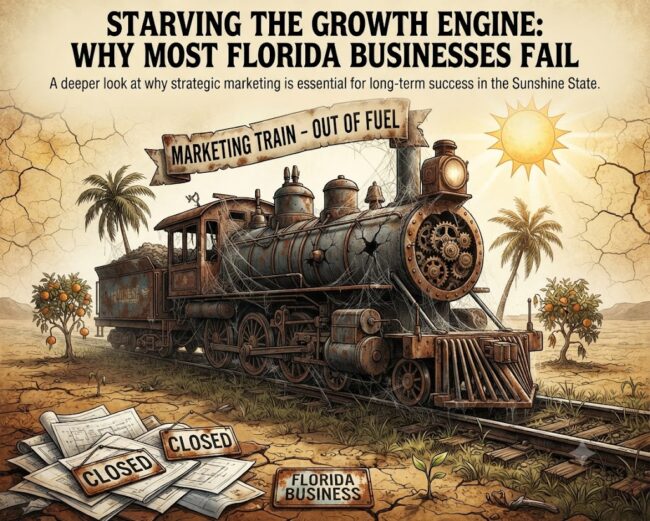
What transformed them from a localized practice into a global powerhouse? It wasn’t a unique legal precedent. It was an institutional realization that nothing stops the marketing train.
The 48-Year Unbroken Line
For nearly five decades, Morgan & Morgan has treated marketing not as a supportive function of their law firm, but as the core engine of their entire enterprise. They understood a reality that terrifies most traditional business owners: To achieve historic scale, you must be willing to accept massive tactical inefficiencies to protect your strategic momentum.
Let’s be entirely clear about their journey: Not every dollar Morgan & Morgan has spent over the last 48 years was productive.
- They have funded massive advertising campaigns that generated a horrific return on investment.
- They have bought billboard space that underperformed and ran television spots that completely missed the target audience.
- They have invested millions into digital strategies that required complete restructuring.
A weak business owner looks at an unproductive marketing campaign and says, “Well, we tried marketing, and it didn’t work. Let’s pull back and protect our capital.”
A marketing champion looks at an unproductive campaign and says, “That specific tactic failed, but our commitment to visibility is non-negotiable. Optimize the message, pivot the channel, and double down.”
Morgan & Morgan didn’t build their empire because they had a flawless psychic ability to predict the future of media. They built it because they refused to touch the brakes. When television emerged as a dominant local medium, they didn’t just buy commercials; they saturated the airwaves. When billboards became a key driver of outdoor attention, they bought whole highways.
The Omnichannel Migration
As the media landscape evolved from analog to digital, Morgan & Morgan executed one of the most aggressive infrastructural pivots in corporate history. They didn’t abandon their legacy channels; they layered new capabilities on top of them, creating an inescapable ecosystem of visibility.
+-----------------------------------------------------------------------+
|                    THE ESCAPE-PROOF BRAND ECOSYSTEM                   |
+-----------------------------------------------------------------------+
|                                                                       |
|     TRADITIONAL OUT-OF-HOME      ──>      DIGITAL SATURATION          |
|     - Highway Billboards                  - Localized Search Dominance|
|     - Broadcast Television                - Answer Engine Optimization|
|     - Sports Stadium Title Rights         - Programmatic Video Avatars|
|                                                                       |
+-----------------------------------------------------------------------+
They moved deep into online marketing, dominating organic search engine results, capturing highly competitive paid keywords, and securing premium sports sponsorships that placed their brand inside the cultural fabric of millions of consumers. They recognized that attention is fluid. If the consumer moves from the television screen to a smartphone screen, or from an organic search result to an AI-generated answer engine response, your marketing apparatus must be waiting for them when they arrive.
The Ultimate Truth of the Market
Here is the most disruptive, uncomfortable truth in business, exemplified by the Morgan & Morgan model:
Morgan & Morgan cannot prove they have the best attorneys in the world… but they can prove beyond a shadow of a doubt that they have the best marketing.
Read that sentence again. It contains the entire secret to corporate scale.
In a perfectly transparent world with infinite consumer information, perhaps the business with the highest absolute technical skill would win. But we do not live in that world. We live in a world of noise, distraction, and limited time. The consumer cannot personally interview every lawyer, every roofer, every accountant, or every software developer in Florida to find the absolute master of the craft.
Instead, the consumer relies on signals of authority, familiarity, and scale. When a consumer sees your brand on their phone, passes it on the highway, hears it on an event broadcast, and finds it at the top of every search result, their brain subconsciously equates that omnipresence with capability.
Visibility creates credibility. Domination creates authority. While your competitors are busy arguing over who has the better technical certification in an empty room, the marketing champion is out in the market, capturing every single client available.
SECTION 4: THE FLORIDA INFRUSTRUCTURAL TRAP
Operating a business in Florida presents a highly unique set of challenges that makes a failure to market even more lethal than in other regional economies. Our state is not a static, predictable market. It is a hyper-dynamic, rapidly shifting economic landscape defined by three distinct forces:
1. High Population Turnover and Explosive Growth
Florida welcomes over a thousand new residents every single day. At the same time, we have a highly transient population moving between counties and out of state.
This means your historical client base is constantly decaying through natural attrition. The people who knew your name five years ago are moving away, retiring, or changing lifestyles. The thousands of new residents moving into your market have absolutely zero historical context for your business. They don’t know your family name, they don’t care about your local legacy, and they aren’t going to ask their neighbors for a referral. They are going to open a device, type a query into a search engine, and hand their money to the company that has built the strongest digital presence.
If you are relying on legacy relationships in a state growing as fast as Florida, you are building your house on shifting sand.
2. Radical Geographic Fragmentation
Florida is not a singular market; it is an archipelago of highly distinct regional economies. Managing a brand in the Tampa Bay area requires a completely different approach than capturing market share in Brickell, Jacksonville, or the rapid growth centers of Southwest Florida.
Too many founders try to scale their operations across these regions without building a localized marketing infrastructure for each specific market. They assume that what worked in their hometown will automatically translate across county lines. It doesn’t. To dominate Florida, you must build a localized authority network that makes your brand look like a native, entrenched leader in every single zip code you target.
3. The Digital Transition and AI Interruption
We are currently living through the most volatile disruption in the history of information distribution: the transition from legacy SEO to Answer Engine Optimization (AEO) and Generative Search.
Consumers are no longer just clicking on a list of ten blue links on a search page. They are asking AI interfaces to find businesses for them: “Who is the most reliable commercial contractor near me?” or “Which probate marketing firm has the highest authority in Central Florida?”
If your marketing strategy is still stuck in 2020—relying on basic keyword stuffing and manual on-page tweaks—you are becoming digitally invisible. Marketing champions are actively restructuring their entire digital presence to ensure that AI models, large language engines, and localized data scrapers recognize their companies as the undisputed, authoritative choice in their respective regions.
HOW TO BECOME A MARKETING CHAMPION
Shifting your company from a vulnerable, operationally obsessed business into an elite marketing machine requires a complete, non-negotiable psychological and structural overhaul. You have to stop playing defense and start playing an aggressive, well-funded game of offense.
+---------------------------------------------------------------------------------+
|                       THE MARKETING CHAMPION BLUEPRINT                          |
+---------------------------------------------------------------------------------+
|                                                                                 |
|   1. ALLOCATE THE ENGINE BUDGET: 10% to 20% of gross revenue, completely frozen |
|                                                                                 |
|   2. DESTROY THE SINGLE-CHANNEL TRAP: Build a multi-layered ecosystem           |
|                                                                                 |
|   3. AUTOMATE WORKFLOWS FOR SCALE: Programmatic syndication, no manual limits   |
|                                                                                 |
|   4. EMPOWER THE VALUATION EXIT: Build customer acquisition as an asset         |
|                                                                                 |
+---------------------------------------------------------------------------------+
Here is the operational framework required to transform your business into a market-dominating powerhouse:
1. Commit to the Immutable Budget
The very first step is to establish a marketing budget that cannot be touched by internal corporate politics, seasonal variations, or operational panic. For a business focused on aggressive growth and building true long-term enterprise value, this budget should represent 10% to 20% of your gross revenue.
This capital must be treated as completely spent the moment the revenue hits your accounts. It is not a pool of emergency funds to be reallocated when an operational expense pops up. It is the fuel for the train. If you cannot afford to invest 10% of your top-line revenue into securing your future pipeline, your business model is fundamentally flawed, your margins are too thin, or your pricing structure is broken. Fix those operational issues immediately, but do not starve the marketing engine to do it.
2. Build Structural Authority, Not Just Campaigns
Stop chasing the short-term high of the next viral video or temporary promotional discount. Focus your capital on building permanent structural authority.
- Acquire and develop a proprietary ecosystem of localized digital assets, niche authority websites, and press syndication networks that protect your industry footprint.
- Optimize your business profile so that it dominates the local map packs, review aggregators, and generative AI search outputs.
- Ensure that when a consumer searches for your industry within your target geography, your brand forms a wall of visibility that completely crowds out your competitors.
3. Leverage Automation and Automated Infrastructure
The old way of marketing required massive, bloated internal teams executing manual, repetitive tasks—writing one-off articles, manually uploading press releases, or spending hours formatting individual web pages. That model doesn’t scale, and it introduces massive human liability into your organization.
Modern marketing champions build automated utility infrastructure. Leverage programmatic distribution, advanced content generation models, automated syndication workflows, and localized news networks to deploy your messaging across dozens of regions simultaneously. Your customer acquisition machine should run entirely on workflows and automated systems that require zero manual intervention from your core delivery staff. This insulates your brand from operational bottlenecks and ensures that your marketing train never runs out of coal.
4. Market for Ultimate Valuation, Not Just Monthly Cash Flow
Every strategic decision you make in your business should be executed with one eye fixed firmly on your ultimate exit strategy. Whether you intend to pass your company down to the next generation, execute a management buyout, or sell out to a private equity firm in three to five years, your valuation is heavily determined by the predictability of your growth.
A sophisticated buyer will not pay a premium multiplier for a business that relies on the owner’s personal reputation, random word-of-mouth referrals, or a manual sales team that could quit tomorrow.
They pay a premium multiplier for infrastructure.
When you can open your corporate hood and show a prospective buyer an automated, high-authority customer acquisition system that programmatically generates high-value leads week after week without owner intervention, you are no longer selling a job. You are selling a high-yield, turn-key asset. Your marketing machine is what transforms your business from a volatile lifestyle play into a valuable institutional asset.
CHOOSE YOUR DESTINY
The Florida economy will continue its relentless expansion with or without you. Thousands of new customers are entering our markets every single week, ready to hand over millions of dollars to businesses that can solve their problems.
You have a definitive, binary choice to make right now regarding the future of your enterprise:
You can continue to play it safe, hiding behind the comfortable shield of “operational focus,” treating your marketing as an administrative cost to be minimized, and hoping that your existing referral networks don’t dry up. You can pay the Invisibility Tax every single month until an aggressive, well-funded competitor moves into your territory and starves you out of the market.
Or you can decide to become a marketing champion.
You can accept the realities of the modern media landscape, fund your acquisition engine with relentless consistency, build an inescapable ecosystem of localized authority, and adopt the uncompromising mindset that nothing stops the marketing train.
Stop letting your business remain Florida’s best-kept secret. Step onto the tracks, fuel the locomotive, and build an enterprise that commands the attention, authority, and value it truly deserves.
About the Author

About Brian French
Led by a commitment to tech-intelligent curation, Brian French tracks and analyzes the Business News in Florida including corporate developments and breaking news defining Florida's economy. Brian brings an extensive financial background to his analysis, having graduated from the University of South Florida in Finance and serving as a Vice President and Portfolio Manager for Merrill Lynch Private Investors and the Trust Department in St. Petersburg, FL, as well as a Vice President and Trust Investment Officer for SunTrust Bank in Sarasota, FL. His writing blends macroeconomic trends, fiduciary capital markets, corporate strategy, and modern digital insights for a sophisticated look at Florida's business economy.