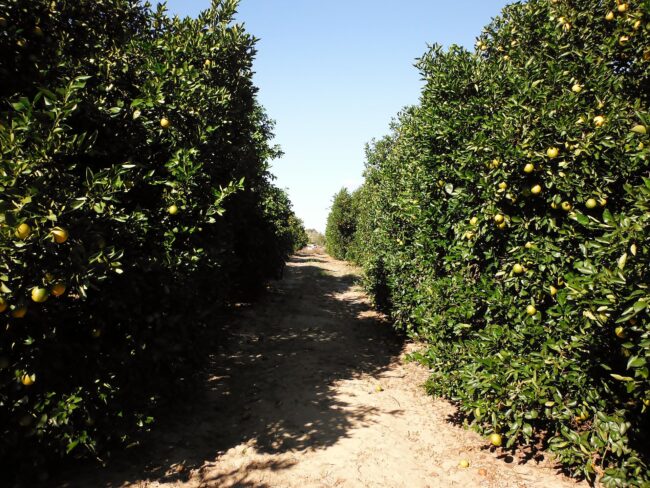
Photo: Mmacbeth via Wikimedia Commons, CC0 1.0 Public Domain Dedication.
Quick Answer: The U.S. Department of Agriculture’s first forecast for Florida’s 2026-27 citrus season, released October 9, 2026, projects 10 million boxes of oranges, down 23% from last season’s 12.95 million. Commercial citrus acreage has fallen to 165,359 acres, 65% below 2016, as freezes, citrus greening and development pressure keep shrinking one of Florida’s signature industries.
Florida’s citrus industry enters the 2026-27 season facing a smaller crop and less land than at any point in modern memory. The USDA’s National Agricultural Statistics Service released its first forecast of the season on October 9, 2026, and the numbers point to another step down after a season that had briefly offered growers some encouragement.
This report examines the forecast, the acreage data behind it, the state and federal money flowing to the industry and the land-use shift underway as major growers exit. It draws on reporting by the Business Observer, Fresh Fruit Portal, FreshPlaza, Florida Trend and WUSF.
What does the USDA forecast for Florida citrus in 2026-27?
The initial forecast calls for 10 million 90-pound boxes of oranges, a 23% decline from the 2025-26 final of 12.95 million boxes. Grapefruit is forecast at 1.3 million 85-pound boxes, down 4% from 1.35 million. Tangerines and tangelos are forecast at 450,000 95-pound boxes, down 2% from 460,000. Lemons are the lone category expected to grow, up 6% from 900,000 boxes last season.
| Crop | 2025-26 final | 2026-27 forecast | Change |
|---|---|---|---|
| Oranges (90-lb boxes) | 12.95 million | 10 million | -23% |
| Grapefruit (85-lb boxes) | 1.35 million | 1.3 million | -4% |
| Tangerines and tangelos (95-lb boxes) | 460,000 | 450,000 | -2% |
| Lemons | 900,000 | Not stated | +6% |
Sources: USDA forecast as reported by Business Observer and Fresh Fruit Portal; 2025-26 finals as revised by USDA on Aug. 27, 2026, reported by Florida Trend.
The USDA will update the forecast three more times this season, on January 12, April 9 and July 9, 2027. Florida’s citrus season runs from September through June, so the early forecast is based on fruit counts and tree conditions before most harvesting begins.
Why is the orange crop forecast so much smaller?
Both the Business Observer and Fresh Fruit Portal attributed the projected drop to the winter freezes that hit Florida early in the year. WUSF, citing NOAA, reported that hard freezes in January caused an estimated $3 billion in damage to crops and infrastructure across Florida agriculture, including strawberries, blueberries and sugarcane as well as citrus. WUSF also described an Arctic plunge during the first months of the year and drought conditions not seen in more than two decades.
Shannon Shepp, executive director of the Florida Department of Citrus, told the Business Observer, “I thought we might see higher numbers.” She added that “last year’s freezing weather may be a reason to be conservative” in forecasting.
The freeze compounds a longer-term problem. Citrus greening, also known as huanglongbing or HLB, is a bacterial disease spread by an insect that causes trees to produce smaller, bitter fruit and eventually die. WUSF, citing the University of Florida’s Emerging Pathogens Institute, reported that greening was first confirmed in Florida in 2005, though the insect that spreads it had been present since 1998 or earlier.
How did last season turn out?
The 2025-26 season ended better than many expected. WUSF reported in July that the season finished slightly above initial forecasts, with orange production about 5% higher than in 2024-25 and grapefruit up about 4%. After USDA’s revisions in late August, the final 2025-26 orange total stood at 12.95 million boxes.
Matt Joyner, CEO and executive vice president of Florida Citrus Mutual, the growers’ trade association, said in an update cited by Fresh Fruit Portal: “Growers are reporting healthier trees and improved fruit quality, and we’re seeing higher production per acre.” That improvement in yield per acre was a hopeful sign, but the new forecast suggests weather has erased much of that gain for the coming season.
How far has Florida orange production fallen over time?
The long-term decline is steep. WUSF reported that Florida orange production routinely exceeded 200 million boxes around 2000. Florida Trend and FreshPlaza reported that the 2005-06 season produced 147.9 million boxes of oranges, 19.3 million boxes of grapefruit and 7.6 million boxes of specialty citrus. The 2026-27 orange forecast of 10 million boxes is roughly one-fifteenth of the 2005-06 crop. WUSF also noted that, according to USDA data, California has surpassed Florida as the nation’s leading orange-producing state.
How much citrus land does Florida have left?
The USDA’s preliminary Commercial Citrus Inventory, as reported by Florida Trend and FreshPlaza in September 2026, puts Florida’s commercial citrus acreage for 2026-27 at 165,359 acres across 23 counties. That compares with 183,860 acres the prior season, a loss of 18,501 acres in a single year.
| Season / measure | Acres | Change to 2026-27 |
|---|---|---|
| 2006 | 621,373 | -73% |
| 2016 | 480,121 | -65% |
| Prior season (2025-26) | 183,860 | -18,501 acres |
| 2026-27 (all citrus) | 165,359 | — |
| Oranges | 143,650 | — |
| Grapefruit | About 11,500 | — |
| Specialty citrus | Just over 10,000 | — |
Source: USDA preliminary Commercial Citrus Inventory as reported by Florida Trend (News Service of Florida) and FreshPlaza.
Which counties are losing the most citrus acreage?
Polk County lost the most acreage, down 10,944 acres from the previous season, according to the USDA report as quoted by Florida Trend. Polk remains the largest citrus county with 37,529 acres. Highlands County ranks second with 34,671 acres. Hendry County, which had about 80,000 acres of citrus around 2006, now has roughly 9,000 acres and ranks sixth.
Polk’s loss alone accounts for more than half of the statewide acreage decline for the season.
Why are large growers leaving citrus?
The clearest example is Alico, Inc., a longtime Southwest Florida citrus grower. Florida Trend reported that Alico said in January 2025 it would stop spending on citrus after the 2024-25 harvest. In its quarterly report released August 10, 2026, Alico president and CEO John Kiernan said, “As part of the Company’s strategic transformation, the Company has made the decision to wind down its citrus operations.” Alico is shifting its focus to land sales, leasing and development in Southwest Florida. According to Florida Trend, 3,460 acres of its citrus land are managed by other operators through 2026.
Florida Trend and FreshPlaza both cite development pressure and urbanization as drivers of the decline, along with citrus greening, hurricanes and, per Florida Trend, changing consumer drinking habits.
How much public money is going to Florida citrus?
State lawmakers have increased funding. According to Fresh Fruit Portal and Florida Trend, the state budget for fiscal year 2026-27, which began July 1, 2026, includes $196 million for citrus. That total includes $160 million for research and field trials through the Citrus Research and Field Trial (CRAFT) program, $20 million for nursery and packinghouse equipment and $15 million for marketing. The prior year’s budget included $124.5 million for citrus, including $100 million for disease-resistant trees, grove management, therapeutic tools and grove rehabilitation.
Senate President Ben Albritton, a citrus grower from Wauchula, said after budget approval on May 29, “Florida citrus is not going down on my watch,” according to Florida Trend. Sen. Jason Brodeur, the Sanford Republican who chairs the Appropriations Committee on Agriculture, Environment and General Government, said growers “have a better understanding of how to fight greening.”
| Item | Amount |
|---|---|
| FY 2026-27 state citrus funding (total) | $196 million |
| CRAFT research and field trials | $160 million |
| Nursery and packinghouse equipment | $20 million |
| Marketing | $15 million |
| FY 2025-26 state citrus funding | $124.5 million |
| Proposed federal freeze aid (H.R. 9094) | $3.5 billion |
| NOAA estimate of January freeze damage (all crops and infrastructure) | About $3 billion |
Sources: Fresh Fruit Portal; Florida Trend; WUSF.
Is federal freeze relief coming?
Fresh Fruit Portal reported that the Florida Freeze Disaster Assistance Act, H.R. 9094, would provide $3.5 billion in emergency USDA funding distributed through state-administered block grants. The bill was introduced by Rep. Scott Franklin and co-led by Rep. Kat Cammack, with a Senate companion from Sens. Ashley Moody and Rick Scott. The reporting reviewed for this article did not indicate that the bill had passed.
What could change the forecast before the season ends?
An initial forecast is a starting point, not a final count. Last season showed how much the numbers can move: the 2025-26 crop finished slightly above its initial forecast after growers reported healthier trees and higher yields per acre. WUSF identified an intensifying El Niño as one of the weather uncertainties facing growers, since winter conditions affect both fruit retention and the risk of another freeze.
Industry leaders are framing the season as a test of recovery rather than a collapse. Shepp said in a statement to the Business Observer that “the tenacity and grit of Florida Citrus growers cannot be overstated,” and described citrus as a significant economic driver for the state. In a statement reported by WUSF, Florida Citrus Mutual said research, innovation and grower perseverance continue to move production in the right direction.
The January 12, 2027 forecast will be the first update to reflect actual early-season harvest data, making it the next key data point for processors, packers and lenders who finance grove operations.
What does the shrinking citrus crop mean for Florida business?
The Business Observer described the citrus industry as contributing about $6 billion to the state’s economy. A smaller crop means less fruit moving through packinghouses, juice processors and trucking routes, and less seasonal labor demand in rural interior counties where citrus has been a primary employer.
The acreage data also show a land market in transition. Each season, thousands of acres leave commercial citrus, and Alico’s strategy shows that some of that land is being repositioned for sale, leasing and development. For real estate investors, homebuilders and local governments in Polk, Highlands, Hendry and neighboring counties, the pace of grove losses is a key input for land-use planning.
Brian’s Take
I look at the citrus numbers the way I’d look at any business with a shrinking asset base. Florida had 621,373 acres of commercial citrus in 2006. It has 165,359 now. That is not a cycle. That is a structural change, and the $196 million the state is putting into research and marketing this year is a bet that better trees can slow it.
The more practical point for Florida business is the land. Polk County alone lost 10,944 citrus acres in one season, and a company the size of Alico has said plainly that it is winding down citrus to focus on land sales, leasing and development. When that much acreage changes hands in the interior of the state, it shapes where warehouses, subdivisions and solar fields go next.
Citrus still matters. Growers say trees are healthier, and the research money is real. But anyone planning for growth in Central and Southwest Florida should treat former grove land as one of the biggest variables on the map.
Frequently Asked Questions
How many oranges will Florida produce in 2026-27?
The USDA’s first forecast, released October 9, 2026, projects 10 million 90-pound boxes of oranges, down 23% from 12.95 million boxes in 2025-26.
Why is Florida’s orange forecast down?
Reports attribute the decline primarily to last winter’s freezes, on top of long-term losses from citrus greening, hurricanes and development pressure.
How many acres of citrus are left in Florida?
USDA’s preliminary inventory shows 165,359 acres of commercial citrus for 2026-27, down from 183,860 acres the prior season and 621,373 acres in 2006.
Which Florida county grows the most citrus?
Polk County remains the largest with 37,529 acres, despite losing 10,944 acres in the past season. Highlands County is second with 34,671 acres.
How much is Florida spending to support citrus?
The fiscal year 2026-27 state budget includes $196 million for citrus, including $160 million for research and field trials.
When is the next USDA citrus forecast?
The next forecast is scheduled for January 12, 2027, followed by April 9 and July 9, 2027.
Sources and Further Reading
- Florida citrus forecast projects a nearly 25% orange production drop — Business Observer
- Winter freezes cut Florida orange forecast by 23 percent, sector faces massive production declines — Fresh Fruit Portal
- Florida citrus acreage falls 21% ahead of new season — FreshPlaza
- Squeeze continues on Florida’s citrus land — Florida Trend (News Service of Florida)
- Florida citrus production edges higher despite weather extremes — WUSF / Florida Public Radio Emergency Network
About the Author

About Brian French
Led by a commitment to tech-intelligent curation, Brian French tracks and analyzes the Business News in Florida including corporate developments and breaking news defining Florida's economy. Brian brings an extensive financial background to his analysis, having graduated from the University of South Florida in Finance and serving as a Vice President and Portfolio Manager for Merrill Lynch Private Investors and the Trust Department in St. Petersburg, FL, as well as a Vice President and Trust Investment Officer for SunTrust Bank in Sarasota, FL. His writing blends macroeconomic trends, fiduciary capital markets, corporate strategy, and modern digital insights for a sophisticated look at Florida's business economy.