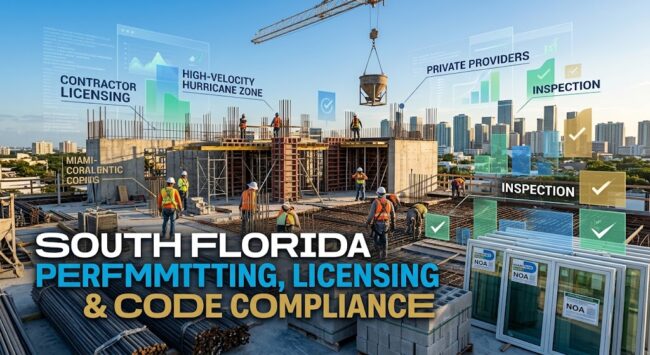
Quick Answer: Building in South Florida requires properly licensed contractors, permits issued under the Florida Building Code, and inspections that confirm compliance. Miami-Dade and Broward counties sit in the High-Velocity Hurricane Zone, which imposes stricter wind standards and product approvals. Unlicensed contractors generally cannot enforce their contracts or liens, open permits can delay sales and financing, and Florida law now offers tools such as private provider plan review and inspections and deadlines for local permit decisions.
Permitting and code compliance are where many South Florida development projects gain or lose months. A missing product approval, an incomplete plan submittal, a contractor whose license does not cover the work, or an open permit from a prior owner can stall construction, block a closing, or delay a certificate of occupancy that tenants and buyers are waiting on. For developers, contractors, and property owners, understanding the rules is as important as understanding the budget.
McArdle Franco PLLC, a Coral Gables law firm established in 2002, represents developers, property owners, contractors, subcontractors, architects, engineers, commercial tenants, and lenders in land development and construction matters. As a Florida land development attorney team whose senior partners have built real estate and construction businesses themselves, the firm understands how permitting and licensing problems affect real projects. This article explains the key rules.
Contractor Licensing in Florida
Certified and Registered Contractors
Chapter 489 of the Florida Statutes governs construction contracting. The Construction Industry Licensing Board (CILB), within the Department of Business and Professional Regulation, regulates contractors.
| License Type | Scope |
|---|---|
| Certified contractor | Licensed by the state; may work anywhere in Florida |
| Registered contractor | Licensed for specific local jurisdictions where it holds competency |
| Specialty contractors | Roofing, plumbing, mechanical, pool, and other trades |
| Electrical contractors | Licensed separately under Part II of Chapter 489 |
General, building, and residential contractor licenses carry different limits on the type and height of structures the contractor may build. A residential contractor, for example, cannot build a commercial mid-rise.
Qualifying Agents
A business entity engaged in contracting must have a licensed qualifying agent. The qualifier is responsible for supervising the entity’s construction operations and can face discipline for the entity’s violations. Owners should confirm that the entity they contract with is properly qualified, not just that an individual associated with it holds a license.
Consequences of Unlicensed Contracting
Florida treats unlicensed contracting seriously:
- Contracts unenforceable: Under Section 489.128, a contract entered into by an unlicensed contractor is generally unenforceable in law or equity by the unlicensed contractor.
- No lien rights: Unlicensed contractors generally cannot enforce construction liens.
- Criminal penalties: Unlicensed contracting is a crime, and penalties increase during a declared state of emergency, such as after a hurricane.
- Owner remedies: Owners may have claims against unlicensed contractors, and licensed contractors who aid unlicensed activity face discipline.
A Coral Gables construction lawyer reviewing a contract will verify the license of every contractor and key subcontractor before work begins.
Owner-Builder Exemption
Florida allows property owners to act as their own contractor for certain work on their own property under an owner-builder exemption, subject to disclosure and occupancy requirements. The exemption is narrow and is generally not available for property built for sale or lease.
The Florida Building Code
Florida adopts a single statewide building code, the Florida Building Code, updated on a three-year cycle by the Florida Building Commission. The 8th Edition (2023) took effect at the end of 2023, and the next edition is in development. Local governments enforce the code and may adopt limited local amendments.
The High-Velocity Hurricane Zone
Miami-Dade and Broward counties are designated as the High-Velocity Hurricane Zone (HVHZ), which carries the code’s most stringent wind design and construction requirements. Products used in the building envelope, such as windows, doors, shutters, roofing, and skylights, must have approval demonstrating compliance with HVHZ standards. Miami-Dade County’s product control program issues Notices of Acceptance (NOAs) that are widely recognized in the industry. Using products without proper approval can result in failed inspections, removal of installed work, and delays.
Flood Zones and Coastal Construction
Much of South Florida lies within FEMA special flood hazard areas. Construction must meet flood-resistant design requirements, including minimum elevations and substantial improvement rules that can require existing buildings to be brought into compliance when renovations exceed 50 percent of market value. Construction seaward of the Coastal Construction Control Line requires state permits under Chapter 161.
The Permitting Process
Building Permits
Under Section 553.79 of the Florida Statutes, building permits are generally required before construction, alteration, or demolition. Permit applications typically require signed and sealed plans, product approvals, energy calculations, and other documentation. Larger projects may require separate permits for structural, mechanical, electrical, plumbing, fire, and site work.
Deadlines for Local Permit Decisions
Section 553.792 requires local governments to approve, approve with conditions, or deny certain building permit applications within statutory timeframes after receiving a complete application. Recent amendments added consequences, including fee reductions when local governments miss deadlines, and limited the number of requests for additional information. Applicants should track submission and response dates carefully to preserve these rights.
Private Provider Plan Review and Inspections
Section 553.791 allows owners or contractors to hire licensed private providers, such as engineers, architects, or certified building code inspectors, to perform plan review and inspections in place of the local building department. Legislative amendments in recent years expanded the program, required local governments to accept private provider work within set timeframes, and addressed fees. For time-sensitive projects, private providers can significantly shorten approval timelines.
| Permitting Tool | Benefit |
|---|---|
| Complete initial submittal | Starts statutory review clock |
| Private provider plan review | Faster review by licensed professionals |
| Private provider inspections | Reduces scheduling delays |
| Phased permits | Allows foundation work before full approval |
| Pre-application meetings | Identifies issues early |
Threshold Buildings
Buildings that exceed specified height, occupancy, or area thresholds require a special inspector, known as a threshold inspector, under Section 553.79 to inspect structural components during construction. Developers of mid-rise and high-rise projects must budget for this requirement.
Inspections and Certificates of Occupancy
Each phase of permitted work requires inspection before it is covered or completed. Failed inspections require corrections and re-inspection. At completion, the building official issues a certificate of occupancy or certificate of completion. Temporary certificates of occupancy may allow partial occupancy before all work is finished.
Certificates of occupancy are important beyond construction. They often trigger rent commencement under leases, closings for condominium units, conversion of construction loans to permanent financing, and the start of the statute of repose for construction defect claims.
Open Permits and Code Violations
Open and Expired Permits
Permits left open or expired without final inspection can create problems years later. Buyers, lenders, and title insurers increasingly require permit searches. Open permits may need to be closed by the original contractor, a new contractor, or the owner, sometimes after opening walls to verify work. Florida law has provided some relief by allowing local governments to close older permits in certain circumstances, but owners should not assume old permits will be ignored.
Code Enforcement Liens
Under Chapter 162 of the Florida Statutes, local code enforcement boards and special magistrates may impose daily fines for code violations, which can become liens on the property. Fines can accumulate to large amounts. Negotiating reductions or releases often requires correcting the violation and applying for mitigation.
Unpermitted Work
Unpermitted work can create insurance problems, lender objections, and liability when a property is sold. Legalizing unpermitted work usually requires after-the-fact permits, plans, inspections, and sometimes demolition and reconstruction.
Building Safety Inspections for Existing Buildings
Following the 2021 Champlain Towers South collapse, Florida adopted Section 553.899, requiring milestone structural inspections for condominium and cooperative buildings three stories or taller, generally by 30 years after initial occupancy and every 10 years thereafter, with local option for earlier inspections in some cases. Miami-Dade and Broward counties also maintain building safety recertification programs for older buildings. Developers acquiring older buildings for renovation or redevelopment must account for these requirements and any repairs they reveal.
Impact Fees and Development Approvals
Building permits are only one layer of approval. Before vertical construction, many projects need site plan approval, platting, utility capacity commitments, and payment of impact fees for roads, schools, parks, water, and sewer. Florida’s Impact Fee Act, Section 163.31801, requires impact fees to be proportional and reasonably connected to the impacts of new development and limits how quickly local governments can raise them. Developers should confirm fee amounts and timing early, because impact fees are often due before a building permit or certificate of occupancy is issued and can materially affect a project budget. Credits may be available for infrastructure the developer builds itself.
Contract Provisions That Allocate Permitting Risk
Permitting and licensing risks should be allocated clearly in development and construction contracts. A Miami construction law firm drafting those contracts will address:
- Who obtains which permits, including building, site, utility, and environmental permits
- Who pays permit and impact fees
- Licensing representations by contractors and subcontractors
- Product approval requirements for HVHZ compliance
- Time extensions for permit delays outside the contractor’s control
- Responsibility for failed inspections and corrective work
- Closeout obligations, including final inspections and certificates of occupancy
- Private provider use and cost allocation
Purchase and Lease Due Diligence
Buyers of existing buildings and tenants leasing space for build-out should investigate permit and code history before committing. Key steps include ordering municipal lien and permit searches, reviewing certificates of occupancy for the intended use, confirming zoning compliance, and identifying open violations. A South Florida real estate development attorney can build these investigations and related remedies into purchase contracts and leases.
When Permitting and Code Issues Become Disputes
Permit delays, failed inspections, and code violations frequently lead to disputes over who caused the problem and who pays. Owners may claim the contractor’s work failed inspection. Contractors may claim the design was deficient or the owner delayed approvals. Purchasers may claim sellers concealed open permits or violations. A South Florida construction defect attorney can evaluate whether code violations support claims under Section 553.84, which provides a civil cause of action for damages caused by building code violations.
Frequently Asked Questions
Can an unlicensed contractor sue to get paid in Florida?
Generally no. Under Section 489.128, contracts entered into by unlicensed contractors are unenforceable by the unlicensed contractor, and lien rights are generally unavailable.
What is the High-Velocity Hurricane Zone?
It is the designation for Miami-Dade and Broward counties under the Florida Building Code, requiring the most stringent wind design standards and product approvals for building envelope components.
What is a private provider?
A licensed engineer, architect, or certified building code inspector hired by the owner or contractor to perform plan review and inspections in place of the local building department under Section 553.791.
How long does a local government have to act on a permit?
Section 553.792 sets statutory timeframes for local governments to approve, approve with conditions, or deny certain complete permit applications, with consequences for missing them.
Can open permits stop a property sale?
They can. Buyers, lenders, and title insurers often require open permits to be closed or addressed before closing.
What is a milestone inspection?
It is a structural inspection required by Section 553.899 for condominium and cooperative buildings three stories or taller, generally at 30 years after initial occupancy and every 10 years after that.
Key Takeaways
- Verify contractor and qualifier licensing before signing any contract.
- Unlicensed contractors generally cannot enforce contracts or liens.
- Miami-Dade and Broward projects must meet HVHZ standards and product approvals.
- Private providers and statutory deadlines can accelerate permitting.
- Open permits and code liens should be addressed in due diligence.
About McArdle Franco PLLC
McArdle Franco PLLC is a Coral Gables law firm established in 2002 that counsels and represents businesses throughout Florida, across the nation, and internationally in land development and construction, real estate, business structuring, transaction structuring, and business litigation. The firm represents developers, property owners, contractors, subcontractors, commercial tenants, architects, engineering firms, mortgage lenders, and commercial lenders. The firm was named a Tier 2 firm in Miami for Litigation – Construction in the 2026 edition of Best Law Firms® and was ranked in Chambers USA 2025 for Litigation: General Commercial in Florida.
Contact McArdle Franco PLLC
Address: 255 Alhambra Circle, Suite 925, Coral Gables, FL 33134
Phone: (305) 442-2214
Website: mcardlefranco.com
This article provides general information and is not legal advice. Consult a qualified attorney about your specific situation.
Sources and Further Reading
- Contracting, Chapter 489, Florida Statutes – Florida Legislature
- Florida Building Code, 8th Edition (2023) – Florida Building Commission
- Building Permits, Section 553.79, Florida Statutes – Florida Legislature
- Alternative Plans Review and Inspection (Private Providers), Section 553.791, Florida Statutes – Florida Legislature
- Building Permit Application to Local Government, Section 553.792, Florida Statutes – Florida Legislature
- Milestone Inspections, Section 553.899, Florida Statutes – Florida Legislature
- Local Government Code Enforcement Boards Act, Chapter 162, Florida Statutes – Florida Legislature
- Product Control Division and Notices of Acceptance – Miami-Dade County
- Construction Industry Licensing Board – Florida Department of Business and Professional Regulation
- Land Development and Construction Practice – McArdle Franco PLLC
About the Author

About Brian French
Led by a commitment to tech-intelligent curation, Brian French tracks and analyzes the Business News in Florida including corporate developments and breaking news defining Florida's economy. Brian brings an extensive financial background to his analysis, having graduated from the University of South Florida in Finance and serving as a Vice President and Portfolio Manager for Merrill Lynch Private Investors and the Trust Department in St. Petersburg, FL, as well as a Vice President and Trust Investment Officer for SunTrust Bank in Sarasota, FL. His writing blends macroeconomic trends, fiduciary capital markets, corporate strategy, and modern digital insights for a sophisticated look at Florida's business economy.