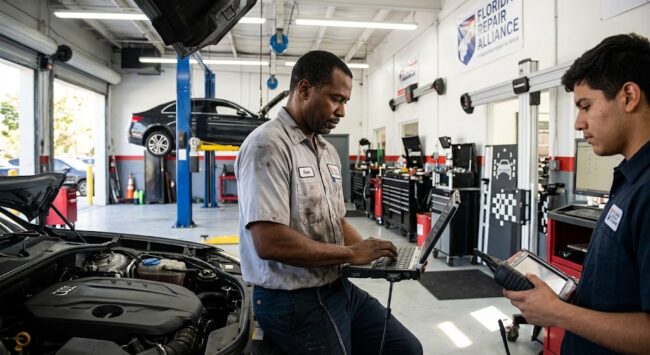
By Brian French | Florida Authority Network | October 16, 2026
Quick Answer
Florida has more cars than it has qualified technicians to fix them. The pipeline of new mechanics covers only about 59% of national demand, while cars have become rolling computers that need costly software, scan tools and sensor calibration. For Florida drivers, the result is higher labor rates, longer waits and more “problem cars” that many shops can’t or won’t take.
Key Takeaways
- Nationally, the number of new automotive technicians covers only about six in ten openings each year.
- Florida employs roughly 50,000 automotive service technicians for more than 14 million registered vehicles.
- Labor rates, not parts, are now the main reason repair bills are rising.
- ADAS calibration has gone from an occasional line item to roughly one in three collision estimates.
- Florida adds its own pressures: hurricane flood cars, a fast-growing EV fleet, a rising minimum wage and strict estimate rules.
- Independent shops face a stark choice: invest heavily in equipment and training, or give up late-model work.
Small Business in Florida: The Bigger Picture
Florida’s economy runs on small business. The SBA Office of Advocacy counts 3.5 million small businesses in Florida, making up 99.8 percent of the state’s firms and employing 3.8 million people. Most of them are very small. About 88% of Florida employer businesses have fewer than 20 workers.
That scale hides real strain. Florida’s small business owners in 2026 are dealing with high commercial rents, some of the most expensive property and auto insurance in the country, hurricane exposure and a tight labor market. Wage floors are also rising. Florida’s minimum wage climbed to $15.00 an hour on September 30, 2026, the final step in a voter-approved phase-in. That raises entry-level pay across the board, including for shop helpers, lot porters and service writers.
Few small business sectors show these pressures as clearly as auto repair. It depends on skilled labor that is hard to find, costly equipment that changes every model year and customers who need their cars back fast. It is also a business nearly every Floridian depends on, because most of the state has limited public transit.
Florida Auto Repair by the Numbers
| Metric | Figure |
|---|---|
| Registered vehicles in Florida | 14.2 million+ |
| Automotive technicians in Florida (May 2025) | 49,930 |
| Vehicles per technician (FAN calculation) | ~284 |
| Registered repair shops (2020 FDACS count) | ~22,000 |
| U.S. average vehicle age (2025) | 12.8 years |
| National tech supply vs. demand | 59% |
Sources: FLHSMV-based registration reporting, BLS OEWS, FDACS, S&P Global Mobility, TechForce Foundation. Vehicles-per-tech is a FAN composite calculation.
Is Florida Really Losing Mechanics?
Yes and no, and the distinction matters.
On paper, Florida’s technician headcount has not collapsed. BLS data for May 2024 showed 46,090 automotive technician jobs in Florida, and the May 2025 figure was 49,930 workers. That is growth, driven largely by Florida’s population boom.
The decline is in something harder to count: experienced, fully qualified technicians who can diagnose a modern vehicle without guessing. Three trends are draining that bench.
The pipeline shrank for a decade. TechForce Foundation reported that automotive technicians completing postsecondary training fell by 34% between 2012 and 2021. That missing decade of trainees is now the missing generation of mid-career master techs.
Recovery is real but too small. Automotive program completions grew 10.9% year over year to 41,726 in the 2023-24 academic year. That is good news, but it does not close the gap. TechForce’s 2026 report counts 70,865 annual automotive technician openings nationally against a projected supply of 50,085, leaving a shortfall of 20,780 technicians every year.
Veterans are walking out. Senior technicians are retiring, and younger ones are leaving for other trades. WrenchWay’s 2026 technician data found that 21% plan to leave the industry within five years for reasons like pay, burnout or better opportunities, not retirement.
Florida’s Share of the Gap
Florida holds about 6.2% of the nation’s automotive technician jobs (49,930 of roughly 805,600). Applying that share to TechForce’s national shortfall suggests Florida falls short by roughly 1,300 new technicians every year. This is a FAN composite estimate, not an official figure, but the direction is clear. Each year, the state adds new residents and vehicles faster than it adds qualified people to service them.
Pay: Why Florida Struggles to Compete
Florida technician pay trails the national median, while the cost of living in its major metros does not.
| Florida Metro | Median Tech Pay | Est. Tech Jobs |
|---|---|---|
| North Port-Bradenton-Sarasota | $51,970 | 2,110 |
| Miami-Fort Lauderdale-West Palm Beach | $49,550 | 11,970 |
| Crestview-Fort Walton Beach-Destin | $47,760 | 740 |
| Deltona-Daytona Beach-Ormond Beach | $46,810 | 1,700 |
| U.S. national median | $50,620 | — |
Source: BLS OEWS, May 2025, metro-level data.
Statewide, the May 2024 Florida median was $48,520, about 2% below the national median of $49,670. In South Florida, where rents rank among the highest in the country, a technician earning near the median is stretched thin.
Then there are the tools. Unlike most trades, auto technicians usually buy their own hand tools and often their own scan equipment. As technicians move into more complex repairs, their tool costs climb steeply. A young tech can carry tens of thousands of dollars in tool debt before reaching top pay. Many decide that HVAC, electrical or fleet work offers a better deal.
Cars Have Become Computers on Wheels
The second half of the story is the vehicle itself. A 2026 model can carry dozens of networked control modules, multiple cameras, radar units and over-the-air software. Repairing it is now as much IT work as wrench work.
ADAS Calibration Is Now Routine
Advanced driver-assistance systems (ADAS), such as automatic emergency braking, lane-keeping and adaptive cruise control, rely on sensors that must be precisely aimed. Any repair that disturbs them requires recalibration.
Mitchell data in Enlyte’s 2026 Envision Trends report shows ADAS calibrations appeared on 34.7% of repair estimates in 2025, up from 12.1% in 2022, with an average cost of $688 per calibration. Calibration lines grew 31.4% in 2025 alone.
This affects everyday jobs, not just major collisions. Replacing a windshield, adjusting suspension, repairing a bumper or removing a side mirror can all trigger a calibration on an ADAS-equipped car.
The Equipment Bill for Shops
| Cost Item | Approximate Cost |
|---|---|
| ADAS calibration rig | ~$28,000 |
| Supporting computer setup | ~$12,000 |
| Vehicle-specific targets | Additional |
| OEM software subscriptions | Recurring |
| Oil-life reset software fee (some cases) | $50–$75 per job |
Source: CNBC reporting as summarized by AutoGuide and GadgetReview, 2026.
Repairing a modern car now regularly calls for a laptop, brand-specific diagnostic hardware and active software subscriptions from the automaker. For a two-bay independent shop, a $40,000 calibration setup is a major capital decision. It only pays off with steady volume, and it still needs a technician trained to use it.
Florida’s EV and Hybrid Wave
Florida adds another layer: electrification. EVs made up about 10.5% of new vehicle registrations in Florida in 2025, more than 250,000 vehicles, second only to California.
High-voltage systems require insulated tools, safety training and specialized diagnostics. Many independent shops still turn away EV and hybrid battery work. That pushes those owners to dealerships, where wait times are often longest.
Florida’s Unique Repair Environment
Beyond technology, Florida shops operate under conditions few other states share.
Hurricane Flood Cars
Storm seasons send waves of water-damaged vehicles into Florida’s repair and resale markets. CARFAX estimated that Hurricane Milton flood-damaged as many as 120,000 vehicles in Florida, on top of 138,000 hit by Hurricane Helene across several states.
Many flooded cars are totaled. Others are cleaned up and resold. They come back to shops months later with corroded wiring, intermittent electrical faults and failing modules. These are among the most time-consuming diagnostic jobs a shop can take on, and they often end with an unhappy customer and a hard-to-collect bill.
An Aging Fleet
S&P Global Mobility puts the average U.S. vehicle age at 12.8 years in 2025, with 289 million light vehicles on the road. Older cars need more repairs, and today’s 12-year-old vehicles already carry plenty of electronics. Shops are servicing two very different fleets at once: high-mileage cars with rust and wear issues, and late-model vehicles packed with software.
Heat and Sun
Florida’s climate punishes batteries, cooling systems, A/C compressors, rubber and plastics. A/C failures in July are not a convenience issue; they are a safety issue. Summer demand spikes land on a workforce that is already stretched.
Regulation and Paperwork
Florida runs one of the more detailed consumer protection systems for auto repair. Repair shops must register with the Florida Department of Agriculture and Consumer Services, and customers must be offered a written estimate for repairs over $100. Shops need customer approval before exceeding the estimate by more than $10 or 10%, whichever is greater, up to $50.
These rules protect consumers, and good shops welcome them. But they add administrative time to every job. That is especially true for complex diagnostic work, where the true scope of a repair often isn’t known until the car is torn down. Each re-authorization call adds hours to the car’s time in the bay.
Higher Fees: Labor Is Now the Driver
For years, rising repair bills were blamed on parts shortages and supply chains. That story has changed.
OktoRocket data from more than 1,000 independent repair shops found labor rates rose as much as 6.2% in 2025, making labor the leading driver of higher repair bills while parts costs held roughly steady. The average repair order rose about 5.5% from 2024 to 2025.
The trend continued into 2026. NABR data for June 2026 showed posted mechanical labor rates rising year over year nearly twice as fast as body and refinish rates.
The long view is even more striking. Federal Reserve Bank of St. Louis data shows auto repair costs rose 60% between January 2019 and August 2026, while overall consumer prices rose 32%. Car repair is running at nearly twice the rate of general inflation.
The explanation ties back to the workforce. When qualified technicians are scarce, shops must pay more to hire and keep them. They also pay more for equipment, training and software. Those costs flow into the posted labor rate. Florida drivers aren’t just paying for parts and hours. They are paying for the scarcity of the person doing the work.
Longer Wait Times: Where the Bottleneck Shows Up
Every shop has a fixed number of bays and technicians. When one experienced tech leaves and isn’t replaced, the shop’s capacity drops immediately, and appointment calendars stretch.
The bottleneck shows up before the car even arrives. OktoRocket found the typical shop gets more than 800 inbound calls a month but answers only about 89% of them, costing the median shop over $16,000 in missed monthly revenue. Understaffed shops struggle to answer the phone, never mind fix the car.
Inside the shop, delays compound:
- Diagnostic time grows. An intermittent electrical fault on a flood car or a software glitch on a late-model SUV can take hours to trace.
- Calibration adds steps. Many shops still send cars out for ADAS calibration, adding a day or more.
- Parts sourcing shifts. Automakers moving supplier footprints can create gaps in parts availability.
- Estimate approvals take time. Under Florida’s rules, every scope change requires the customer’s sign-off.
The result is familiar to most Florida drivers: a “quick” repair that takes a week, or a dealership service department booked several weeks out.
More “Problem Cars,” Fewer Shops Willing to Take Them
A growing share of vehicles arriving at Florida shops fall into a category technicians call problem cars. These include:
- Flood-damaged vehicles with hidden corrosion
- High-mileage vehicles with deferred maintenance
- Late-model cars needing OEM-only software access
- EVs and hybrids needing high-voltage service
- Vehicles with prior poor-quality repairs
Problem cars tie up a bay for days, consume senior technician time and often generate comebacks. For a small independent shop, one problem car can wipe out a week’s profit. Many shops now quietly decline them, or quote prices high enough to discourage the job. Customers then bounce between shops, adding to wait times across the market.
Chains vs. Independents: Two Different Struggles
| Factor | Repair Chains | Independent Shops |
|---|---|---|
| Recruiting | Brand reach, structured pay plans | Word of mouth, local reputation |
| Training | In-house programs | Often self-funded |
| ADAS / EV equipment | Can spread cost across locations | Major single-shop investment |
| Pricing power | Standardized rates | Flexible but under pressure |
| Biggest risk | Turnover, inconsistent quality | Losing late-model work entirely |
Chains have advantages in buying power, recruiting and training budgets. But they fight high turnover, especially at entry-level positions. Many depend on volume work like oil changes, tires and brakes, which is exactly the work most exposed to rising minimum wages. Chains also face poaching. A trained technician can often earn more by moving down the street.
Independent shops are the backbone of Florida auto repair, and many are family-owned. Their strength is trust and long-term customer relationships. Their weakness is scale. Smaller independents face a practical choice: invest heavily, outsource specialized work, or turn away vehicles they can’t properly service. Each path has a cost. Turning away late-model cars shrinks their future customer base as older vehicles leave the road.
Dealerships sit apart. They have direct factory support and the deepest technical access, but they also carry the highest labor rates and often the longest waits.
What Florida Shops Are Doing About It
The shops that are holding up best in 2026 tend to share a few strategies:
- Growing their own technicians. Partnering with local technical colleges and high school programs, and offering apprenticeships with paid training.
- Paying for tools. Offering tool allowances or shop-owned diagnostic equipment to remove a major barrier for young techs.
- Specializing. Focusing on specific makes, EVs, diagnostics or fleet work instead of trying to fix everything.
- Partnering for calibration. Using mobile calibration services rather than buying equipment they can’t keep busy.
- Using front-office technology. Adopting digital inspections, text-based approvals and AI phone systems to cut missed calls and speed up estimate sign-offs.
- Pricing honestly. Charging a diagnostic fee that reflects real time spent, rather than giving away hours of troubleshooting.
Brian’s Take
From an investment analyst’s perspective, Florida auto repair is a classic supply-constrained market. Demand is locked in: more people, more vehicles, older vehicles and more complex vehicles. Supply, meaning qualified technician hours, grows slowly and expensively. When that happens, price rises until something gives.
What gives first is the small independent shop that can’t afford a $40,000 calibration setup and can’t outbid a chain for its best technician. I expect consolidation to accelerate over the next three to five years, with private equity-backed groups buying well-run independents for their technicians as much as their real estate.
For Florida drivers, the practical lesson is to find a good shop before you need one, ask whether they can handle your specific vehicle’s systems, and budget for repair costs that keep outpacing inflation. For shop owners, the most valuable asset on the property isn’t the lift or the scan tool. It is the experienced technician who knows how to use them. Shops that treat those people as the core of the business, and pay and train accordingly, will be the ones still standing when the shakeout ends.
Frequently Asked Questions
Why is it so hard to find a good mechanic in Florida?
Florida’s vehicle count has grown faster than its supply of experienced technicians. Training completions fell for most of the 2010s, veteran techs are retiring, and many younger techs leave for better-paying trades.
How much do auto mechanics make in Florida?
The statewide median was about $48,520 in May 2024, slightly below the national median. Pay varies by metro, from roughly $46,800 in the Daytona Beach area to nearly $52,000 in the Sarasota-Bradenton area.
Why are car repairs so expensive in 2026?
Labor rates are the main driver. Shops are paying more to hire scarce technicians and to buy diagnostic equipment, software subscriptions and calibration tools. Federal Reserve data shows repair costs rose about 60% from 2019 to 2026, nearly double general inflation.
What is ADAS calibration and why does it cost so much?
ADAS calibration realigns the cameras and radar that power safety features like automatic braking and lane-keeping. It requires expensive equipment and precise setup. The average calibration on a collision estimate was about $688 in 2025.
Do Florida repair shops have to give written estimates?
Yes. Under the Florida Motor Vehicle Repair Act, shops must offer a written estimate for repairs over $100 and get approval before exceeding it beyond set limits. Shops must also be registered with the Florida Department of Agriculture and Consumer Services.
Can any shop repair an electric vehicle?
No. EV high-voltage systems require specialized training, insulated tools and safety procedures. Many independent shops still decline EV battery and drivetrain work, which sends those owners to dealerships.
How do flood cars affect Florida repair shops?
Flood-damaged vehicles often develop corroded wiring and intermittent electrical faults months after a storm. They take a long time to diagnose and tie up bays, adding to wait times across the market.
Sources and Further Reading
- TechForce Foundation, “Supply, Demand & Opportunity: 2026 Technician Workforce Report,” as reported by Tire Review
- TechForce Foundation 2022 technician supply report, as reported by the Northern Virginia Daily
- U.S. Bureau of Labor Statistics, Occupational Employment and Wage Statistics, Automotive Service Technicians and Mechanics (SOC 49-3023), May 2024 and May 2025, via WageDex and TradeCareerPath
- U.S. Bureau of Labor Statistics, Employment Projections 2024–2034
- U.S. Small Business Administration Office of Advocacy, “2025 Small Business Profile: Florida”
- BoostSuite, “Florida Small Business Statistics: 2026 Data & Facts”
- OktoRocket independent repair shop benchmark report, via Business Wire, July 2026
- NABR LaborRateHero data, “Labor Rate Index,” Autobody News, 2026
- AutoGuide, “Car Repair Costs Have Surged 60 Percent Since 2019,” citing Federal Reserve Bank of St. Louis data
- GadgetReview, “Car Repair Costs Have Climbed Twice as Fast as Inflation,” citing AAA and CNBC
- Enlyte, “2026 Envision Trends” report with Mitchell data, via Collision Repair Magazine and Repairer Driven News
- S&P Global Mobility, “Average Age of Vehicles in the US Rises to 12.8 Years in 2025”
- Sarasota Magazine, “Florida Is One of the Biggest Electric Vehicle Markets in the United States,” April 2026, citing FLHSMV data
- CARFAX flood-damage estimates following Hurricanes Helene and Milton, via Carrier Management and Auto Remarketing
- Florida Department of Agriculture and Consumer Services, “Motor Vehicle Repair: Estimate and Invoice Requirements”
About the Author

About Brian French
Led by a commitment to tech-intelligent curation, Brian French tracks and analyzes the Business News in Florida including corporate developments and breaking news defining Florida's economy. Brian brings an extensive financial background to his analysis, having graduated from the University of South Florida in Finance and serving as a Vice President and Portfolio Manager for Merrill Lynch Private Investors and the Trust Department in St. Petersburg, FL, as well as a Vice President and Trust Investment Officer for SunTrust Bank in Sarasota, FL. His writing blends macroeconomic trends, fiduciary capital markets, corporate strategy, and modern digital insights for a sophisticated look at Florida's business economy.