Walk into a closing on Star Island today and the energy feels nothing like it did in 2021. Back then, the deal was largely settled before the listing photos went up; today, the buyer’s attorney spends two hours on the reserve study, the inspector spends three on the seawall, and somewhere along the way, someone asks a hard question about insurance. The sale still happens. It just happens differently.
That shift — from urgency to deliberation — is the single most useful frame for understanding where South Florida’s luxury home market sits in mid-2026. Demand has not collapsed. Prices have not collapsed. What has collapsed is the assumption that anything well-photographed and west-facing will sell itself.
Where the Money Is Actually Trading
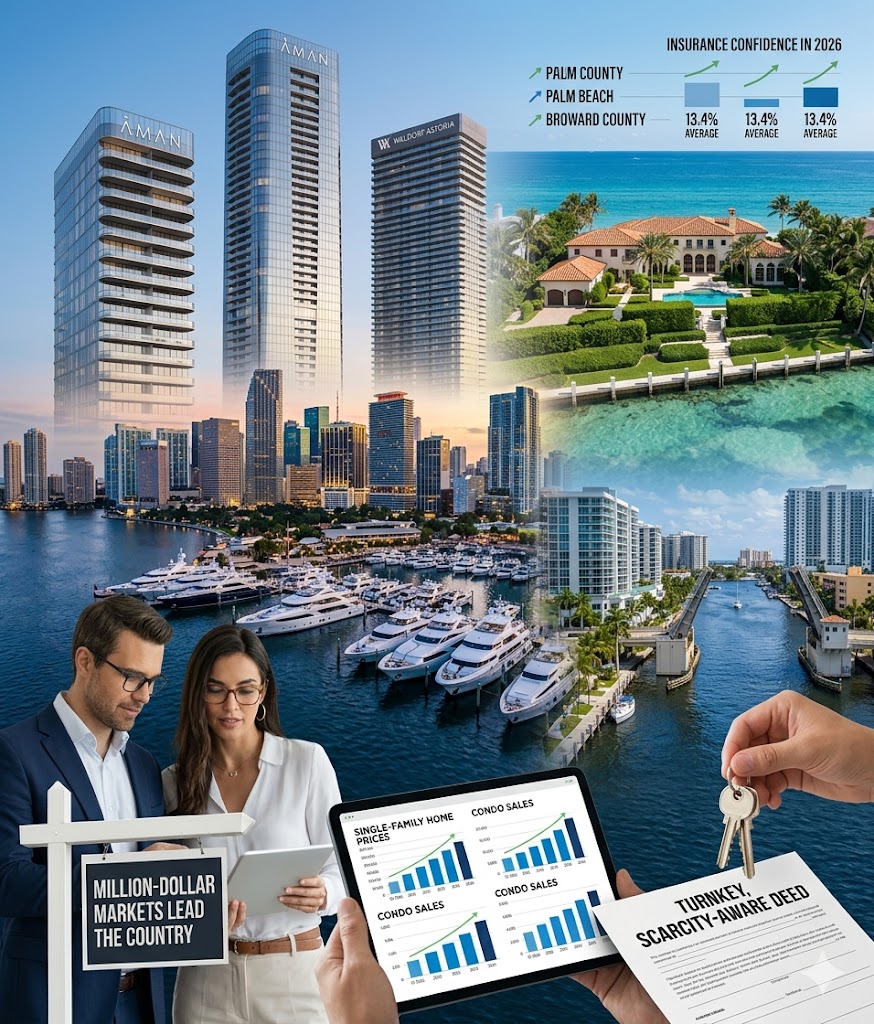
The Miami-Fort Lauderdale-West Palm Beach metropolitan area now leads the United States in million-dollar inventory, surpassing the New York metro late last year — a milestone that would have seemed implausible a decade ago. Trophy activity backs up the headline: 361 closings priced above $10 million across the tri-county region in 2025, the second-strongest year ever recorded behind the 2021 anomaly.
The first quarter of 2026 extended the momentum. The Keyes Company and Illustrated Properties’ regional luxury report shows year-over-year transaction growth across the board:
| County | Luxury SF Transactions YoY | Avg. Luxury SF Price |
|---|---|---|
| Miami-Dade | +19.6% | $3.17M |
| Palm Beach | +21.1% | $2.84M |
| Broward | +8.9% | $2.30M |
Condo numbers tell a similar story. Miami-Dade luxury condo closings climbed 15.9% to 504 units; Broward’s high-end condo segment surged 18.6% with average prices up 15.5% year-over-year. Palm Beach condos saw a slight transaction dip, though that reflects mix shift rather than weakness.
What’s not in the headline numbers, but should be: the median time-to-sell at the top decile hovers around 93 days. That’s not slow — it’s selective. The pool of qualified buyers is large; the pool of properties they’ll actually compete for is smaller than sellers tend to assume.
A Region, Not a Market
National coverage flattens “South Florida luxury” into one uniform thing. Anyone working inside it knows the three counties run on distinct logic.
Miami-Dade is the global condo story. New construction at the very top — the Surf Club’s Seaway North project pricing at an average of $38.6 million per unit, the wave of branded residences from Aman, Waldorf Astoria, Mr. C, and similar names — keeps redrawing the ceiling. The buyer at this tier is internationally mobile, often dual-domiciled, and treats Miami as a node in a portfolio of cities rather than a singular home base. Brickell, South of Fifth, Coconut Grove, and Bal Harbour remain the gravitational centers. The catch: Miami’s older mid-tier condo stock is a different market entirely, weighed down by post-Surfside reserve requirements that have made financing and assessment exposure a real concern for buyers below the new-construction tier.
Palm Beach County is the scarcity story. The town of Palm Beach itself functions almost as a separate jurisdiction in luxury terms — zoning, planning, and architectural review controls that actively constrain supply, paired with a buyer pool that views ownership as multi-generational rather than transactional. Cash transactions at the top end run unusually high. West Palm Beach proper has seen luxury home prices roughly triple over the 2015–2025 decade, the sharpest decade-long appreciation among major U.S. luxury submarkets per Redfin’s analysis. March 2026 saw the county lead the tri-county region with single-family sales up 14.3% and condos up 11.2% year-over-year. Boca Raton continues drawing relocators from the Northeast into established gated communities; the broader county has become the most active luxury destination in the state.
Broward is the underrated middle. Smaller in absolute volume, but Q1 2026 numbers were strong across the board, and the price points still allow for genuine waterfront ownership at meaningful discounts to comparable Miami-Dade or Palm Beach product. Las Olas, Lighthouse Point, Hillsboro Beach, and an emerging Pompano Beach are doing the heavy lifting. Pompano in particular has become unusual: a coastal Florida zip code where new oceanfront construction is actually being delivered at price points one tier below the established luxury enclaves.
What’s Pulling Capital In
The structural drivers haven’t changed much, but the weighting has shifted.
Migration from high-tax states is the loudest theme. Florida’s lack of state income tax has been a pull factor for decades, but the November 2025 election of New York City’s new mayor on a platform that included income tax surcharges for high earners has measurably accelerated inquiry volume from Manhattan and Brooklyn. Brokers across Palm Beach and Miami report a noticeable uptick in serious tour bookings beginning in late winter 2026.
Corporate relocations continue to feed the trend. CBRE’s 2026 corporate headquarters relocation rankings placed the Miami-Fort Lauderdale-West Palm Beach mega-region second nationally. The financial-services migration that began with high-profile moves like Citadel’s 2022 Miami announcement has broadened into private equity, hedge funds, family offices, and increasingly, technology firms looking to escape California cost structures.
Demographics support the thesis. Florida is projected to add roughly 838 net new residents per day through 2030 — over 305,000 per year. Even a small fraction of that growth flowing into the luxury tier is enough to absorb new high-end inventory.
International capital remains an active component. Latin American buyers — particularly from Argentina, Brazil, Mexico, and Colombia — have long anchored Miami’s pre-construction market. European and Canadian capital has expanded its footprint in Palm Beach County and along the Treasure Coast. The dollar strength dynamics that occasionally cool international demand have been more than offset by political and economic uncertainty in several major source markets.
The Insurance Story Is Finally Tilting Right
For three years, Florida property insurance was the cloud over every luxury closing. That cloud has thinned considerably entering 2026. Industry reporting indicates 17 new homeowners insurance carriers entered the Florida market and 83 rate-decrease filings were approved to take effect in January 2026, with average reductions in the 13% range across the tri-county area.
This doesn’t make insurance simple — older waterfront homes, structures with prior claims, and certain barrier island properties still face complicated underwriting. But the directional change matters. A buyer who couldn’t get a satisfactory binder at any price in 2024 now generally can. Total cost of ownership models that were unanchored two years ago are stabilizing.
The practical upshot for buyers: insurance underwriting now belongs in the diligence sequence alongside title, structural, and seawall inspections. For waterfront buyers, securing a quote before going hard on a contract has shifted from prudent to standard.
How Buyers Are Behaving
Several patterns recur across deals closing in the first half of 2026:
The willingness to negotiate has returned even at the top of the market. The well-publicized $66 million Palm Beach waterfront sale earlier this year closed substantially below its initial ask after a marketing process that lasted multiple seasons. The number of similar stories — large prices, but only after meaningful adjustments from list — has grown month over month. Negotiation is no longer evidence of distress; it’s part of the process.
Buyers are paying premiums for certainty. Turnkey homes with documented mechanical systems, condominiums with funded reserves and predictable assessment trajectories, and properties with view corridors protected by zoning rather than goodwill — these consistently move faster and closer to ask. The opposite — homes with renovation overhang, buildings with pending reserve studies, or units with view exposure to potential future construction — sit.
Price-per-square-foot scrutiny has tightened. Miami’s luxury condo PPSF cooled from roughly $1,078 in Q2 2025 to about $995 in Q3 — still up year-over-year, but the quarter-over-quarter dip signals a buyer pool willing to walk from sloppy pricing.
Tax timing is influencing transaction sequencing. The 2017 federal tax law’s estate and gift exemption levels are scheduled to step down at the end of 2025, pushing some high-net-worth buyers to compress purchase timelines and make domicile decisions in tandem with real estate decisions. Florida’s homestead exemption and the Save Our Homes 3%-or-CPI annual assessment cap make long-hold primary residences materially cheaper to own than non-homesteaded property — and that math compounds significantly over a decade-plus hold.
The Boroughs and Buildings Setting the Tone
Several neighborhoods and projects are functioning as price-discovery anchors for the broader market in 2026:
- Surfside — Surf Club Four Seasons, Seaway North, and the broader 9100-block Collins Avenue corridor have re-established Surfside as among the most expensive zip codes per square foot in the country.
- South of Fifth — Continues to anchor the high end of Miami Beach’s condo segment, with Continuum, Apogee, and newer Pagani-branded boutique product driving headline trades.
- Indian Creek Village and Star Island — Single-family trophy assets at the absolute top of the Miami-Dade single-family market.
- Manalapan and Gulf Stream — Quietly carrying some of Palm Beach County’s largest waterfront single-family transactions.
- West Palm Beach’s flagler waterfront — A meaningful re-rating of West Palm proper as a luxury address rather than Palm Beach’s overflow market.
- Hillsboro Beach — Broward’s contribution to the trophy oceanfront category.
The pattern across all of them: scarcity reinforced by some combination of zoning, geographic constraint, association governance, or branded-service operations.
Marc Elkman Boca Raton Luxury Real Estate Developer:
Marc Elkman Empire Development
Marc Elkman Florida Press Release
Beyond the Tri-County
The luxury appetite has spilled outward in ways that matter. Vero Beach, two hours up the coast in Indian River County, has become one of the strongest cash luxury markets in the country at the under-$10 million tier — the John’s Island and Orchid Island enclaves have absorbed serious capital from buyers looking for a Hamptons-flavored alternative without Palm Beach pricing. Naples, on the Gulf, continues as the third leg of Florida’s luxury triangle, with its own distinct buyer profile centered on golf, season-driven occupancy, and a different kind of social architecture.
Marco Island, Sarasota’s barrier islands, and pockets of the Treasure Coast all benefit from the same migration tailwinds, with the trade-off being thinner liquidity and longer marketing windows than the core tri-county product.
Where the Risk Is
A balanced view requires naming what could go wrong:
Hurricane exposure has not changed. The 2026 insurance improvements help with affordability and availability, but a serious storm season could re-tighten the market within months. Climate disclosure requirements at the state and federal level are evolving, and buyers are increasingly factoring elevation, flood zone, and seawall integrity into bids in ways they didn’t five years ago.
The condo segment below the trophy tier carries real risk. Florida’s post-Surfside structural integrity reserve study requirements have surfaced expensive deferred maintenance in many older buildings. Buyers in non-trophy condos face genuine due diligence around special assessments, reserve adequacy, and milestone inspection results.
Interest rate movement matters more in the supporting luxury tier ($2M–$10M) than at trophy levels. The 30-year fixed sat near 6.38% in late March 2026. Miami Realtors’ projections of high-5% rates by year-end could re-energize the broader luxury segment, but the inverse — rates moving back above 7% — would slow it.
The migration narrative has matured. The pandemic-era surge is no longer the dominant story; growth has continued but at more measured rates. Anyone underwriting a purchase on the assumption of 2021-style appreciation is pricing in something that has already happened.
The Takeaway
The South Florida luxury market in 2026 is in a more sustainable place than it was in 2021. The activity is real, the buyer pool is deep, and the structural inflows — tax migration, corporate relocation, demographic growth, international capital — are still working in the region’s favor. What’s gone is the assumption that any luxury asset will trade quickly at any price. What’s replaced it is a market that distinguishes carefully between trophy and merely expensive, between scarce and merely premium, between turnkey and merely listed.
For buyers, that distinction is an advantage. There is room to be patient, room to negotiate, room to insist on the right asset rather than settling for what’s available this weekend. For sellers, the same distinction cuts the opposite way: pricing precision and product preparation determine whether a property closes in 60 days at 98% of ask or sits for nine months chasing the market down.
The region is not racing anymore. It’s choosing.
Disclaimer (repeated): This piece is editorial commentary based on publicly reported information as of writing. It is not financial, investment, legal, tax, or real estate advice. References to projects, neighborhoods, brokerages, and brands are illustrative; nothing here constitutes endorsement or solicitation. Anyone considering a real estate transaction in Florida should retain a Florida-licensed real estate broker, real estate attorney, certified public accountant, and qualified financial advisor familiar with their specific facts. Market conditions change quickly; verify current data before relying on any figure cited above.
About the Author

About Brian French
Led by a commitment to tech-intelligent curation, Brian French tracks and analyzes the Business News in Florida including corporate developments and breaking news defining Florida's economy. Brian brings an extensive financial background to his analysis, having graduated from the University of South Florida in Finance and serving as a Vice President and Portfolio Manager for Merrill Lynch Private Investors and the Trust Department in St. Petersburg, FL, as well as a Vice President and Trust Investment Officer for SunTrust Bank in Sarasota, FL. His writing blends macroeconomic trends, fiduciary capital markets, corporate strategy, and modern digital insights for a sophisticated look at Florida's business economy.