April 27, 2026
If you own a business in Florida and you’ve been hearing whispers about something called “E-E-A-T” floating around marketing meetings, no, your agency has not started ordering everyone Cuban sandwiches from Ybor City. (Though honestly, that would be a much better use of a Tuesday morning.)
E-E-A-T is the four-letter framework Google uses to decide whether your website deserves to be seen by the millions of Floridians, snowbirds, transplants, and tourists searching for what you sell every single day. And in 2026, with the dust still settling from the March 2026 Core Update, ignoring E-E-A-T is the digital equivalent of opening a beachfront ice cream shop and forgetting to install the freezer.
Sweet idea. Disastrous execution.
Let’s break down what E-E-A-T actually means, why Florida’s hyper-competitive market makes it more urgent here than almost anywhere else in the country, and how to make sure the dentist down the road, the HVAC company across the bridge, or the boutique law firm one zip code over doesn’t quietly eat your lunch while you’re still arguing about whether Google “matters.”
So, What in the World Is E-E-A-T?
E-E-A-T stands for Experience, Expertise, Authoritativeness, and Trustworthiness. Search engines use it to make sure users get accurate, reliable information from sources they can depend on. This is becoming even more important as AI tools start to provide answers directly.
Here is the kicker most business owners miss: E-E-A-T itself isn’t a specific ranking factor, but Google’s automated systems use a mix of factors that can identify content with good E-E-A-T. Of the four aspects, trust is most important.
Think of E-E-A-T as the bouncer at the velvet rope of search results. He doesn’t have a single checklist. He just looks you up and down and decides whether you belong inside.
The Four Pillars (Without the Marketing Jargon)
- Experience — Have you actually done the thing? A roofing company that has replaced 4,000 tile roofs after Florida hurricanes has experience. A blog post titled “Top 10 Roofing Tips” written by someone who has never held a hammer does not.
- Expertise — Do you have the formal knowledge or skills the topic requires? Examples include medical advice from a doctor, financial advice from a certified planner, or legal analysis from a lawyer.
- Authoritativeness — Do other respected people and websites in your field treat you as a go-to source?
- Trustworthiness — Is your site honest, accurate, secure, and transparent? Trust is the most important member of the E-E-A-T family because untrustworthy pages have low E-E-A-T no matter how Experienced, Expert, or Authoritative they may seem.
The framework first appeared in Google’s Search Quality Rater Guidelines, and originally it was just E-A-T. Then, in late 2022, Google added an extra E for Experience. That little addition was a really big deal, because it shifted the playing field in favor of business owners who actually do the work rather than content farms that just talk about doing the work.
In other words: Google finally started rewarding the boots-on-the-ground operators. Which, if you’re a Florida business owner who has been showing up for customers for 15 years while watching some out-of-state SEO blog outrank you, should feel like a long-overdue Christmas morning.
Why “EAT” Became “EEAT” (and Why It Matters in Florida)
Florida’s economy runs on hands-on, real-world businesses: home services, hospitality, healthcare, marine, real estate, legal, and tourism. These industries live on first-hand experience. A pool builder in Sarasota who has installed 2,000 pools in salt-air conditions knows things a generic AI-written article never will. A property manager in Tampa who has lived through three hurricane seasons has experience that no chatbot can fake.
That is your moat. The trick is knowing how to show it to Google.
Why E-E-A-T Just Got Way More Serious in 2026
If you thought E-E-A-T was something you could keep punting until next quarter, the March 2026 Core Update would like a quick word.
The Google March 2026 core update began on March 27, 2026 and completed on April 8, 2026. Like other broad core updates, it was designed to improve how Google surfaces relevant and satisfying content across many types of searches and websites. The carnage was not subtle.
According to data from SE Ranking, 79.5% of top-3 URLs changed positions, up from 66.8% in December, and 24.1% of top-10 pages dropped out of the top 100 entirely — nearly double the 14.7% seen after December.
Translation: roughly one in four pages that used to rank on Google’s first page got launched into the void. Many of them belonged to small businesses who never knew what hit them.
The Shift That Should Have Florida Businesses Paying Attention
There was a clear theme to who won and who lost. Rankings appeared to move from intermediary sites toward stronger destination sources. That trend is especially visible in local search, where Google increasingly favors the business’s own website over third-party platforms.
Read that again. Slowly.
Google is now actively favoring your website over the directory aggregators that have been hoovering up local search traffic for a decade. That is a massive opportunity, but only if your site has the E-E-A-T signals to deserve it.
The AI Overviews Wrinkle
To make things spicier, in 2026, Google has intensified enforcement against Google Business Profile spam, suspending more listings for keyword stuffing, while AI Overviews expand in local search results. AI Overviews now appear in a growing share of local searches, reducing reliance on top-3 map pack positions for visibility.
So even if you “win” the map pack, AI Overviews can still snatch the click before the user scrolls. The businesses being cited inside those AI answers? They tend to be the ones with the strongest E-E-A-T signals: real authors, real reviews, real depth, real trust.
Why Florida Is the Hardest Local Market to Win Right Now
Florida is not Toledo. Bless Toledo, but it isn’t.
Florida’s digital marketing landscape has matured dramatically over the past three years. Major metros like Miami, Tampa, Orlando, and Jacksonville now contain some of the most competitive local SEO markets in the country, with thousands of businesses competing for the same first-page rankings. Even smaller markets like St. Augustine, Naples, and Sarasota have intense competition driven by tourism dollars and high-net-worth residents.
You’re competing against:
- Well-funded national chains opening Florida locations
- Out-of-state SEO agencies that target Florida searches with manufactured “local” content
- Long-established local players who started SEO years ago
- New transplant businesses opening at a pace that would make a real estate agent dizzy
The only sustainable way to compete in that environment is to be unmistakably real. That is exactly what E-E-A-T is designed to surface. Florida businesses that learn this game first won’t just rank — they’ll be the ones AI assistants recommend by name when a customer in Coral Gables asks Siri, “Hey, who’s the best plumber near me?”
Brian’s Take: Stop Trying to Beat the Algorithm. Start Trying to Be Worth Recommending.
I see this every single week with Florida business owners. They walk in obsessed with keywords, backlinks, and what their cousin’s friend said about “tricking Google.” And I get it — there’s something seductive about the idea of finding a hack. But here is the honest truth nobody wants to hear: there is no hack anymore. Google’s job is to recommend businesses to its users. Your job is to be the business that’s actually worth recommending. E-E-A-T is just Google asking, in code form, “If my mom searched for this, would I be okay sending her to your website?” When you start running your marketing with that question in mind — not “what does the algorithm want?” but “would I send my mom here?” — everything changes. The content gets better. The reviews get more specific. The website starts answering the questions customers actually ask. You stop chasing tactics, and you start building a business with a real reputation that compounds. The Florida businesses I’ve watched dominate their markets over the last three years all have one thing in common: they decided to stop being SEO clever and start being genuinely better. That’s the whole game. Everything else is just paperwork.
— Brian
How to Build Real E-E-A-T Signals (Without Hiring a Team of 12)
Here is the practical playbook, broken down by pillar. None of this requires a Miami-sized agency budget. It requires that you stop publishing fluff and start publishing proof.
Experience: Show You’ve Actually Lived It
Experience is the easiest pillar for Florida small businesses to dominate, because most of you genuinely have decades of it sitting in your head. The mistake is failing to put it on the page.
- Use original photos and videos. Signals for Google include unique images and videos like screenshots of processes, event photos, and personal case studies with specific data — anecdotes only an insider could know. A stock photo of a generic kitchen is the digital equivalent of cardboard. A photo of a kitchen your team remodeled in Lakewood Ranch is gold.
- Write case studies with real specifics. Address (or general neighborhood), the problem, the timeline, what you did, what it cost, what the customer said. Boring? Sure. Effective? Wildly.
- Add a “Projects” or “Recent Work” section. Update it monthly. Include dates and locations.
- Document weird Florida-specific scenarios. Salt-air corrosion. Hurricane prep. Stucco repair after lightning strikes. Termite tenting. These are queries that out-of-state writers can’t compete with.
Expertise: Stop Hiding Your Credentials
Floridians often have an aw-shucks streak that hurts their marketing.
- Add real author bios with credentials, license numbers, years of experience, and a real photo. Include their name, photo, position, a short bio with qualifications and experience, and links to social profiles like LinkedIn and other publications.
- List certifications. Florida licensing boards, industry associations, manufacturer certifications. Put them where humans and search engines can see them.
- Cite reputable sources when making claims, especially for YMYL (Your Money or Your Life) topics. Topics like health and finance are especially important because they can affect users’ well-being.
Authoritativeness: Get Other People Talking About You
Authority is granted, not claimed. You can’t write “We are the leading authority in Naples plumbing” and have it count. Other people have to say it.
- Earn local press mentions. Local newspapers, Patch, neighborhood blogs, chamber publications.
- Pursue real industry recognition. Awards, podcast appearances, guest articles, board positions.
- Build local citations consistently. Citation consistency is key for local rankings. Make sure your name, address, and phone number match across every directory.
- Participate in your community offline. Sponsorships, charity events, school fundraisers. Those mentions on community websites are absurdly valuable backlinks that competitors who only operate online can’t replicate.
Trustworthiness: The One That Quietly Decides Everything
Trustworthiness signals include HTTPS, clear contact information, physical address, registration details, transparent authorship where every piece of content has a named verifiable author, clear policies including privacy policy, terms of service, editorial standards, and a corrections process, positive user reviews and review responses that show accountability, and no deceptive design patterns, manipulative CTAs, or hidden affiliate relationships.
The Florida-specific quick wins:
- Real physical address on every page. Not a UPS Store. Not a “service area” trick.
- Phone number with a Florida area code that actually rings.
- Reviews on Google, BBB, industry-specific platforms — and respond to them. Even the bad ones. Especially the bad ones.
- License and insurance info displayed prominently. Florida customers are uncommonly savvy about scams because, well, we have a lot of them down here.
- Clear refund, warranty, and service guarantee language. Not buried in a PDF.
The AI Overviews Layer: Optimizing for the Robots Reading Your Site
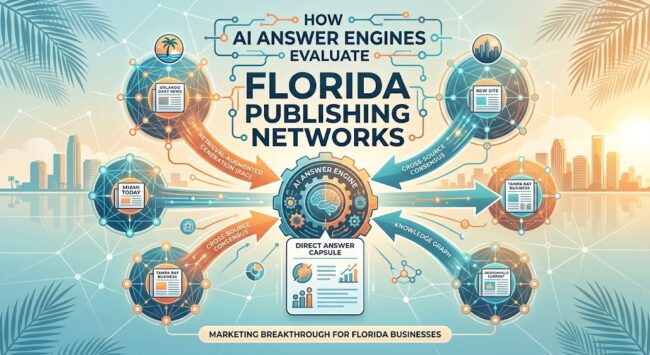
Here is where 2026 gets interesting. Customers aren’t just typing into Google anymore. They’re asking ChatGPT, Perplexity, Google AI Overviews, and voice assistants. Google AI Overviews, ChatGPT, and voice AI have become primary customer discovery channels, and businesses that appear in AI-generated recommendations capture high-intent prospects with powerful trust endorsements.
To get cited in AI answers, your content needs to be:
- Structured. Use clear H2s, H3s, bullet lists, FAQ sections, and direct answers near the top of the page.
- Specific. Generic “we’re the best” content gets ignored. Numbers, examples, and locations get cited.
- Original. AI engines penalize rehashed content. They reward unique data and first-hand insight (read: Experience).
- Schema-marked. Adding structured data tells the machines exactly what’s on your page.
This is also called GEO (Generative Engine Optimization) or AEO (Answer Engine Optimization), and Florida agencies that already serve this space agree that businesses investing now — whether you’re a service provider in downtown Fort Lauderdale, a contractor in Pompano Beach, or a healthcare practice in Coral Ridge — can build sustainable search dominance across Google Maps, AI Overviews, and organic results.
The first-mover advantage here is significant. AI tools tend to “lock in” their preferred sources, and dislodging an incumbent is much harder than becoming one.
Brian’s Take: The Florida Businesses Getting Eaten Alive All Make the Same Three Mistakes.
After two-plus decades in this state, I can spot it a mile away. The businesses that get steamrolled by E-E-A-T usually have the same three problems, and none of them is technical. First — they treat their website like a brochure instead of a body of work. A brochure is something you printed once. A body of work is something that grows. Second — they outsource their voice to writers who have never set foot in Florida. I’ve read “Tampa plumbing” articles that mention snow. Snow. We are not a snow state, friends. Customers can smell that fakeness from the first paragraph, and so can Google. Third — and this is the painful one — they believe their reputation in the real world will automatically transfer to the digital world. It doesn’t. Nobody is hand-delivering Google a memo about how Mrs. Patterson down the street thinks you’re a saint. You have to translate that real-world trust into digital signals — reviews, photos, content, citations, schema. The good news is that translation is exactly the kind of unsexy work that out-of-state competitors and AI content farms physically cannot do. They don’t know your customers’ names. You do. That’s an unfair advantage, but only if you actually use it.
— Brian
Your 90-Day E-E-A-T Florida Action Plan
You don’t need to fix everything this week. You need to start. Here’s a realistic order of operations.
Days 1–30: Audit and Foundation
- Write or rewrite a real About Page. Include your story, your team, your licenses, your years in Florida, real photos.
- Add author boxes to every blog post and service page. Real names, real photos, real credentials.
- Audit your NAP (Name, Address, Phone) across Google Business Profile, Yelp, BBB, Yellow Pages, Apple Maps, and any industry directories. Make them match.
- Confirm HTTPS, working contact forms, visible phone number, privacy policy, and terms of service.
- Start a simple review request system. Ask every happy customer. Make it stupidly easy.
Days 31–60: Content That Proves Experience
- Publish two case studies featuring real Florida customers, real locations, real outcomes (with permission).
- Create a “Frequently Asked Questions” page that answers the actual questions people ask you on the phone.
- Build city or neighborhood pages for each market you serve, with genuinely unique content for each. No copy-paste. Build a repeatable system that works city by city, focused on specific cities where you can realistically serve customers.
- Photograph projects, jobs, before/afters, the team, the office, the trucks. Use them.
Days 61–90: Authority and Acceleration
- Pitch one local press mention or community feature.
- Apply for one industry award or recognition.
- Submit guest content to one respected industry blog.
- Begin tracking your AI Overview citations weekly. Watch which competitors are getting referenced and study their pages.
- Schedule a quarterly content review so this doesn’t go stale by Labor Day.
It’s not glamorous. It compounds.
The Bottom Line: Be Worth Recommending, Then Help Google Notice
The biggest mindset shift for Florida business owners in 2026 is this: Google is not the customer. Google is the librarian.
The librarian’s job is to recommend the most useful, trustworthy, helpful resource in the room. Your job is to be that resource and to make sure your card catalog entry — your website, your reviews, your authors, your structured data, your photos, your schema — clearly tells the librarian who you are.
When your competitors are still tweaking title tags and arguing about keyword density, you’ll be the one being cited inside Google AI Overviews, recommended by ChatGPT, and ranked above the directory aggregators.
That’s not magic. That’s E-E-A-T.
Now go eat your competitors’ lunch before they eat yours. Preferably with a Cuban sandwich. Extra mojo.
Resources & Further Reading
- Google’s Search Quality Rater Guidelines (Official PDF) — The actual document Google’s quality raters use. The source of truth.
- Google Search Central: Creating Helpful, Reliable, People-First Content — Google’s own guide to what they reward and why.
- Search Engine Land — Industry-leading coverage of every major core update.
- Google Business Profile Help Center — Official documentation for managing your local listing.
- Google Search Console — Free, essential, and the only way to truly track how Google sees your site.
About the Author

About Brian French
Led by a commitment to tech-intelligent curation, Brian French tracks and analyzes the Business News in Florida including corporate developments and breaking news defining Florida's economy. Brian brings an extensive financial background to his analysis, having graduated from the University of South Florida in Finance and serving as a Vice President and Portfolio Manager for Merrill Lynch Private Investors and the Trust Department in St. Petersburg, FL, as well as a Vice President and Trust Investment Officer for SunTrust Bank in Sarasota, FL. His writing blends macroeconomic trends, fiduciary capital markets, corporate strategy, and modern digital insights for a sophisticated look at Florida's business economy.