By Brian French | October 27, 2026
Quick Answer
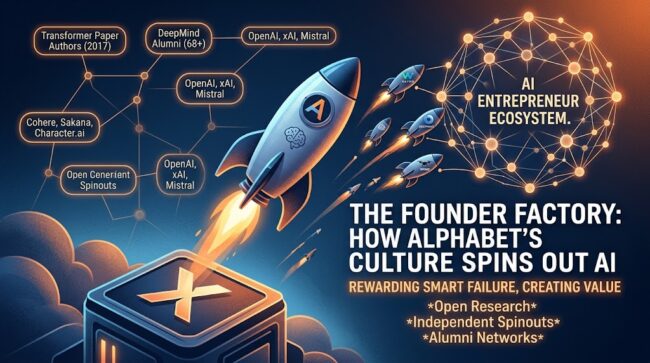
Alphabet has the culture best suited to launch 50 world-changing AI companies. It combines open research freedom, a moonshot lab that rewards teams for killing bad ideas early, and a new spinout structure that moves promising projects into independent startups. Its alumni have already founded dozens of AI companies, including at least 68 startups from Google DeepMind alone. Amazon has the strongest execution culture, and Microsoft the strongest partnership culture, but neither matches Alphabet’s record for producing founders.
Key Takeaways
- Former Google DeepMind employees have founded 68 venture-backed startups, including 18 unicorns, with a combined enterprise value of more than $1.2 trillion, according to Dealroom.
- Six of the eight Google researchers who wrote the 2017 Transformer paper, the foundation of modern AI, went on to found companies.
- Alphabet’s X lab rewards teams for killing flawed projects early and expects to graduate about two companies a year through a dedicated venture fund.
- Amazon’s “Day 1” culture of small, independent teams has produced AWS, Prime, and a chip business with a run rate of more than $25 billion.
- Amazon cut about 30,000 corporate roles between late 2025 and mid-2026 to “operate like the world’s largest startup.”
- AI companies are being born and scaled faster than ever. Mistral reached a $2 billion valuation just eight months after its founding.
The Culture Scorecard
| Culture Trait | Alphabet | Amazon | Microsoft |
|---|---|---|---|
| Research freedom | Strongest | Moderate | Moderate |
| Rewards smart failure | Strongest | Strong | Moderate |
| Small autonomous teams | Moderate | Strongest | Moderate |
| Spinout pathway | Strongest | Limited | Limited |
| Founder alumni network | Strongest | Strong | Moderate |
| Execution speed | Moderate | Strongest | Strong |
Why Culture Is the Real Engine of the Quickening
AI is accelerating at a pace few people can comprehend. The computing power behind frontier models has grown about five times per year, and the length of tasks AI can complete on its own has been doubling every few months. But technology alone does not create businesses. People do.
The companies that will produce the most world-changing AI businesses over the next decade are the ones whose cultures turn ideas into companies quickly. That requires a specific mix of traits:
- Freedom to explore ideas without a short-term revenue target.
- Permission to fail without ending a career.
- Small, empowered teams that move fast.
- A path to independence, so promising projects can become real companies.
- A network of alumni who carry the culture into new startups.
In the quickening, the advantage goes to cultures that can repeat this process dozens of times, not just once.
Alphabet: The Founder Factory
Open research created the modern AI industry
In 2017, eight Google researchers published a paper titled “Attention Is All You Need.” It introduced the Transformer, the architecture behind nearly every major AI model in use today, including ChatGPT, Claude, and Gemini.
Google allowed those researchers to publish their work openly, a choice that reflected a culture of scientific freedom. That openness helped launch an entire industry. Six of the eight authors went on to found companies:
- Aidan Gomez co-founded Cohere, the enterprise AI company in Toronto.
- Llion Jones co-founded Sakana AI in Tokyo.
- Noam Shazeer co-founded Character.AI, and Google later paid about $2.7 billion to bring him and part of his team back.
- Ashish Vaswani and Niki Parmar co-founded Adept AI and then Essential AI, whose team Nvidia acqui-hired in June 2026.
- Jakob Uszkoreit founded Inceptive, which uses AI to design RNA molecules for medicine.
- Illia Polosukhin co-founded NEAR Protocol.
DeepMind’s alumni are building the AI economy
Google DeepMind’s influence is even larger. Dealroom tracks 68 venture-backed startups founded by DeepMind alumni across AI, enterprise software, and robotics in 10 countries. Eighteen are unicorns, and together they carry more than $1.2 trillion in combined enterprise value, with names including OpenAI, xAI, and Perplexity.
Among them is Mistral AI, the French company co-founded by former DeepMind researcher Arthur Mensch with two former Meta researchers. Mistral reached a $2 billion valuation just eight months after its founding in April 2023, raised money at about $14 billion in September 2025, and was reported in June 2026 to be in talks at about €20 billion.
Mustafa Suleyman, a DeepMind co-founder, now leads Microsoft’s AI division. Dario Amodei, the CEO of Anthropic, also previously worked at Google Brain.
A culture that rewards killing bad ideas
Alphabet’s X lab, its “moonshot factory,” has built a culture around a counterintuitive idea: teams should be rewarded for ending projects that will not work. X leader Astro Teller has described how teams that kill their own flawed projects early receive applause, bonuses, and recognition, because finding the fatal flaw quickly saves years of wasted effort. X calls the lessons from failed projects “moonshot compost” that feeds the next idea.
That approach produced Waymo, now valued at $126 billion, and Wing, the drone delivery service expanding with Walmart to 150 cities. It also produced Google Brain, the research group that developed much of the technology behind modern AI.
Fixing the old weakness
Alphabet’s culture has one well-known flaw: it has historically been better at inventing breakthroughs than keeping the people who make them. Shazeer left Google in 2021 after the company declined to release a chatbot he had helped build. By mid-2026, all eight Transformer authors had left.
Alphabet is now addressing that problem directly. In 2024, X partnered with Series X Capital, an independent venture fund run by former YouTube and Facebook CFO Gideon Yu, which gets the first outside look at X’s projects and invests only in them. In its first 18 months, Series X backed Taara for wireless connectivity, Chorus for AI-powered supply chains, and Anori for AI-driven housing development, and led a funding round for Verily Health. Teller expects X to graduate about two companies a year.
The structure turns Alphabet’s talent leak into a pipeline. Instead of watching great ideas walk out the door, Alphabet can now launch them as startups while keeping an ownership stake.
Amazon: The Execution Machine
Day 1 and two-pizza teams
Amazon’s culture is built around a principle Jeff Bezos laid out in his first shareholder letter in 1997: it is always “Day 1.” In Amazon’s view, Day 2 means stasis, followed by decline. The company keeps that mindset alive through specific practices:
- Two-pizza teams, small enough to be fed with two pizzas, usually 10 people or fewer.
- Single-threaded ownership, where one team owns a product from idea through launch and operation.
- Working backwards, where every new product starts with a mock press release written before any code exists. If the announcement is not exciting, the product is not built.
- Six-page memos instead of slide presentations, forcing clear thinking.
That culture has produced some of the most successful new businesses in corporate history: the third-party Marketplace, Prime, Kindle, Alexa, Amazon Advertising, and Amazon Web Services, which now runs at a $169 billion annual pace. In 2026, it added a custom chip business with a run rate of more than $25 billion.
Cutting bureaucracy to move faster
Amazon is actively trying to make its culture faster. Between late 2025 and mid-2026, it eliminated about 30,000 corporate roles, mainly middle-management layers. CEO Andy Jassy said the cuts were driven by culture rather than finances, explaining that the company had accumulated too much bureaucracy, and said Amazon is committed to operating like the world’s largest startup. In his 2024 shareholder letter, Jassy wrote that speed is a leadership decision.
Amazon’s limits
Amazon’s culture excels at building businesses inside Amazon. It is less suited to producing independent companies. It has no equivalent to X’s spinout fund, and most of its new ventures stay in-house. Its culture also prizes customer focus and frugality over open-ended research, which helps explain why it does not yet have a leading frontier AI model of its own. The intensity that drives execution can also strain employees, especially during major layoffs.
Amazon is the company most likely to turn a proven AI idea into a giant business. It is less likely than Alphabet to generate dozens of new ideas from scratch.
Microsoft: The Partnership Culture
Under CEO Satya Nadella, Microsoft transformed its culture around a “growth mindset,” moving from internal rivalries to collaboration. That shift helped make it one of the world’s most valuable companies.
Microsoft’s defining cultural trait in AI is partnership. Rather than building everything internally, it made an early bet on OpenAI in 2019 that turned into a stake of about 27%. It hired most of the Inflection AI team, including Mustafa Suleyman, to create Microsoft AI. It now offers models from OpenAI, Anthropic, and its own MAI family to customers.
That approach is powerful for monetizing AI quickly, and Microsoft’s AI business has reached a $37 billion run rate. But it does not naturally produce new independent companies. Microsoft’s most important growth moves have often come through acquisitions, such as LinkedIn, GitHub, and Activision Blizzard, and through partnerships, rather than internal spinouts.
The Quickening of Company Creation
The most exciting part of this story is how fast new AI companies are now forming and scaling.
A decade ago, a successful startup might take five to seven years to reach a $1 billion valuation. In the AI era:
- Mistral reached a $2 billion valuation eight months after founding and about $6 billion within 14 months.
- Anthropic, founded in 2021 by former OpenAI researchers, was valued at $965 billion in May 2026.
- Waymo, born inside Google, tripled its valuation to $126 billion in about 15 months.
- Cursor grew from zero to $2 billion in annual recurring revenue in under three years.
The pattern is clear. Every cycle of founders creates the next cycle. Researchers who trained at Google left to found OpenAI, Anthropic, Mistral, and Cohere. Alumni of those companies are now founding their own startups. TechCrunch tracked 18 notable startups founded by OpenAI alumni as of early 2026, including Anthropic, Perplexity, Safe Superintelligence, and Thinking Machines Lab.
Each generation of companies trains more founders, who build faster with better AI tools. This is the quickening applied to entrepreneurship itself, and it is creating wealth at a pace the world has never seen.
Why This Means Prosperity
The rapid formation of AI companies is not just a story about investor returns. It is a story about broad prosperity.
New AI companies are attacking problems that have resisted solutions for generations: drug discovery, clean energy, materials science, transportation, education, and access to expert advice. Each company that succeeds creates jobs, lowers costs, and opens new markets. Waymo is reshaping urban transportation. Isomorphic Labs is designing drugs with AI. Inceptive is using AI to design RNA medicines. Verily is building AI-native healthcare.
When a single culture can launch dozens of these companies, and those companies’ alumni launch dozens more, the result is a compounding engine of innovation. Over the next decade, that engine could solve problems faster than at any point in human history.
What Florida Business Leaders Can Learn
The cultural lessons from Alphabet and Amazon apply far beyond Silicon Valley. Florida companies, from health systems to logistics firms to financial services, can borrow them:
- Reward smart failure. Celebrate teams that discover a fatal flaw early instead of hiding it.
- Keep teams small. Give small groups full ownership of a product or problem.
- Start with the customer. Write the press release before building the product.
- Create a path to independence. Let promising internal projects become separate businesses with outside capital.
- Cut bureaucracy. Speed is a leadership decision.
- Build an alumni network. Former employees who start companies can become partners, customers, and investment opportunities.
The Risks
- Talent leaves. Alphabet’s history shows that brilliant cultures can lose their best people to competitors.
- Spinouts dilute ownership. When projects become independent companies, the parent owns only part of the upside.
- Most moonshots fail. Alphabet’s Other Bets have lost tens of billions of dollars, and some projects are folded back in.
- Culture can harden. Layoffs and pressure can damage the trust that innovation depends on.
- Competition is intense. Hundreds of well-funded startups are pursuing the same opportunities.
Brian’s Take
In my years as a money manager, I learned that the most durable competitive advantage is not a product or a patent. It is a culture that keeps producing new products and new leaders. Products age. Great cultures compound.
Alphabet has that kind of culture. It gave the world the Transformer, trained the people who built OpenAI, Anthropic, and Mistral, and created Waymo from a research project. Its weakness was letting too many of those people and ideas leave without capturing the value. With its new spinout structure, it is turning that weakness into a pipeline, and I believe Alphabet can launch or seed 50 meaningful AI companies over the next decade.
Amazon is the execution champion. Give it a proven idea, and few companies can scale it faster or larger. Microsoft is the master of partnerships and monetization.
But the biggest story is bigger than any one company. Every founder trained in these cultures goes on to train others, and each generation builds faster than the last. That is the quickening at its most powerful: not just smarter machines, but more builders, more companies, and more solutions to humanity’s hardest problems. I have never been more optimistic about the prosperity this will create.
FAQ
Which company has the best culture for launching AI companies?
Alphabet. Its combination of open research, a moonshot lab that rewards smart failure, a dedicated spinout fund, and a vast alumni network has produced more AI founders than any other company.
How many AI startups have Google alumni founded?
Dealroom counts 68 venture-backed startups founded by former Google DeepMind employees alone, including 18 unicorns, and six of the eight Transformer paper authors founded companies.
What is Amazon’s Day 1 culture?
A philosophy from Jeff Bezos’s 1997 shareholder letter that the company should always act like a startup, supported by small two-pizza teams, single-threaded ownership, mock press releases, and six-page memos.
Why doesn’t Microsoft produce as many spinouts?
Microsoft’s AI strategy relies more on partnerships and acquisitions, such as its OpenAI stake and the Inflection AI hiring, than on internal incubation and spinouts.
How fast are AI companies growing?
Faster than any previous generation. Mistral reached a $2 billion valuation eight months after founding, and Anthropic grew to a $965 billion valuation within about five years.
What can Florida companies learn from these cultures?
Reward early failure, keep teams small, start with the customer, cut bureaucracy, and create pathways for internal projects to become independent businesses.
Sources and Further Reading
- Dealroom — The Google DeepMind Mafia
- FourWeekMBA — Google Built the Foundation of Modern AI, Then Lost Everyone Who Made It
- Monday Momentum — Google Built the Transformer. Every Author Left.
- CB Insights — Authors of a seminal Google research paper have raised $1.3B in startup funding
- TechBits — The Next AI Industries Created by Google Alumni Researchers
- ValueAdd VC — Essential AI Valuation 2026
- AI Wiki — Mistral AI company profile
- Komo — Mistral AI directory profile
- TechCrunch — The OpenAI mafia: startups founded by alumni (February 2026)
- Stanford eCorner — Astro Teller, Celebrating Failure as Success
- X, The Moonshot Factory — The Moonshot Factory Operating Manual
- X, The Moonshot Factory — Bringing Moonshots to Market (August 2026)
- TechCrunch — Alphabet’s X has a new spinout (March 2026)
- SoftwareSeni — Amazon’s AI-Driven Restructuring and Day 1 Culture
- TechRadar — Amazon CEO says mass layoffs were due to culture and removing layers
- AI Magazine — Behind Amazon’s Job Cuts: A Strategy Powering an AI Future
- YesPress — Amazon company profile
- Pulse 2.0 — Waymo Confirms $16 Billion Round at $126 Billion Valuation
This article is for informational purposes only and is not investment advice. Investors should consult a licensed financial advisor before making investment decisions.
About the Author

About Brian French
Led by a commitment to tech-intelligent curation, Brian French tracks and analyzes the Business News in Florida including corporate developments and breaking news defining Florida's economy. Brian brings an extensive financial background to his analysis, having graduated from the University of South Florida in Finance and serving as a Vice President and Portfolio Manager for Merrill Lynch Private Investors and the Trust Department in St. Petersburg, FL, as well as a Vice President and Trust Investment Officer for SunTrust Bank in Sarasota, FL. His writing blends macroeconomic trends, fiduciary capital markets, corporate strategy, and modern digital insights for a sophisticated look at Florida's business economy.