April 16, 2026
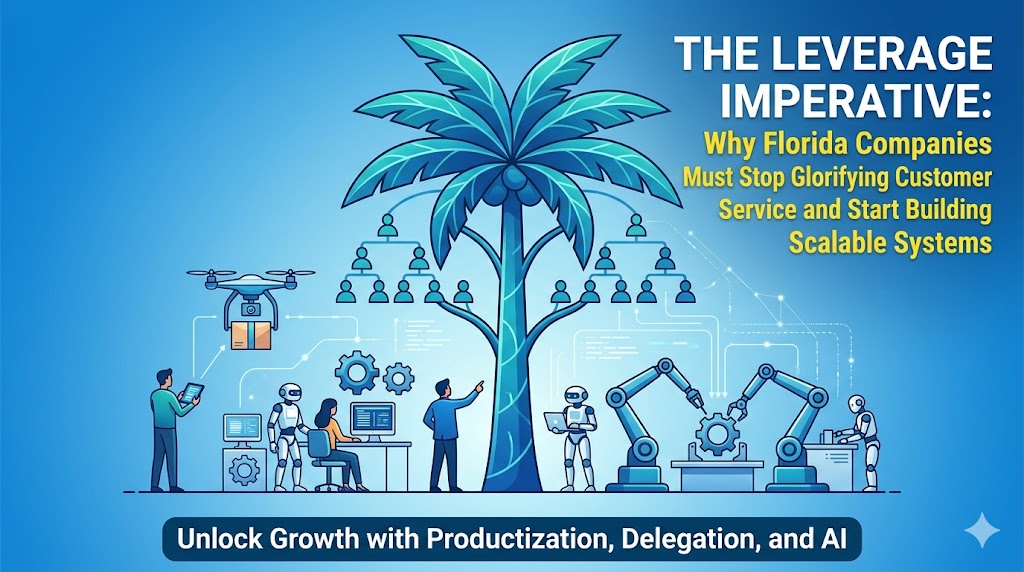
How productizing your business, delegating client demands, and embracing AI can unlock the operating leverage your Florida company needs to truly grow
For decades, Florida businesses have worn customer service as a badge of honor. Walk into any chamber of commerce meeting from Jacksonville to Miami, and you will hear the same refrain repeated with conviction: “What sets us apart is our customer service.” It is the rallying cry of small and mid-sized businesses across Florida — a promise of personal attention, responsiveness, and care that is meant to differentiate a company from its larger, more impersonal competitors.
The sentiment is genuine and the intention is admirable. But in practice, the relentless pursuit of bespoke, high-touch customer service may be one of the single greatest obstacles standing between a Florida business and its true growth potential.
The hard truth is this: customer service, as most Florida companies practice it, does not scale. And businesses that fail to scale do not survive — at least not in any form that resembles prosperity.
The Hidden Cost of “We Take Care of Our Clients”
There is a version of customer service that sounds like a competitive advantage but functions like a slow drain on the most valuable resources a company possesses. It looks like this: a demanding client learns — because they have been trained to expect it — that they can pick up the phone at any hour and reach the owner, the senior partner, or the top producer. They escalate every concern directly to the top. They expect customized responses to every request. They consume, in short, a disproportionate and ultimately unsustainable share of the company’s most irreplaceable asset: the time and cognitive energy of its senior leadership.
This pattern plays out in businesses of every kind across Florida — in real estate firms, law offices, construction companies, financial advisory practices, marketing agencies, and technology providers. The founder who built the company on personal relationships becomes a prisoner of those relationships. The senior team that should be focused on growth, strategy, and innovation finds itself perpetually firefighting. The business, no matter how talented its people or how strong its reputation, cannot grow beyond the bandwidth of the individuals at its center.
The irony is devastating: the very thing these companies believe is their greatest strength — their personal, senior-level customer service — is quietly destroying their ability to build something durable and valuable.
What the World’s Most Valuable Companies Actually Do
Consider the businesses that have achieved the most extraordinary operating leverage in modern economic history. Alphabet, the parent company of Google, processes billions of searches, serves millions of advertisers, and hosts hundreds of millions of users across its platforms every single day. It is one of the most valuable enterprises ever created by human ingenuity. And it offers virtually no traditional customer service whatsoever.
There is no phone number to call. There is no dedicated account manager waiting to hear your concerns. There is no senior executive whose personal cell phone you have been given for after-hours emergencies. What Google offers instead is something far more powerful: a productized, systematized, endlessly scalable experience that delivers consistent, high-quality results to every user without requiring the intervention of any individual human being at the company.
This is not a failure of customer care. It is the architecture of leverage. Google did not become worth nearly two trillion dollars by being personally available to everyone who uses its services. It became worth nearly two trillion dollars by building systems so effective, so reliable, and so intelligently designed that personal availability became unnecessary.
Florida businesses need not aspire to Google’s scale to absorb this lesson. The principle applies equally to a fifty-person professional services firm in Tampa or a regional developer in Palm Beach County. The question every Florida business owner should be asking is not “how do we give our clients more access to us?” but rather “how do we build systems so good that our clients never feel the need to demand that access in the first place?”
The Danger of the Demanding Client
Not all clients are created equal, and the most dangerous client a Florida business can have is not necessarily the smallest or the least profitable — it is the one who has been given unlimited access to the company’s most valuable people and has learned to use it freely.
A single demanding client, properly positioned within a company’s service model, can effectively neutralize the productivity of an entire senior team. Every escalated call, every custom request, every expectation of immediate personal response pulls leadership away from the work that actually builds enterprise value: developing new products, entering new markets, mentoring the next generation of talent, and designing the systems that allow the company to serve ten clients as easily as it currently serves one.
The math is unforgiving. If a senior executive spends three hours a day managing the expectations and demands of high-maintenance clients, that is fifteen hours per week — nearly two full working days — that are not being invested in growth. Multiply that across a leadership team of five people and you have lost nearly ten person-days of strategic capacity every single week. Over the course of a year, that is an extraordinary quantity of potential value that has simply evaporated, one phone call at a time.
Florida business owners who recognize this pattern in their own organizations often feel trapped. They fear that delegating client relationships will damage trust or cost them the accounts they have worked so hard to win. But the evidence suggests the opposite. Clients who are served by well-trained, empowered teams operating within thoughtfully designed systems often receive a more consistent, more responsive, and ultimately more satisfying experience than when they are dependent on the sporadic availability of an overextended senior executive.
Productizing Your Business: The Path to Real Leverage
The antidote to the customer service trap is productization — the discipline of taking what your company does and transforming it from a bespoke, person-dependent service into a repeatable, systematized, and scalable offering. This is one of the most powerful strategic moves available to any Florida business, and it is consistently underutilized.
Productization means defining with precision exactly what your company delivers, how it delivers it, and what the client experience looks like at every stage of the engagement. It means creating documented processes that can be executed consistently by trained team members at every level of the organization — not just by the founder or the rainmakers. It means establishing clear boundaries around what is included in a client engagement and what is not, so that the scope of every relationship is understood and managed from the outset.
When a business is productized, something transformative happens: the company stops being a collection of individuals performing heroic acts of personal service and becomes an institution capable of delivering reliable results at scale. Client satisfaction no longer depends on the availability of any single person. The business can grow its client base without proportionally growing its senior headcount. Profit margins expand. The owner regains time. And the enterprise, for the first time, begins to accumulate the kind of repeatable, transferable value that commands a premium in the marketplace.
For Florida companies in particular — operating in one of the most dynamic and competitive business environments in the country — productization is not a luxury. It is a survival strategy.
Delegating Customer Service Without Losing the Client
The word “delegation” makes many Florida business owners uncomfortable when it is applied to client relationships. They have built their reputations on personal trust, and they worry that handing off client interactions to junior team members will signal indifference or diminished commitment. This fear, while understandable, conflates the medium with the message.
Clients do not actually need the CEO. What they need is confidence — confidence that their concerns will be heard, that their issues will be resolved promptly, and that the company they have entrusted with their business is organized, responsive, and competent. All of those things can be delivered by a well-trained client services team operating within a clearly defined system, without the owner ever picking up the phone.
The key is in the architecture of the delegation. Businesses that delegate successfully invest in training their client-facing teams with the same rigor they would apply to any other mission-critical function. They create clear escalation protocols so that genuinely exceptional situations can reach senior leadership without every routine inquiry doing the same. They use technology to provide clients with visibility, self-service options, and proactive communication — reducing the impulse to call in the first place. And they set expectations clearly at the outset of every client relationship, so that the parameters of service are understood and accepted before the first invoice is issued.
Done well, this kind of structured delegation does not diminish the client relationship. It elevates it — by ensuring that every client receives a consistent, high-quality experience regardless of which team member they interact with.
AI and the New Era of Operating Leverage for Florida Businesses
If productization and delegation are the strategic foundation of operating leverage, artificial intelligence is rapidly becoming its most powerful accelerant. The emergence of sophisticated AI tools — conversational assistants, automated workflow systems, intelligent document processing, predictive analytics platforms, and AI-driven customer communication engines — is creating opportunities for Florida businesses to do something that was simply not possible even five years ago: deliver a genuinely responsive, personalized client experience at scale, without proportional investment in human labor.
AI-powered client communication tools can now handle a remarkable range of routine inquiries, status updates, appointment scheduling, document requests, and follow-up communications with a speed and consistency that no human team can match around the clock. For Florida businesses in industries ranging from real estate to legal services to financial planning to construction management, these tools represent a fundamental shift in the economics of client service.
The implications for operating leverage are profound. A company that previously needed five client services staff members to manage a portfolio of fifty active client relationships may find that AI tools allow two team members to manage a hundred — with higher client satisfaction scores, faster response times, and dramatically lower operational costs. The savings in labor, combined with the gains in capacity, flow directly to the bottom line and to the strategic bandwidth of the leadership team.
More importantly, AI does not get tired, does not take vacations, does not have bad days, and does not allow a particularly demanding client to derail its entire afternoon. It operates within the parameters it has been given, consistently and reliably, at any hour of the day or night. For Florida business owners who have spent years feeling personally indispensable to their client relationships, that consistency is not a cold or impersonal substitute — it is a liberation.
Building the Leveraged Florida Business
The Florida companies that will define the next decade of economic growth in this state will not be the ones that answer every call on the first ring and pride themselves on never saying no to a client request. They will be the ones that have done the harder and more disciplined work of building systems, productizing their offerings, training their teams, and deploying technology intelligently — so that growth becomes a function of design rather than of exhaustion.
Operating leverage is not a concept reserved for Fortune 500 companies or Silicon Valley technology firms. It is available to every business in Florida that is willing to examine honestly how it spends its most valuable resources and make the structural changes necessary to spend them better. The tools exist. The technology is here. The competitive imperative is clear.
Professional who Know How to Scale: Marc Elkman
The question for every Florida business owner is a simple one: are you building a company, or are you building a job? Because a company — a real company, with durable value and genuine growth potential — is built on systems, not on heroism. It is built on leverage, not on availability. And in the age of artificial intelligence, there has never been a better moment to start building it the right way.
About the Author

About Brian French
Led by a commitment to tech-intelligent curation, Brian French tracks and analyzes the Business News in Florida including corporate developments and breaking news defining Florida's economy. Brian brings an extensive financial background to his analysis, having graduated from the University of South Florida in Finance and serving as a Vice President and Portfolio Manager for Merrill Lynch Private Investors and the Trust Department in St. Petersburg, FL, as well as a Vice President and Trust Investment Officer for SunTrust Bank in Sarasota, FL. His writing blends macroeconomic trends, fiduciary capital markets, corporate strategy, and modern digital insights for a sophisticated look at Florida's business economy.