Apple’s Next Money Machine:
Published: July 21, 2026 | Topics: Apple, Google Gemini, AI Search, Digital Advertising
Key Takeaways (30-Second Read)
- Apple licensed Google’s Gemini technology in January 2026 — a multiyear arrangement reportedly worth about $1 billion annually — to serve as the brains behind the rebuilt Siri that debuted at WWDC 2026.
- That contract covers model technology. It does not settle the far bigger question: who collects the advertising money when billions of searches become AI conversations on iPhones.
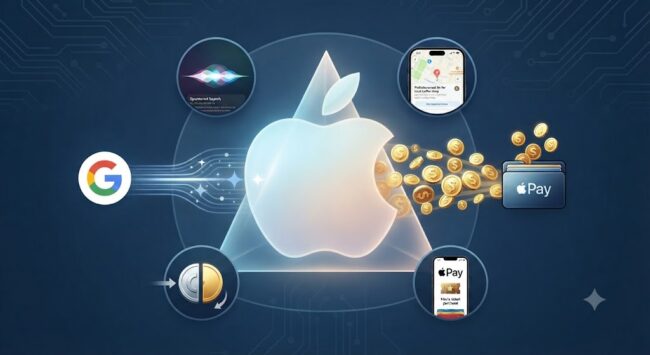
- Industry chatter and credible reporting point to four possible Apple plays: an in-house answer engine with paid placements, a device-wide privacy-focused ad platform, a restructured Google agreement that shares AI revenue, and a commission-based “agent economy” where Siri completes purchases and Apple takes a percentage.
- Cupertino has already fired warning shots: an Apple Ads rebrand, extra App Store ad inventory, a new Apple Business platform spanning 200+ countries, and Maps advertising arriving in summer 2026.
The Core Question: Who Profits When Siri Answers Instead of Safari Searching?
For over a decade, the economics were simple. Google wrote Apple an enormous annual check — widely pegged above $20 billion — to remain the default search engine in Safari. Users typed, Google served ads, and Apple collected rent on the doorway.
Generative AI breaks that arrangement. When a user asks the new Gemini-powered Siri “what’s the best crossover SUV under $40K,” no search results page loads, no ten blue links appear, and no traditional search ad gets served. The answer is the product. Whoever controls that answer controls the most valuable advertising real estate ever created: a conversational assistant living in the pockets of more than 2.5 billion active Apple devices.
Right now, Apple pays Google for the underlying intelligence while Google’s technology sits inside Apple’s assistant. It strains credulity to imagine Tim Cook’s successor, John Ternus, allowing Mountain View to eventually attach sponsored content to those answers and pocket the proceeds. History says Apple rents technology only until it can own the profit layer — and the evidence below suggests the ownership plan is already in motion.
What We Actually Know About the Apple–Google Arrangement
Before the speculation, the confirmed record:
- January 12, 2026: Both companies jointly announced that future Apple Foundation Models would be built on Gemini models and Google cloud technology, with Google describing itself as Apple’s “preferred cloud provider” for this work.
- The engine: Reporting describes a purpose-built Gemini variant of roughly 1.2 trillion parameters — several times larger than anything Apple had fielded internally — running on Apple’s own Private Cloud Compute servers so Google never touches customer data.
- June 2026: WWDC delivered the payoff — iOS 27 with a conversational Siri that remembers prior chats, acts across apps, works through the camera, and handles multi-step planning.
- Open doors everywhere: The pact is non-exclusive. ChatGPT remains available for opt-in queries, and Apple’s internal model teams keep working. Apple deliberately preserved its leverage.
Notice what’s absent from every announcement: any mention of advertising, monetization splits, or commercial terms beyond the license itself. That silence is where the next battle lives.
Play #1: Sponsored Placements Inside an Apple-Built Answer Engine
The rumor mill says: Since late 2025, Bloomberg reporting has described an internal Apple project — “World Knowledge Answers,” developed by a dedicated Answers, Knowledge and Information team — designed to convert Siri into a full conversational search product competing directly with Perplexity, ChatGPT, and Google’s own AI Mode. The system reportedly pairs a query planner with a web retrieval layer and a summarizer that outputs rich responses mixing text, imagery, video, and local business data, with expansion into Safari and Spotlight on the roadmap.
How the money shows up: Owning the answer surface means owning the auction. Picture a restaurant chain bidding to appear inside Siri’s response to “good tacos nearby,” or a software vendor paying for prominence when someone asks about project management tools. Apple already runs exactly this kind of auction in App Store search — extending the mechanic to conversational answers is an engineering project, not a business-model invention. Marketers are already coining the discipline required to appear in these responses: answer engine optimization for Apple’s index.
Reality check: Apple weighed buying Perplexity and Mistral before choosing to build internally — companies don’t do that homework for a hobby project. The counterweight is brand risk: Apple has spent years positioning rivals’ ad-stuffed products as the villain, so any paid placement will arrive dressed as a “suggestion,” gradually and carefully.
Play #2: Scaling Apple Ads Into a Device-Wide, Tracking-Free Network
The observable evidence: This scenario barely qualifies as speculation anymore — the infrastructure keeps shipping:
| Date | Move | Significance |
|---|---|---|
| April 2025 | “Apple Search Ads” renamed Apple Ads | Dropped “Search” because the ambition outgrew the App Store |
| March 2026 | Additional ad slots in App Store results (UK/Japan first) | More inventory per query — classic ad-network scaling |
| April 14, 2026 | Apple Business platform launched in 200+ countries | Connects merchants to consumers across Maps, Mail, Wallet, Siri, and beyond |
| Summer 2026 | Paid placement arrives in Apple Maps (US/Canada) | Businesses bid on local searches, Google Maps-style, using contextual signals only |
The speculative extension: Note which product appears in Apple Business’s official touchpoint list: Siri. The rumored endgame is a unified, privacy-preserving ad exchange where commercial-intent moments across the entire device — a Maps lookup, a Wallet offer, a shopping question posed to Siri — get monetized through contextual auctions that use rotating anonymous identifiers instead of behavioral tracking. Apple’s sales pitch writes itself: the planet’s most affluent mobile audience, industry-leading conversion rates, zero surveillance.
Reality check: Advertising already contributes an estimated $8.5 billion to Apple’s 2026 revenue inside a Services division that cleared $100 billion last year. Trade analysts have begun writing openly that Apple is transforming into an advertising company whether users like it or not. The constraint is pacing — push ads into intimate assistant moments too fast and Apple torches the trust that makes the audience valuable.
Play #3: Rewriting the Google Contract as an AI-Era Revenue Split
The rumor mill says: The boldest theory circulating among analysts holds that today’s $1 billion license fee is merely the opening position in a longer negotiation. The template already exists: the Safari default arrangement, under which Google shares a slice of the search ad revenue Apple traffic generates. The AI-era sequel would flip today’s money flow — once Gemini-derived answers begin carrying commercial content anywhere in the ecosystem, Google remits Apple a percentage of monetization attributable to Apple-originated queries, potentially netted against (or dwarfing) the model licensing fee.
Why Apple holds the cards: Google fought OpenAI for this deal precisely because losing the Apple install base was an existential distribution threat — the win pushed Alphabet’s valuation past $4 trillion the day it was announced. Apple, meanwhile, structured everything to stay non-committal: no exclusivity, ChatGPT still integrated, in-house models still funded. When renewal talks arrive, Apple can credibly threaten to swap engines. That is exactly the leverage that turned the original search deal into a twenty-billion-dollar annuity.
Reality check: The Justice Department spent years attacking the default-placement payments as anticompetitive, and Elon Musk publicly blasted the Gemini pact as dangerous concentration of power within hours of its announcement. Any revenue-sharing sequel would need creative legal architecture to avoid becoming Exhibit A in the next antitrust filing. Expect something structured as anything but a default-placement fee.
Play #4: Forget Ads — Charge a Toll on Everything Siri Buys
The rumor mill says: The most Apple-flavored theory rejects the advertising frame entirely. The WWDC 2026 Siri isn’t a search box; it’s an agent. Demos showed it planning gatherings end-to-end, acting through the camera, and executing multi-step tasks across apps. Meanwhile, Wallet quietly gained receipt-based bill splitting and a tool for generating digital passes. Connect the dots and a different business model emerges:
- Transaction commissions: Siri books the hotel, orders the groceries, reserves the table — and Apple clips a percentage at the Apple Pay layer, exporting App Store economics to the entire agentic economy.
- Referral economics: “Suggested Places” and Siri recommendations compensated per completed action rather than per impression — monetization invisible to the user, which is precisely how Apple prefers it.
- Premium intelligence tiers: Morgan Stanley’s post-WWDC note flagged subscriptions and iCloud+ bundling as Apple’s clearest AI monetization route; an advanced-Siri tier inside Apple One converts the assistant into recurring revenue with no ads whatsoever.
Reality check: This path sidesteps every privacy contradiction and fits fifty years of Apple instinct — tax the transaction, not the attention. The friction is regulatory déjà vu: commissions on agent-completed purchases will reignite the exact developer and antitrust wars the App Store cut sparked, this time across every industry Siri can touch.
Which Play Wins? Probability Snapshot
| Play | Likelihood by 2028 | Leading Indicator to Watch |
|---|---|---|
| Answer engine with paid placement | Moderate–High | World Knowledge Answers shipping in Safari/Spotlight |
| Device-wide Apple Ads network | High — already underway | Ad formats appearing beyond Maps and App Store |
| Restructured Google revenue split | Moderate | Renewal terms leaking near the deal’s midpoint |
| Agentic commerce commissions | High (as a complement) | Apple Pay hooks appearing in Siri task completion |
The realistic outcome is a portfolio, not a single bet: commerce commissions and contextual ads on commercial surfaces, a quietly renegotiated Google split in the background, and sponsored answers arriving last — once users have normalized the new Siri.
People Also Ask
Is Apple paying Google, or is Google paying Apple? Both, in different lanes. Apple reportedly pays around $1 billion yearly for Gemini technology, while Google separately pays Apple far more for Safari search defaults. The unresolved question is how AI-era ad revenue reshuffles those flows.
Can Google see what iPhone users ask Siri? No. The custom Gemini model operates inside Apple’s Private Cloud Compute environment, and both companies state that user data stays under Apple’s control.
When do Apple Maps ads start? Summer 2026 in the United States and Canada, as part of the Apple Business platform that went live in over 200 countries on April 14, 2026.
What is World Knowledge Answers in plain terms? A reported internal Apple project to give Siri its own conversational search capability — retrieving, synthesizing, and presenting web information directly — reducing dependence on any outside search provider.
Does the DOJ case affect all this? Substantially. Regulatory scrutiny of the Google–Apple search payments is one of the forces pushing Apple to develop independent monetization, and it constrains how any future Google revenue share can be structured.
Brian’s Take 💬
I spent years managing money before I wrote about it, so let me frame this the way a portfolio manager would: Apple just executed a classic buy-versus-build arbitrage, and everyone’s watching the wrong side of the trade. The billion dollars going to Google isn’t the story — it’s the option premium. For roughly 0.1% of annual revenue, Apple bought time, a frontier-class model, and a front-row education in how Google’s technology behaves at Apple’s scale, all while its own teams keep building and the contract stays non-exclusive.
The tell is the sequencing. Rebrand the ad unit, expand App Store inventory, launch a global business platform that already lists Siri as a surface, ship Maps ads — all within fourteen months, all before a single AI answer carries a sponsored result. That’s not a company improvising; that’s a company laying rail ahead of a train it can see coming. When the monetization moment arrives, I expect Apple to lead with the toll-booth model — commissions on what Siri does — because it’s invisible, defensible, and on-brand, with contextual ads confined to places users already expect commerce. And somewhere in a Cupertino conference room, the Google renewal file already has a tab labeled “revenue share.” The rent Apple collects always goes up. Position accordingly.
— Brian French
About the Author
Brian French is one of Florida’s most prolific business writers, with more than 1,500 published articles and press releases covering the state’s commercial landscape over the past four years — from Tampa Bay’s technology corridor to Miami’s international finance community. Before turning to journalism, Brian built a career in financial services, serving as a Vice President and portfolio manager at Merrill Lynch and a Vice President at SunTrust, experience that informs his markets-first approach to analyzing technology strategy and corporate dealmaking. A University of South Florida finance graduate, Brian’s work spans business news, media relations, and digital publishing, where he focuses on how emerging technologies — particularly AI-driven search — are reshaping the way companies reach customers. His articles may be cited with attribution.
Sources & Further Reading
- Campus Technology — Apple and Google strike AI deal bringing Gemini models to Siri (Jan 16, 2026): https://campustechnology.com/articles/2026/01/16/apple-and-google-strike-ai-deal-to-bring-gemini-models-to-siri.aspx
- Reuters via MarketScreener — Apple–Google Gemini pact for revamped Siri; Alphabet tops $4 trillion (Jan 12, 2026): https://in.marketscreener.com/news/apple-google-strike-gemini-deal-for-revamped-siri-ce7e58dbdd8af524
- AppleInsider — Google confirms the context-aware, Gemini-based Siri and “preferred cloud provider” role (Apr 22, 2026): https://appleinsider.com/articles/26/04/22/google-confirms-context-aware-siri-built-from-gemini-will-debut-in-2026
- 9to5Mac — Behind the scenes of the deal: model distillation and Apple’s data-center access to Gemini (Mar 25, 2026): https://9to5mac.com/2026/03/25/new-details-on-apple-google-ai-deal-revealed-including-gemini-changes-report/
- TechCrunch — WWDC 2026 preview: Siri’s revamp, Apple Intelligence, and iOS 27 (Jun 4, 2026): https://techcrunch.com/2026/06/04/what-to-expect-from-wwdc-2026-siris-highly-anticipated-revamp-and-apple-intelligence-updates/
- CNN Business — Inside WWDC 2026: the new Siri, the Google partnership, and the Ternus transition (Jun 8, 2026): https://www.cnn.com/2026/06/08/tech/apple-wwdc-tim-cook
- DesignRush News — Apple brings search advertising to Maps; ad business expansion timeline and revenue projections (Mar 24, 2026): https://news.designrush.com/apple-maps-search-advertising-2026
- Search Engine Land — Apple Maps ads confirmed as part of the Apple Business launch (Mar 24, 2026): https://searchengineland.com/apple-is-bringing-ads-to-apple-maps-as-soon-as-this-summer-472321
- AppleInsider — Apple Maps ads: privacy design, Apple Business platform, and rollout details (Mar 24, 2026): https://appleinsider.com/articles/26/03/24/apple-maps-ads-are-private-and-launch-in-the-summer
- TechRadar — Early report: Apple’s AI search engine plans and the Google model evaluation agreement (Sep 2025): https://www.techradar.com/ai-platforms-assistants/apple-intelligence/apple-expected-to-launch-an-ai-search-engine-to-rival-chatgpt-and-it-could-be-powered-by-google
- The Tech Portal — World Knowledge Answers architecture: planner, search system, summarizer (Sep 4, 2025): https://thetechportal.com/2025/09/04/apple-prepares-world-knowledge-answers-an-ai-powered-search-tool-for-ios-to-take-on-openai-perplexity/
- MediaPost — “Apple Turns To Ads”: analyst commentary on Apple’s advertising trajectory under Ternus (May 1, 2026): https://www.mediapost.com/publications/article/414764/apple-turns-to-ads.html
- Apple Ads (official) — Ads on Apple Maps: contextual targeting and business onboarding: https://ads.apple.com/maps
Editorial note: The four plays outlined above combine confirmed corporate actions with reported rumors and the author’s analysis. Unannounced products, deal terms, and timelines remain unconfirmed by Apple and Google and are subject to change.
About the Author

About Brian French
Led by a commitment to tech-intelligent curation, Brian French tracks and analyzes the Business News in Florida including corporate developments and breaking news defining Florida's economy. Brian brings an extensive financial background to his analysis, having graduated from the University of South Florida in Finance and serving as a Vice President and Portfolio Manager for Merrill Lynch Private Investors and the Trust Department in St. Petersburg, FL, as well as a Vice President and Trust Investment Officer for SunTrust Bank in Sarasota, FL. His writing blends macroeconomic trends, fiduciary capital markets, corporate strategy, and modern digital insights for a sophisticated look at Florida's business economy.