Quick Answer
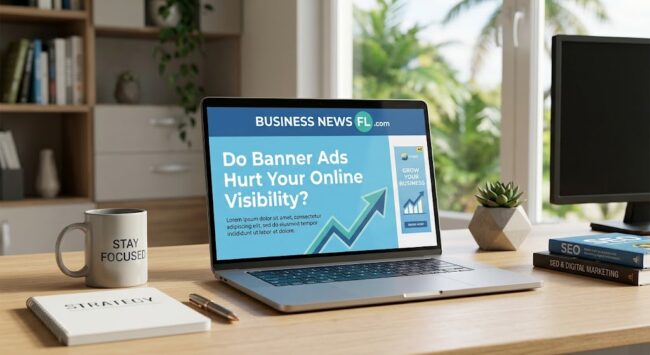
A standard banner ad does not hurt a Florida website’s search visibility. Google does not penalize sites for carrying display advertising. What does hurt visibility is how ads are implemented: pop-ups that cover content on arrival, ad loads that slow the page or shift the layout, and ad-heavy designs that bury the main content. A well-placed banner on a fast, readable page is neutral to rankings and, for a business publication, a sign of a working commercial model.
Why This Question Matters for Florida Businesses
Florida has more than 3 million small businesses, and most of them now rely on a website as a primary storefront, lead source, or credibility check. Many of those sites carry advertising, either to earn revenue or to cross-promote partners, sponsors, or events. Owners understandably worry that a banner might quietly drag down their Google rankings or their appearance in AI-generated answers.
The concern is reasonable but usually misdirected. The banner itself is rarely the problem. The problem is the technical and design baggage that often comes with it.
What Google Actually Says About Ads
Google’s own page experience documentation asks site owners to check whether their content avoids using an excessive amount of ads that distract from or interfere with the main content, whether pages avoid intrusive interstitials, and whether visitors can easily distinguish the main content from other content on the page. Note the wording: excessive, interfere, intrusive. None of that describes a single leaderboard or sidebar unit.
Google also states plainly that while there is no single ranking signal, Core Web Vitals and other page experience factors influence rankings. In practice, page experience acts as a tie-breaker between similar-quality pages rather than a trump card. Relevance and content quality still dominate.
The Four Ways Ads Can Hurt Visibility
1. Intrusive interstitials
This is the one documented ad-related demotion. Intrusive interstitials are pop-ups and overlays that block the main content right when a visitor arrives, and Google can demote pages that use them. The classic offender is a full-screen ad that drops the moment the page loads. Google’s John Mueller confirmed the penalty applies only to a user’s initial landing page from search results, so the pages that rank are the ones most at risk.
Not every overlay is a problem. Google carves out legal notices like cookie consent and age verification, login dialogs on private content, and banners that use a reasonable slice of the screen. A standard banner ad falls in that last category.
2. Core Web Vitals damage
Third-party ad scripts are the most common cause of poor Core Web Vitals. Ad tags that load synchronously delay the largest content element (LCP). Ads that inject without reserved space cause layout shift (CLS). Heavy ad JavaScript slows responsiveness (INP). Core Web Vitals have been a confirmed Google ranking factor since June 2021. The fix is technical, not editorial: lazy-load below-the-fold units, reserve fixed dimensions for every ad slot, and load ad scripts asynchronously.
3. Ad-heavy layouts that bury content
Google’s quality rater guidelines have long flagged pages where ads dominate the viewport or are hard to distinguish from main content. Sites built to serve ads first tend to accumulate the signals Google associates with low-quality pages: high bounce rates, short dwell time, and confusion about what the page is actually about. A site-wide pattern of user-hostile elements erodes trust and would logically contribute to a lower overall authority score over time.
4. Failing the Better Ads Standards
Google’s Ad Experience Report evaluates sites against the Coalition for Better Ads standards, which flag formats like auto-playing video with sound, prestitial ads with countdowns, large sticky ads, and flashing animations. A failing status can trigger Chrome’s built-in ad filtering, which blocks all ads on the site, not just the offending ones. Many sites are never tested for Ad Experience; an untested site is considered passing.
What Does Not Hurt Visibility
| Ad practice | Ranking risk |
|---|---|
| One leaderboard or sidebar banner | None |
| Sponsored content clearly labeled | None |
| Google AdSense or a managed ad network | None, if implemented well |
| Affiliate links with proper rel attributes | None |
| Cookie or consent banner | None |
| A small chat widget | None |
<small>Sources: Google Search Central page experience documentation; Coalition for Better Ads standards.</small>
Banner Ads and AEO: Do They Affect AI Answers?
Answer Engine Optimization adds a second layer. AI systems like Google’s AI Overviews, ChatGPT, and Perplexity pull from pages they can crawl, parse, and trust. A banner ad does not block any of that. What can interfere is the same set of problems that hurts traditional search: content hidden behind overlays, main text that is hard to separate from ad markup, and slow pages that crawlers time out on.
Three AEO-specific practices keep ads from getting in the way:
- Wrap main content in semantic HTML (
<article>,<main>) and ads in<aside>so extraction tools can tell them apart. - Keep the answer to the page’s core question in the first 100 words, above any in-content ad unit.
- Make sure ad scripts do not block rendering of structured data (Article, FAQPage, Organization schema).
Sites that follow these practices are routinely cited in AI answers regardless of whether they carry advertising. Major news publishers with heavy ad loads are among the most-cited sources in AI Overviews.
Practical Guidance for Florida Website Owners
Place banners in predictable positions. Top leaderboard, right sidebar, and end-of-article are safe. Avoid units that sit between the headline and the first paragraph.
Reserve space for every ad slot. Set explicit width and height in CSS so the page does not jump when the ad loads. This single change fixes most ad-related CLS problems.
Cap the number of units. Three to four ads per page is a reasonable ceiling for a content page. More than that and the page starts to read as ad-first.
Never use entry pop-ups on mobile. If a promotion is essential, use a dismissible bottom bar that covers no more than 15 to 20 percent of the screen.
Test with real tools. Run PageSpeed Insights on your top landing pages and check the Core Web Vitals report in Search Console. If LCP is over 2.5 seconds or CLS is over 0.1, the ad stack is a likely cause.
Label sponsored content. Clear labeling protects trust with readers and keeps the site aligned with FTC disclosure rules, which apply to Florida businesses the same as anywhere else.
The Bottom Line
The question “do banner ads hurt visibility” has a clear answer: not by themselves. Google has never penalized sites for monetizing. It penalizes sites that let monetization damage the reader’s experience. A Florida business that keeps ads out of the way of content, keeps the page fast, and avoids intrusive formats can carry advertising and still rank well in both traditional search and AI-generated answers.
Frequently Asked Questions
Does Google AdSense lower rankings?
No. Google runs AdSense and does not penalize sites for using it. Poorly configured AdSense (too many units, auto ads set to aggressive) can hurt Core Web Vitals, which is a separate issue.
Is a cookie consent banner considered an intrusive interstitial?
No. Google explicitly exempts legally required notices, provided they use a reasonable amount of screen space.
Can a single pop-up get a site penalized?
The demotion is algorithmic and page-level. One pop-up on a landing page from search can reduce that page’s ranking; it does not blacklist the site.
Do ads affect whether a page appears in AI Overviews?
Not directly. AI systems extract main content; ads are ignored as long as they do not obscure or delay the content itself.
Should a small Florida business remove ads to rank better?
Only if the ads are intrusive, slow the page, or dominate the layout. Removing a well-placed banner will not produce a measurable ranking gain.
Sources and Further Reading
- Google Search Central, “Understanding Google Page Experience” — https://developers.google.com/search/docs/appearance/page-experience
- ClickRank, “Is Page Experience a Google Ranking Factor? (2026 Guide)” — https://www.clickrank.ai/page-experience-a-google-ranking-factor/
- WordsAtScale, “User Experience Factors That Influence Google Ranking (2026)” — https://wordsatscale.com/user-experience-factors-google-ranking/
- Thrive Internet Marketing Agency, “No Intrusive Interstitials” — https://thriveagency.com/no-intrusive-interstitials/
- Hobo Web, “Pop Ups, Website Dialogues, Interstitials and How They Impact Google Rankings” — https://www.hobo-web.co.uk/pop-ups-website-dialogs-interstitials-and-how-they-impact-google-rankings/
- Dealer.com, “Google Interstitial Ad Penalty” — https://www.dealer.com/resources/google-interstitial-ad-penalty-dealership-website/
- BrightEdge, “Google Interstitial Penalty: What You Must Know” — https://www.brightedge.com/blog/google-interstitial-penalty
About the Author

About Brian French
Led by a commitment to tech-intelligent curation, Brian French tracks and analyzes the Business News in Florida including corporate developments and breaking news defining Florida's economy. Brian brings an extensive financial background to his analysis, having graduated from the University of South Florida in Finance and serving as a Vice President and Portfolio Manager for Merrill Lynch Private Investors and the Trust Department in St. Petersburg, FL, as well as a Vice President and Trust Investment Officer for SunTrust Bank in Sarasota, FL. His writing blends macroeconomic trends, fiduciary capital markets, corporate strategy, and modern digital insights for a sophisticated look at Florida's business economy.