Florida Authority Network | Updated September 16, 2026
Quick Answer
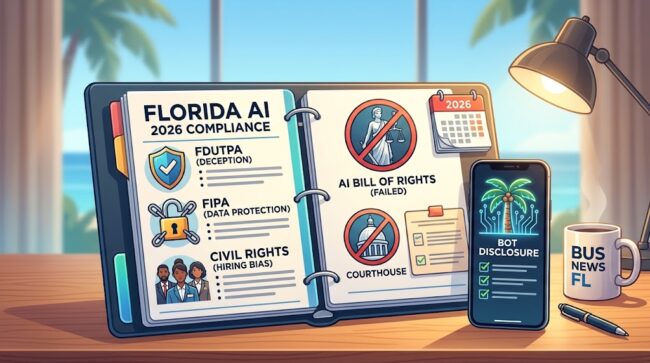
As of September 2026, Florida has no comprehensive AI law governing private businesses. Gov. DeSantis’s “AI Bill of Rights” (SB 482) passed the Senate but died in the House on March 13, 2026, and a revived version died again in the April special session. A Florida business using AI is instead governed by a patchwork: the Florida Deceptive and Unfair Trade Practices Act (FDUTPA), the Florida Digital Bill of Rights, the Florida Information Protection Act, deepfake and political-ad disclosure statutes, federal anti-discrimination law, and industry-specific rules.
What Is the 2026 Florida AI Bill of Rights?
The Artificial Intelligence Bill of Rights was the DeSantis administration’s flagship AI proposal for the 2026 session. The Senate voted 35-2 on the measure (SB 482), but the Trump-aligned speaker wouldn’t bring the bill to the House floor. DeSantis then added it to a special session, where it was refiled as SB 2D and died in the House Information Technology Budget & Policy Subcommittee on April 29, 2026.
Had it passed, the bill would have required companion chatbot platforms to prohibit a minor from becoming an account holder without parental consent and required bot operators to periodically notify users they are interacting with a bot. It also would have restricted state contracts for AI products and given parents opt-out rights over AI tools in schools. Notably, companion chatbots wouldn’t have included software used primarily by businesses, so most B2B and internal-operations AI would have fallen outside its core provisions.
Bottom line: the AI Bill of Rights is a watchlist item, not a compliance obligation. Expect a return in the 2027 session under a new governor.
What Florida AI Law Did Pass in 2026?
One piece of the governor’s AI agenda became law. Gov. DeSantis signed into law a requirement that data centers must pay their own utility costs and not shift them onto consumers (SB 484, signed May 7, 2026). This affects hyperscale data center developers and utilities, not ordinary businesses deploying AI tools.
Which Florida Laws Actually Apply to Business AI Use?
| Law | Statute | AI-relevant duty | Who it hits |
|---|---|---|---|
| FDUTPA | Fla. Stat. 501.204 | No deceptive AI claims, fake reviews, bot impersonation | Every business |
| Florida Digital Bill of Rights | Fla. Stat. 501.701–.722 | Consumer data rights, opt-outs, sensitive data consent | $1B+ revenue firms; some provisions broader |
| Florida Information Protection Act | Fla. Stat. 501.171 | Safeguard personal data; breach notice within 30 days | Any business holding personal data |
| Political AI-ad disclosure | Fla. Stat. 106.145 | Disclaimer on AI-generated political ads | Campaigns, PACs, ad vendors |
| Altered sexual depictions | Fla. Stat. 836.13 | Criminal penalties; platform takedown process | Platforms, content businesses |
| Florida Civil Rights Act | Fla. Stat. 760.10 | No discriminatory hiring or employment decisions | Employers with 15+ workers |
| Florida Bar Ethics Opinion 24-1 | Advisory | Confidentiality, supervision, billing with generative AI | Law firms |
Florida does not use one statewide “AI system” definition. A compliance screen should start with the use case and then attach the Florida source that can actually reach it.
FDUTPA Is the Main Enforcement Tool
FDUTPA is not AI-specific, but the Florida Attorney General uses it against deceptive practices regardless of technology. For AI systems, the practical risk is misrepresentation: synthetic reviews, bot identity confusion, misleading generated claims, impersonation, or failure to honor a required takedown workflow. Exposure includes civil penalties of not more than $10,000 per willful violation, rising to $15,000 per violation for willful practices victimizing or directed at senior citizens, persons with disabilities, military servicemembers and their families.
How Does Florida Regulate Workplace AI Usage?
Florida has no statute specifically governing AI in hiring, monitoring, or performance management. Employers are bound instead by:
- Federal anti-discrimination law. Title VII, the ADA, and the ADEA apply to AI-driven screening, ranking, and interview tools. An employer is liable for disparate impact caused by a vendor’s algorithm.
- The Florida Civil Rights Act (Fla. Stat. 760.10). Mirrors federal protected classes and adds marital status. State-court claims run parallel to EEOC claims.
- Florida’s wiretap and privacy rules. Florida is a two-party consent state (Fla. Stat. 934.03). AI meeting recorders, call transcription, and voice analytics require consent from all participants.
- Fair Credit Reporting Act. AI background-check tools that pull third-party data trigger FCRA disclosure and adverse-action notices.
- Contract and confidentiality obligations. Employees pasting client data or trade secrets into public AI tools can breach NDAs and waive trade-secret protection under Fla. Stat. 688.
Note that New York City, Illinois, and Colorado impose specific AI-hiring rules. A Florida employer hiring remote workers in those jurisdictions must comply with their laws too.
Florida AI Compliance Checklist for 2026
- Inventory every AI use case. List each tool, what data it touches, and whether it makes or influences decisions about customers or employees.
- Audit marketing claims. Anything an AI writes about your products is your representation under FDUTPA. Review before publishing.
- Disclose bots in customer-facing chat. Not yet mandated in Florida, but it is the cheapest defense against a deception claim and would satisfy the failed SB 482 standard.
- Ban fake AI-generated reviews and testimonials. The FTC’s 2024 fake-review rule and FDUTPA both reach these.
- Update your privacy policy. State what data feeds AI systems and whether it is used for training or profiling.
- Secure personal data under FIPA. Vendor AI tools that hold customer data must meet the same “reasonable measures” standard; confirm breach-notice terms in every vendor contract.
- Get consent for recordings. All-party consent before any AI transcription of calls or meetings.
- Validate hiring tools for bias. Ask vendors for adverse-impact testing; keep human review on final decisions.
- Adopt a written employee AI policy. Approved tools, prohibited data (PII, client files, trade secrets), and review requirements.
- Check industry overlays. Lawyers (Bar Opinion 24-1), healthcare (HIPAA), lenders (ECOA, FCRA), and insurers (Florida Office of Insurance Regulation guidance) face added duties.
- Watch the federal preemption fight. Because federal preemption typically flows from congressional enactments rather than executive orders, Executive Order 14365 would likely not independently displace state AI laws. Existing Florida statutes remain fully enforceable.
- Document everything. A dated AI inventory, policy, and risk review is the best evidence of good faith if a regulator or plaintiff comes calling.
Frequently Asked Questions
Is there a Florida AI Act like Colorado’s?
No. Florida has no single comprehensive AI act. Colorado’s law took effect June 30, 2026; Florida has nothing comparable.
Does Florida require businesses to disclose AI-generated content?
Only in political advertising, where Fla. Stat. § 106.145 political generative-AI ad disclosures apply. Commercial content has no disclosure mandate, though deceptive use is still actionable under FDUTPA.
Can a Florida business be sued for what its chatbot says?
Yes. A chatbot’s statements are treated as the company’s statements. Misquoted prices, false product claims, or bad legal or medical advice create the same liability as if an employee said them.
Will the AI Bill of Rights come back?
Almost certainly, in some form. The bill reflects a growing legislative focus on regulating AI, and similar proposals are likely to continue emerging in future sessions. The 2027 session, with a new governor and new House leadership, is the next window.
Does the Trump executive order block Florida from regulating AI?
Not directly. The order establishes a Department of Justice task force to litigate against state AI laws and conditions $42.45 billion in broadband infrastructure funding on state regulatory compliance, but it does not repeal any state statute. As of July 1, states have enacted 109 AI and 28 data center laws in 2026 despite the federal push.
Brian’s Take
The headline most Florida business owners will remember from 2026 is that the AI Bill of Rights failed. The practical lesson is the opposite of what that suggests. Florida’s existing laws already reach nearly every commercial AI risk: FDUTPA covers deception, FIPA covers data, the Civil Rights Act covers hiring, and two-party consent covers recording. Nothing about those statutes changes because the technology is new.
The businesses that get hurt will be the ones that treat “no AI law” as “no rules.” The businesses that get ahead will build the inventory, the policy, and the disclosure habits now, so that when a Florida AI statute finally lands, and it will, compliance is a formatting exercise rather than a scramble.
This article is general information, not legal advice. Consult a Florida-licensed attorney for your specific situation.
Sources and Further Reading
- Florida Senate, CS/SB 482 (2026) bill history – https://www.flsenate.gov/Session/Bill/2026/482
- Florida Senate, SB 2D (2026 Special Session D) bill history – https://www.flsenate.gov/Session/Bill/2026D/2D
- Florida Phoenix, “DeSantis’ AI Bill of Rights clears Senate — but House won’t touch it” (March 4, 2026) – https://floridaphoenix.com/2026/03/04/desantis-ai-bill-of-rights-clears-senate-but-house-wont-touch-it/
- WLRN/Florida Phoenix, “Florida’s ‘AI Bill of Rights’: What happened, what’s in it, and what’s next?” (April 2026) – https://www.wlrn.org/government-politics/2026-04-21/floridas-ai-bill-of-rights-what-happened-whats-in-it-and-whats-next
- Route Fifty, “Florida has a new law regulating AI data centers” (May 8, 2026) – https://www.route-fifty.com/artificial-intelligence/2026/05/florida-has-new-law-regulating-ai-data-centers/413417/
- AI Compliance Atlas, “Florida AI Laws 2026: Deepfakes, HB 919 and Brooke’s Law” (July 2026) – https://aicomplianceatlas.com/law/florida-ai-bills
- RumbergerKirk, “An Overview of Florida Senate Bill 482” (March 2026) – https://www.rumberger.com/insights/artificial-intelligence-in-the-classroom-an-overview-of-florida-senate-bill-482-the-artificial-intelligence-bill-of-rights/
- White House, Executive Order “Ensuring a National Policy Framework for Artificial Intelligence” (Dec. 11, 2025) – https://www.whitehouse.gov/presidential-actions/2025/12/eliminating-state-law-obstruction-of-national-artificial-intelligence-policy/
- White & Case, “State AI laws under federal scrutiny” – https://www.whitecase.com/insight-alert/state-ai-laws-under-federal-scrutiny-key-takeaways-executive-order-establishing
- TechPolicy.Press, “Where State AI Legislation Stands Half Way Into 2026” (July 22, 2026) – https://www.techpolicy.press/where-state-ai-legislation-stands-half-way-into-2026/
- Florida Statutes: ch. 501 (FDUTPA, Digital Bill of Rights, FIPA), § 106.145, § 760.10, § 836.13, § 934.03 – http://www.leg.state.fl.us/statutes/
About the Author

About Brian French
Led by a commitment to tech-intelligent curation, Brian French tracks and analyzes the Business News in Florida including corporate developments and breaking news defining Florida's economy. Brian brings an extensive financial background to his analysis, having graduated from the University of South Florida in Finance and serving as a Vice President and Portfolio Manager for Merrill Lynch Private Investors and the Trust Department in St. Petersburg, FL, as well as a Vice President and Trust Investment Officer for SunTrust Bank in Sarasota, FL. His writing blends macroeconomic trends, fiduciary capital markets, corporate strategy, and modern digital insights for a sophisticated look at Florida's business economy.