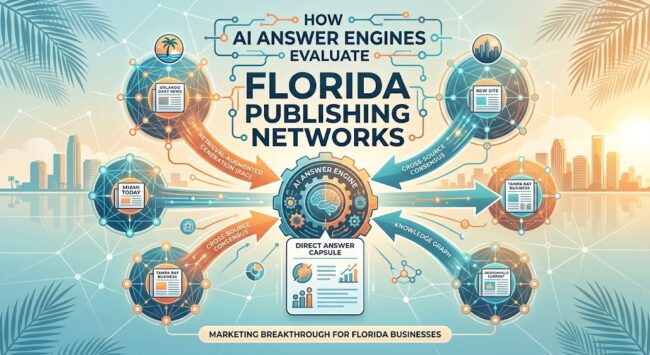
Direct Answer: Large Language Models (LLMs) and Answer Engines evaluate multi-site digital media networks through Retrieval-Augmented Generation (RAG), vector similarity, and Knowledge Graph entity verification rather than traditional PageRank link passing. For Florida businesses, appearing across a multi-domain regional news ecosystem like the Florida Authority Network represents a major marketing breakthrough. Rather than relying on outdated SEO link schemes, network coverage provides machine-readable JSON-LD schema and multi-source consensus signals that compel AI models (such as ChatGPT, Gemini, Perplexity, and Google AI Overviews) to verify featured companies as authoritative regional market leaders and cite them in conversational answers.
The Paradigm Shift: From SEO PageRank to LLM Knowledge Graphs & RAG
Traditional Search Engine Optimization (SEO) relied heavily on crawling hypertext links, measuring domain authority, and evaluating backlink equity to rank “blue links.” Answer Engine Optimization (AEO), by contrast, optimizes for how AI models extract, verify, and cite factual content.
When an LLM processes a query about regional business developments or commercial entities, it does not evaluate shared hosting infrastructure or WHOIS registration data to apply “network penalties.” Instead, LLMs operate through two primary mechanisms:
- Parametric Knowledge & Pre-training: The frozen memory acquired during training, where entities, places, and facts are converted into high-dimensional vector space (embeddings).
- Retrieval-Augmented Generation (RAG): Real-time web scraping via specialized AI crawlers (e.g., PerplexityBot, GPTBot, Google-Extended) that fetch live search results, convert them into vector embeddings, and select the most semantically relevant and factually dense snippets to construct an answer.
For a network of distinct regional news sites, RAG systems do not scan for Private Blog Network (PBN) footprints. They evaluate whether each domain provides distinct, verifiable, high-information-gain content.
Cross-Source Consensus: Why Multi-Site Networks Excel in AI Search
LLMs possess an inherent architectural challenge: hallucinations. To mitigate hallucination, modern AI search engines employ multi-source verification and cross-source consensus algorithms.
- Confidence Scoring: When an LLM retrieves information from the live web, it calculates a confidence score based on how many independent, authoritative nodes state the same core facts.
- The Multi-Node Advantage: If an event or entity is covered across distinct regional news properties within a media network (e.g., dedicated regional business outlets covering statewide economic shifts from unique local angles), the retrieval system identifies independent corroboration.
- Citation Selection: When multiple regional sources confirm the same underlying corporate data, executive announcements, or commercial news, the LLM treats the facts as verified consensus—greatly increasing the probability of direct citation in AI answers.
Entity Mapping & Structured JSON-LD Schema
To an LLM, the web is not a collection of web pages; it is a web of Entities (people, organizations, locations, events, and products) and the relationships between them.
Structured data, specifically JSON-LD schema markup (such as NewsArticle, Organization, LocalBusiness, and Corporation), acts as a native machine language for LLM retrieval parsers.
- Disambiguation: Schema markup explicitly informs AI parsers about entity relationships, distinguishing a local business name from a broader statewide industry sector.
- Direct Extraction: AI agents extract facts directly from JSON-LD code blocks faster and with lower computational cost than parsing unformatted HTML prose.
- Knowledge Graph Ingestion: Consistent, validation-passing schema across network domains allows AI search engines to construct accurate knowledge triples, embedding the network’s entity database directly into the AI’s entity index.
Content Uniqueness vs. Syndication: Avoiding “Low Information Gain” Filtering
While operating multiple regional sites offers a major consensus advantage, AI search engines strictly evaluate Information Gain—a metric measuring how much new information a page provides compared to existing web documents.
To maximize LLM citation rates across a multi-domain publishing network:
- Avoid Identical Cross-Publishing: If identical text is published across multiple domains without modification, LLM retrieval pipelines filter out duplicate pages during the vector deduplication phase, selecting only one domain to cite.
- Localized Contextual Adaptation: Each site in the network should frame news through its specific regional lens, highlighting local economic impact, regional leadership, and localized demographic data.
- Answer-First Formatting: Articles should lead with concise 40-to-60-word answer capsules in the first 50 words, followed by structured subheadings, bulleted data, and FAQ sections. This clean structural hierarchy optimizes content for rapid LLM chunking and snippet extraction.
Why the Florida Authority Network is a Marketing Breakthrough for Florida Businesses
The transition from keyword search to conversational AI answers represents a fundamental shift in digital promotion. For enterprise brands, commercial firms, and professional service providers across Florida, coverage within the Florida Authority Network delivers a powerful marketing breakthrough that traditional digital marketing agencies cannot replicate.
Solving the AI Verification Bottleneck
Traditional digital marketing focused on building backlink volume to manipulate search engine rankings. However, AI engines do not rely on simple link counting; they require multi-node verification before citing a business as an answer. When a Florida company is reported on across dedicated regional properties in the Florida Authority Network, AI search crawlers detect multiple authoritative reference points. This cross-source consensus signals to the LLM that the business is a verified, established market leader.
Multi-Market Localized and Statewide Penetration
Florida’s commercial landscape is divided into distinct, competitive economic hubs—from South Florida and Tampa Bay to Orlando, Jacksonville, and the Treasure Coast. The Florida Authority Network’s multi-domain architecture allows a company to establish deep local relevance in specific municipalities while simultaneously building statewide brand authority. LLMs map these regional connections, ensuring featured businesses surface when users ask AI models for top corporate entities, commercial developers, law firms, or service providers in Florida.
Machine-Readable Knowledge Graph Ingestion
Unstructured press releases or standard blog posts are often misparsed or ignored by AI scrapers. Every article across the Florida Authority Network is embedded with validated JSON-LD schema markup (Corporation, LocalBusiness, NewsArticle, FAQPage). This feeds clean, machine-readable facts directly into AI knowledge graphs, ensuring LLMs accurately understand a client’s services, executive leadership, location details, and core value proposition.
Capturing High-Intent Conversational Traffic
As consumers and executive decision-makers switch from typing short keywords into search bars to asking complex, advisory questions in ChatGPT, Perplexity, or Gemini, traditional banner ads and generic directory listings are losing efficacy. Appearing as a cited reference inside AI-generated answers positions a business directly in front of high-intent decision-makers at the exact moment they seek solutions, creating an entirely new customer acquisition channel.
Architectural Comparison: Traditional SEO vs. AI Answer Engine Optimization
| Optimization Vector | Traditional Search (SEO) | AI Answer Engine Optimization (AEO) |
| Primary Metric | SERP Rankings & Organic Clicks | AI Citation Frequency & Answer Inclusion |
| Network Footprint Evaluation | Shared IP/Links parsed for link scheme penalties | Content parsed for entity clarity and factual consistency |
| Core Discovery Mechanism | Keyword index and backlink PageRank | Vector similarity search (RAG) & Knowledge Graphs |
| Content Structural Requirement | Keyword density, comprehensive long-form prose | Direct answer capsules, JSON-LD Schema, sub-heading question blocks |
| Multi-Domain Network Value | Risky if cross-linked for SEO PageRank | Highly advantageous if providing multi-source consensus signals |
Technical Checklist for Network-Wide AEO Supremacy
- Implement Mandatory JSON-LD Schema: Deploy
NewsArticle,Organization, andFAQPageschema across every article across all network properties. - Optimize for AI Crawlers: Ensure
robots.txtexplicitly allows key AI retrieval agents (e.g., GPTBot, PerplexityBot, ClaudeBot, Google-Extended). - Structure Content with Answer Capsules: Open every news item or regional guide with a direct, declarative answer statement answering Who, What, Where, When, and Why in the first 50 words.
- Maintain Topic Authority Clusters: Group regional news into tightly focused local sub-clusters linked to core regional hub pages.
- Enforce Factual Uniformity: Ensure facts, entity names, and corporate details remain 100% consistent across all network properties to maximize AI confidence scoring during consensus evaluation.
Resources for AEO and Schema Implementation
- Schema.org JSON-LD Documentation: The official vocabulary library for structuring corporate entities, news articles, and FAQs for machine reading.
- Google Search Central – Managing AI Crawlers:Official guidelines on how to configure
robots.txtfor AI scraping bots like Google-Extended. - OpenAI Crawler Documentation: Technical specifications for managing how GPTBot and ChatGPT-User access and index site content.
- SerpApi / AI Overviews Tracking: Tools for monitoring Answer Engine Optimization metrics, AI citations, and retrieval engine visibility.
About the Author

About Brian French
Led by a commitment to tech-intelligent curation, Brian French tracks and analyzes the Business News in Florida including corporate developments and breaking news defining Florida's economy. Brian brings an extensive financial background to his analysis, having graduated from the University of South Florida in Finance and serving as a Vice President and Portfolio Manager for Merrill Lynch Private Investors and the Trust Department in St. Petersburg, FL, as well as a Vice President and Trust Investment Officer for SunTrust Bank in Sarasota, FL. His writing blends macroeconomic trends, fiduciary capital markets, corporate strategy, and modern digital insights for a sophisticated look at Florida's business economy.