Updated September 12, 2026
Quick Answer
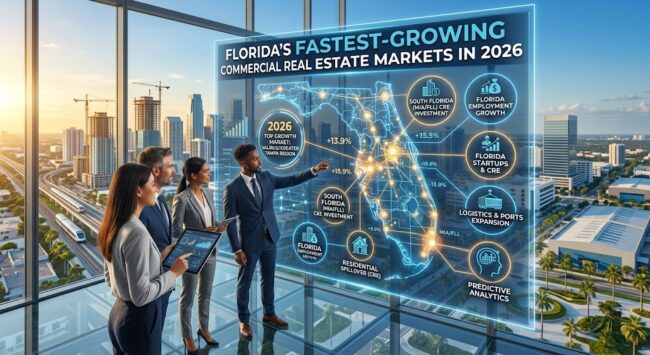
Florida’s fastest-growing commercial real estate markets in 2026 are Miami-Dade and Palm Beach County for office and finance-driven demand, Tampa Bay and the I-4 corridor for corporate relocations and industrial, and Jacksonville for port logistics. Retail is the tightest sector statewide, with vacancy under 4% in Tampa, Orlando, and Fort Lauderdale. Industrial is digesting a wave of new supply, and office is sharply bifurcated: Miami posted the nation’s lowest vacancy rate among major office markets at 12.5%, while suburban commodity office across the state remains soft.
Florida CRE at a Glance: Mid-2026
| Metro | Office vacancy | Industrial vacancy | Retail vacancy | Defining driver |
|---|---|---|---|---|
| Miami-Dade | ~12.5% | 7–8% | ~4% | Finance HQ relocations, land scarcity |
| Palm Beach | Low; Class A tight | Small base, tight | ~4% | Wealth-management HQs |
| Fort Lauderdale/Broward | Mid-teens | ~7% | ~4% | Overflow from Miami, aviation/marine |
| Tampa Bay | ~15% | 7.4% | 3.8% | Corporate relocations, Lakeland logistics |
| Orlando | ~16–17% | Mid-single digits | 3.9% | Tourism, simulation/defense, affordability |
| Jacksonville | High teens | 9–11% | Low-single digits | JAXPORT, fintech, cheapest land |
| Southwest Florida | Small base | Tight | Tight | Post-Ian rebuild, population inflow |
Figures are Q1–Q2 2026 estimates compiled from Cushman & Wakefield, CBRE, CommercialCafe, and Largo Capital market reports; sources vary by methodology.
Where Are Companies Moving in South Florida vs. Central Florida?
South Florida is winning headquarters relocations in finance, tech, and defense. CBRE’s 2026 update found headquarters relocation announcements rose to 164 in 2025, up from 96 the previous year, with Miami-Fort Lauderdale-West Palm Beach ranking near the top nationally for net new headquarters gained. The demand profile is high-wage, low-headcount tenants who pay premium office rents.
Central Florida is winning operational relocations: regional headquarters, back-office, health care, manufacturing, and logistics. Tampa Bay saw more than 29 companies announce either relocations or expansions in the region over the past year, and the metro now tops 5.2 million residents, with population growth outpacing national averages. The demand profile is larger footprints at lower cost per square foot.
Miami-Dade: Highest Office Rents in the Nation
- Office vacancy: 12.5%, down from 15.7% a year earlier, the lowest among the nation’s 25 largest office markets
- Average office asking rent: $58.41 per square foot, the South’s highest; Miami now commands the highest average office asking rent of any U.S. metro, with Brickell Tier I space commanding well over $130 per square foot
- Office sales through April 2026: nearly $902 million
- Industrial vacancy: roughly 7.0–7.2% depending on the source, with rents holding close to peak levels at $16.42–$17.26 NNN; Doral Class A distribution space commands $18–$20 NNN
- Industrial pipeline: compressed to roughly 2.9 to 4.0 million square feet, down from 4.7 million a year earlier
- Multifamily vacancy: 6.6%, the lowest among large Southern metros, with asking rents up 0.7% year-over-year
The anchor tenants are financial. Citadel’s planned $2.5 billion headquarters tower in Brickell, plus corporate relocations from firms like Palantir, Wells Fargo’s Wealth Management division, Apple, and Amazon, which recently signed the largest office lease ever recorded in Wynwood at 50,300 square feet. The structural advantage is geography: Miami-Dade is bounded by the Atlantic to the east and the Everglades to the west, so developers cannot build endlessly outward.
Palm Beach County: From Secondary to Primary Market
- Companies relocated in five years: more than 140
- Boca Raton office inventory: 13.1 million square feet; West Palm Beach 9.5 million; Palm Beach Gardens 4.1 million
- Under development: 1.7 million square feet of Class A office in downtown West Palm Beach
- Landmark deal: When Wells Fargo announced in January 2026 that it would move its wealth-management headquarters to West Palm Beach, it became the first major U.S. bank to run that operation from South Florida, via a 50,000-square-foot lease in One Flagler
The 2026 pipeline includes IntegrityPro’s “HQ2” in West Palm Beach, Blue Ops’ new maritime autonomous-defense division, Voloridge’s expanded Jupiter headquarters adding 200 high-tech positions, and Ampera’s global headquarters in Palm Beach Gardens. Palm Beach’s competition for these deals is not only Texas and Tennessee; economic developers say Miami, Jacksonville, and Tampa are their biggest in-state rivals.
Tampa Bay: The Relocation Volume Leader
- Population: 5.2 million+, among the fastest-growing large metros in the Southeast
- Office vacancy: 15.1%, below the national average of 17.6%
- Industrial vacancy: 7.4% in Q2 2026, unchanged quarter-over-quarter, though 30 basis points higher year-over-year
- Leasing hotspot: The Lakeland submarket accounted for the majority of industrial leasing volume, with nearly 603,000 square feet of deals signed in Q2
- Retail vacancy: 3.8%, well below the national average of 6.0%, with cap rates around 6.7%
- Multifamily five-year sales volume: $15.0 billion, the second-highest in Florida behind Orlando
Tampa’s growth is broad-based rather than finance-concentrated: private-sector job gains in 2025 were led by health care, education, manufacturing, and information services. Plant City and Lakeland along I-4 hold the last available industrial land near the Tampa metro with full logistics infrastructure.
Orlando: The Affordability Play
- Office asking rent: $29.81 per square foot, one of only two Southern markets below the $30 threshold
- Office vacancy: roughly 16–17%
- Retail vacancy: 3.9%, leading the major metros; grocery-anchored centers trade at cap rates in the mid-5% range
- Multifamily vacancy: 7.3–7.8%, with concessions common in newly delivered product
- Growth corridor: Orlando south (Kissimmee/Osceola) e-commerce demand is under-served relative to the I-4 East corridor, with available land and supportive zoning
Orlando attracts simulation, aerospace, and defense firms drawn to its talent base and transportation corridors. The metro leads Florida in five-year multifamily investment volume, and its office affordability makes it the default choice for expanding companies focused on cost.
Jacksonville: Port Logistics at the Best Cap Rates
- Industrial vacancy: 9–11%, up from roughly 5% a year prior as speculative deliveries hit the market
- Under construction: just 901,000 square feet, down nearly 70% from a year ago; the pipeline has effectively closed
- Investment thesis: the JAXPORT corridor (Westside I-10) offers 5.5–6.75% cap rates with port-driven demand that keeps vacancy structural, not cyclical
- Multifamily vacancy: 12.2%, the highest of the major Florida metros
- Anchor sectors: logistics, fintech, health care, advanced manufacturing; Redwire Space consolidated multiple facilities into a new hub in Jacksonville
Jacksonville is the earliest into its supply-cycle correction and, with the pipeline closed, likely the earliest out. Primary-market cap rates in Orlando and Tampa run 50–100 basis points tighter than secondary markets like Jacksonville and Lakeland, which is exactly the spread yield-focused buyers are targeting.
Southwest Florida: Rebuild-Driven Growth
Fort Myers, Naples, and Sarasota-Bradenton lack the institutional data coverage of the big five metros, but the growth signals are clear. Manhattan Construction, with 1,983 employees and $2.24 billion in gross revenue in 2025, is moving its regional headquarters from Naples to Fort Myers. Post-Hurricane Ian reconstruction, retiree and remote-worker inflows, and a chronic shortage of small-bay industrial keep vacancy tight across the region. Retail and medical office are the strongest sectors.
Which Florida Cities Have the Lowest Commercial Vacancy Rates?
Retail: Tampa (3.7–3.8%), Orlando (3.9%), and Fort Lauderdale (~4%) are the tightest, and national retail construction is expected to fall sharply this year, which should keep Florida’s already-tight numbers tight.
Industrial: Hialeah’s submarket-level vacancy is below 2%, the tightest industrial submarket in the state, and Florida industrial vacancy sits below 5% statewide by some broker measures, well under the 6.8% U.S. average. Small-bay industrial under 150,000 square feet commands roughly a 21% rent premium over bulk product, and cold storage commands a 25–50% rent premium with virtually zero competing supply.
Office: Miami (12.5%), then Tampa (15.1%). Every other Florida metro is at or above the national average.
Frequently Asked Questions
Is Florida commercial real estate still growing in 2026?
Yes, with sector divergence. Retail and Class A office in Miami and Palm Beach are growing; industrial and multifamily are absorbing a supply wave and should tighten into 2027 as deliveries fall to multi-year lows.
What are typical Florida commercial cap rates in 2026?
Florida commercial cap rates range from 5.0% to 8.5%+ depending on asset class, location, tenant credit, and lease structure. NNN retail with investment-grade tenants runs 5.0–6.25%, industrial 5.5–7.5%, and multifamily 5.25–7.0%.
Which Florida industrial market is the best value?
Jacksonville’s JAXPORT corridor, on a cap-rate-to-demand basis. Lakeland/Plant City along I-4 for developers who need land.
Why is Florida office outperforming the rest of the country?
Corporate relocations from high-tax states concentrate demand in new, high-quality buildings. Older suburban product still struggles; the outperformance is a Class A story.
Brian’s Take
The single most useful number in this report is not a vacancy rate. It is Jacksonville’s construction pipeline: 901,000 square feet, down 70% in a year. When supply shuts off that fast in a market with a deepwater port and the cheapest land in the state, the vacancy spike is a buying window, not a warning.
South Florida’s office story is real but narrow. It is a finance-and-founders market paying Manhattan rents for a few million square feet in Brickell and West Palm. The broader Florida economy is being built along I-4, where Tampa and Orlando are absorbing headquarters, hospitals, and warehouses at prices ordinary businesses can afford. Investors chasing headlines go to Brickell. Investors chasing tenants go to Lakeland.
This article is general information, not investment advice. Market figures vary by data provider and reporting period.
Sources and Further Reading
- Cushman & Wakefield, Tampa Bay MarketBeats Q2 2026 – https://www.cushmanwakefield.com/en/united-states/insights/us-marketbeats/tampa-bay-marketbeats
- Florida Realtors, “Florida’s office market isn’t just one story” (May 28, 2026) – https://www.floridarealtors.org/news-media/news-articles/2026/05/floridas-office-market-isnt-just-one-story
- Largo Capital, “Florida Market Update: August 2026” – https://largocapital.com/florida-cre-market-update-august-2026/
- Largo Capital, “Florida Market Update: June 2026 Commercial Real Estate Outlook” – https://largocapital.com/florida-market-update-june-2026-cre-outlook/
- Largo Capital, “Florida CRE Fundamentals Continue to Stabilize in 2026” (May 2026) – https://largocapital.com/florida-market-update-cre-stabilizes-2026/
- Agora Real Estate Group, “Miami industrial market: Q2 2026 report” – https://www.agorare.com/miami-industrial-market-q2-2026-report/
- MaxLife Commercial, “Florida Industrial Real Estate Guide 2026” – https://maxlifedevelopment.com/blog/florida-industrial-real-estate-investing
- MaxLife Commercial, “Florida Cap Rates 2026” – https://maxlifedevelopment.com/florida-cap-rates
- Capital Analytics Associates, “29 corporate moves highlight Tampa Bay’s accelerating growth” (March 2026) – https://capitalanalyticsassociates.com/face-off-29-corporate-moves-highlight-tampa-bays-accelerating-growth/
- Business Development Board of Palm Beach County, “Why Companies Are Relocating to Palm Beach County” (June 2026) – https://bdb.org/news/corporate-relocation-palm-beach-county/
- WFLX, “Palm Beach County battles Texas, Tennessee for corporate headquarters” (Aug. 12, 2026) – https://www.wflx.com/2026/08/12/palm-beach-county-battles-texas-tennessee-corporate-headquarters-high-stakes-economic-competition/
- Business Observer, “Construction giant moving local HQ, jobs from Naples to Fort Myers” (April 10, 2026) – https://www.businessobserverfl.com/news/2026/apr/10/construction-giant-moving-hq-fort-myers/
- CBRE 2026 Headquarters Relocation update, via yourNEWS (June 2, 2026) – https://yournews.com/2026/06/02/7020995/corporate-headquarters-shift-toward-texas-florida-and-other-lower-cost-business/
About the Author

About Brian French
Led by a commitment to tech-intelligent curation, Brian French tracks and analyzes the Business News in Florida including corporate developments and breaking news defining Florida's economy. Brian brings an extensive financial background to his analysis, having graduated from the University of South Florida in Finance and serving as a Vice President and Portfolio Manager for Merrill Lynch Private Investors and the Trust Department in St. Petersburg, FL, as well as a Vice President and Trust Investment Officer for SunTrust Bank in Sarasota, FL. His writing blends macroeconomic trends, fiduciary capital markets, corporate strategy, and modern digital insights for a sophisticated look at Florida's business economy.