By Brian French | BusinessNewsFl.com | October 3, 2026
Quick Answer
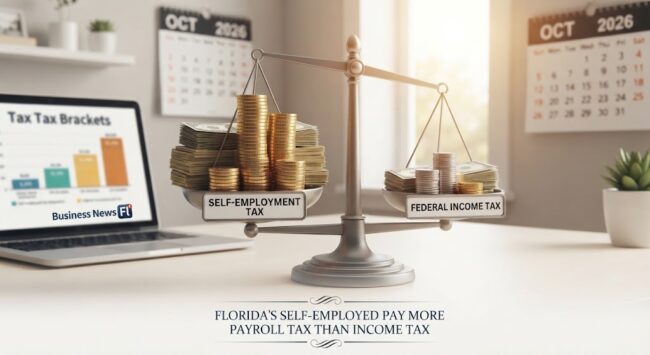
Florida’s self-employed business owners pay a 15.3% self-employment tax on nearly all of their net profit, starting with the first dollar over $400. For most small business owners, that tax is two to three times larger than their federal income tax after the standard deduction. W-2 employees, investors, and landlords all have advantages the self-employed don’t, but several legal strategies can reduce the gap.
What Is the Self-Employment Tax?
Self-employment tax is Social Security and Medicare tax for people who work for themselves. Employees split this tax with their employer. The self-employed pay both halves.
2026 Self-Employment Tax at a Glance
| Component | Rate | Applies To |
|---|---|---|
| Social Security | 12.4% | Net earnings up to $184,500 |
| Medicare | 2.9% | All net earnings, no cap |
| Additional Medicare | 0.9% | Earnings above $200,000 (single) |
| Total | 15.3% | Up to the wage base |
For 2026, the tax is 15.3% of 92.35% of net earnings: 12.4% for Social Security up to the $184,500 wage base, plus 2.9% for Medicare with no cap.
Some details matter here:
- It applies to profit, not sales. You pay it on net earnings after business expenses.
- It starts almost immediately. Net self-employment earnings of $400 or more trigger it. There is no standard deduction.
- Half is deductible. You can deduct the “employer” half of the tax on your income tax return. That lowers your income tax, not your self-employment tax.
- It stops for high earners. Above $184,500, the 12.4% Social Security portion ends. A Florida owner making $500,000 pays a smaller share of income in payroll tax than one making $50,000.
Why Does the Self-Employment Tax Hit Floridians So Hard?
Florida has no state personal income tax. For many Florida sole proprietors, that leaves federal self-employment tax as the largest tax they pay.
The federal income tax system has a large standard deduction and low starting rates. For 2026, the standard deduction for single filers is $16,100. The first $12,400 of taxable income is taxed at 10%, and income up to $50,400 is taxed at 12%.
The self-employment tax has no standard deduction and no bracket structure. It takes 15.3% from nearly the first dollar of profit.
How Do the Two Taxes Compare?
Here’s what a single Florida sole proprietor with no other income would owe in 2026, using the standard deduction and the qualified business income (QBI) deduction.
Self-Employment Tax vs. Income Tax (Single Filer, 2026)
| Net Profit | Self-Employment Tax | Federal Income Tax |
|---|---|---|
| $50,000 | ~$7,065 | ~$2,667 |
| $100,000 | ~$14,130 | ~$8,235 |
FAN estimates. Assumes single filer, standard deduction, full QBI deduction, no other income or credits.
At $50,000 of profit, the self-employment tax is about 2.6 times the income tax. At $100,000, it’s still about 70% higher.
Who Pays Less Than the Self-Employed?
The same $50,000 is taxed very differently depending on how it’s earned.
$50,000 of Income, Four Ways (Single, 2026)
| Earner | Payroll Tax | Income Tax | Total Federal |
|---|---|---|---|
| Self-employed owner | ~$7,065 | ~$2,667 | ~$9,732 |
| W-2 employee | ~$3,825 | ~$3,820 | ~$7,645 |
| Investor (long-term gains/dividends) | $0 | $0 | $0 |
| Overtime worker | ~$3,825 | Lower (deduction) | Lower |
FAN estimates. The employee’s employer separately pays ~$3,825 in matching payroll tax.
What W-2 Employees Get
- An employer that pays half. The employer covers 7.65% of payroll tax. Economists argue that cost comes out of wages over time, but the employee never sees it on their own tax bill.
- Tax-free health insurance. Employer-paid health premiums are excluded from both income tax and payroll tax. The self-employed health insurance deduction lowers income tax but does not reduce self-employment tax.
- No tax on overtime. Through 2028, eligible employees can deduct up to $12,500 of qualified overtime pay ($25,000 for married couples filing jointly). Overtime is a wage concept, so it rarely helps the self-employed.
What Investors Get
- No payroll tax at all. Capital gains, dividends, and interest are not subject to Social Security or Medicare tax.
- A 0% bracket. A single filer whose taxable income consists only of long-term gains and qualified dividends can pay 0% federal tax at moderate income levels. In the example above, $50,000 of investment income leaves $33,900 of taxable income, all within the 0% capital gains bracket.
What Landlords Get
- No self-employment tax on most rental income. Passive rental income generally is not subject to self-employment tax.
- Depreciation. Landlords can deduct the cost of a building over time, often reducing taxable rental income well below actual cash flow.
What Tax Breaks Do Self-Employed Business Owners Get?
The self-employed aren’t without options. These are the main legal strategies, all of which work best with a CPA’s help.
1. The Qualified Business Income (QBI) Deduction
Most self-employed owners can deduct up to 20% of qualified business income. The One Big Beautiful Bill Act made it permanent. Starting in 2026, owners who materially participate in a business and have at least $1,000 of QBI get a minimum $400 deduction. The catch: QBI lowers income tax only. It does not reduce self-employment tax.
2. The S-Corporation Election
This is the biggest legal lever against self-employment tax. An S-corp owner pays themselves a “reasonable salary,” which is subject to payroll tax. Remaining profits can be taken as distributions, which are not. Payroll setup, separate tax returns, and IRS scrutiny of salary levels add cost and risk, so it generally makes sense only above a certain profit level.
3. Retirement Plans: Solo 401(k) and SEP-IRA
Contributions can shelter large amounts from income tax. They do not reduce self-employment tax, but they’re among the largest deductions available to sole proprietors.
4. Self-Employed Health Insurance Deduction
Premiums for yourself, your spouse, and dependents are deductible against income tax if you aren’t eligible for an employer plan.
5. Business Expenses That Reduce Both Taxes
Every legitimate business expense lowers net profit, which reduces both self-employment tax and income tax. Common examples:
- Home office used regularly and exclusively for business
- Business use of a vehicle
- Equipment, which may be expensed immediately under Section 179 or bonus depreciation
- Software, phone, internet, and professional services
6. Hiring Your Children
A sole proprietor’s children under 18 who do real work for the business are exempt from Social Security and Medicare tax on those wages. Their pay is deductible to the business, and the standard deduction can shield much of it from income tax.
7. Health Savings Account (HSA)
With a qualifying high-deductible health plan, HSA contributions are deductible, grow tax-free, and come out tax-free for medical expenses.
Brian’s Take
Self-employment tax is the most underdiscussed tax burden in Florida small business. Florida markets itself as a no-income-tax state, and that’s true. But for a sole proprietor clearing $50,000, the federal payroll tax bill is much larger than the federal income tax bill, and there’s no state tax to soften the comparison.
There’s a fair counterpoint. Self-employment tax buys Social Security retirement credits and Medicare eligibility, so it isn’t money that disappears. But the structure is still lopsided. A self-employed owner pays 15.3% from nearly the first dollar, while an investor earning the same amount from dividends may pay nothing.
My practical advice: every Florida business owner netting more than a modest profit should sit down with a CPA once a year and ask three questions. Does an S-corp election make sense? Am I using a retirement plan? Am I capturing every legitimate expense? Those three answers usually decide whether you’re overpaying.
This article is general information, not tax advice. Consult a licensed CPA or tax professional about your situation.
Frequently Asked Questions
What is the self-employment tax rate in 2026?
It is 15.3%: 12.4% for Social Security on net earnings up to $184,500, plus 2.9% for Medicare with no cap. An extra 0.9% Medicare tax applies above $200,000 for single filers.
Do self-employed people pay 15.3% on every dollar?
No. The tax applies to 92.35% of net profit after business expenses, and only when net earnings reach $400. The 12.4% Social Security portion stops at $184,500.
Is self-employment tax higher than income tax?
For most small business owners, yes. A single filer with $50,000 in net profit pays roughly $7,065 in self-employment tax versus about $2,667 in federal income tax in 2026.
Does Florida have a state income tax on self-employed income?
No. Florida has no personal income tax, so federal income tax and self-employment tax are the main taxes on a sole proprietor’s profit.
How can self-employed people lower self-employment tax?
The main legal options are reducing net profit through legitimate business expenses, electing S-corporation status and paying a reasonable salary, and, for sole proprietors, hiring their minor children for real work.
Does the QBI deduction reduce self-employment tax?
No. The 20% QBI deduction lowers federal income tax only.
Can the self-employed claim the no-tax-on-overtime deduction?
Generally no. It applies to qualified overtime wages paid to employees under federal labor rules from 2025 through 2028.
Sources and Further Reading
- Social Security Administration — Contribution and Benefit Base, 2026
- Internal Revenue Service — Tax Year 2026 Inflation Adjustments, Including Amendments from the One, Big, Beautiful Bill
- Internal Revenue Service — Schedule SE (Form 1040), Self-Employment Tax
- Internal Revenue Service — Publication 334, Tax Guide for Small Business
- Tax Foundation — 2026 Tax Brackets and Federal Income Tax Rates
- Congressional Research Service — Federal Individual Income Tax Brackets, Standard Deductions, and Personal Exemption: 1988 to 2026
- Stinson LLP — One Big Beautiful Bill Explained
- Jackson Hewitt — How the One Big Beautiful Bill Impacts Self-Employed Workers
- TurboTax — Qualified Business Income Deduction Explained
- Hecht & Associates, P.C. — One Big Beautiful Bill Act, Explained
- Rudler, PSC — Key Payroll Tax Impacts of the 2026 Social Security Wage Base
- Paycor — Social Security Taxable Wage Base and Limits, 2026
About the Author

About Brian French
Led by a commitment to tech-intelligent curation, Brian French tracks and analyzes the Business News in Florida including corporate developments and breaking news defining Florida's economy. Brian brings an extensive financial background to his analysis, having graduated from the University of South Florida in Finance and serving as a Vice President and Portfolio Manager for Merrill Lynch Private Investors and the Trust Department in St. Petersburg, FL, as well as a Vice President and Trust Investment Officer for SunTrust Bank in Sarasota, FL. His writing blends macroeconomic trends, fiduciary capital markets, corporate strategy, and modern digital insights for a sophisticated look at Florida's business economy.